MonkiBox Digital Play Guides
Pick your box
Pick a toy 8
Shop Look With Me →Months 0+
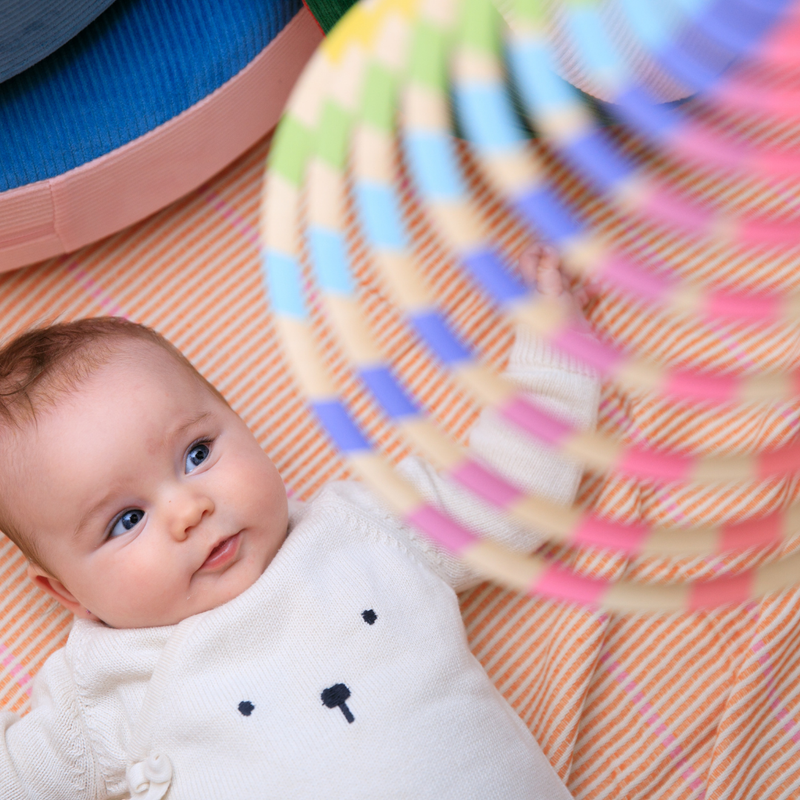
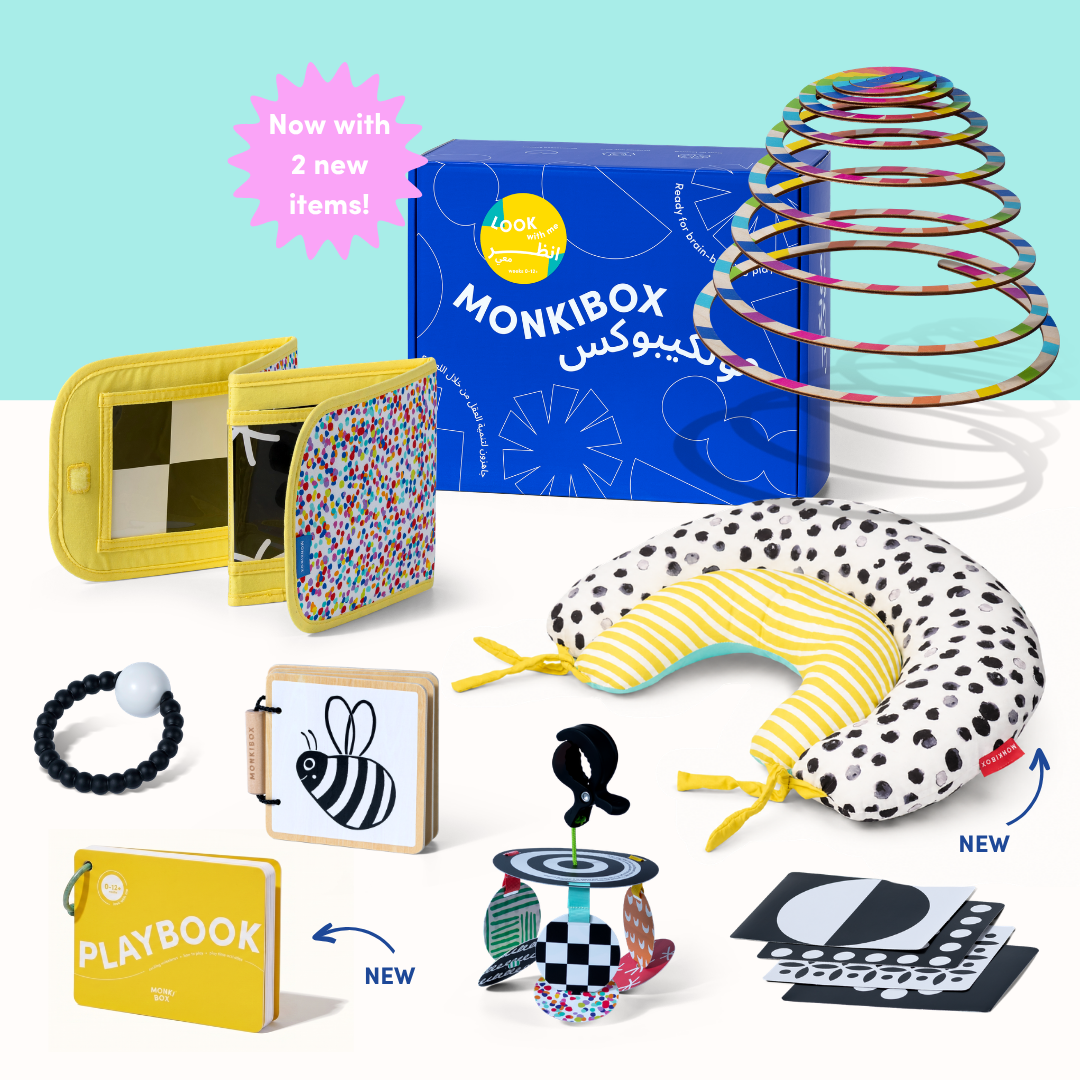
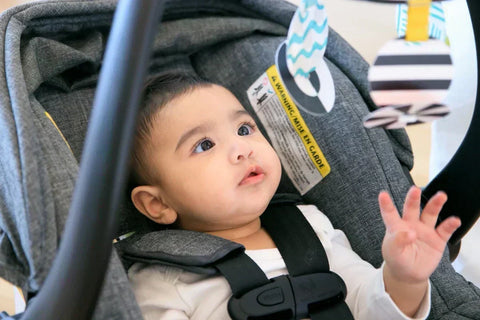
High Contrast Mobile
Made for early visual development
Why this matters?
For the first few months, a mobile is important for your child’s development and to enhance their ability to explore the world visually. The baby gradually develops focus on a moving object, tracking, and creating the perception of color and depth. The mobile is critical for visual stimulation for newborns, it helps teach the muscles of their eyes and their brain to coordinate and practice following attractive objects.
How to use it?
- Place it 30 cms above your baby; that's how far they can see. Make sure it’s in their line of sight above the face (over their chin/nose will minimize eye strain).
- Attach the contrast mobile above the changing table or safely above their nursery. Keep the mobile out of reach for safety.
- Use the black and white side first. Newborns cannot see colour contrast is everything in these early weeks.
- Around 6–8 weeks, flip to the colour side as their visual range and colour perception begin to develop.
Read more
 Why High-Contrast Visuals Matter: For your baby, it really is all black & white
Read →
 Week 3: For Your Baby, It's All Black & White
Read →
 Easy Ways to Develop your Baby’s Visual & Auditory Tracking Skills
Read →
 6 Easy Ways to Help Develop Your Baby's Vision
Read →
 10 Everyday Activities That Support Your Newborn's Brain Development
Read →
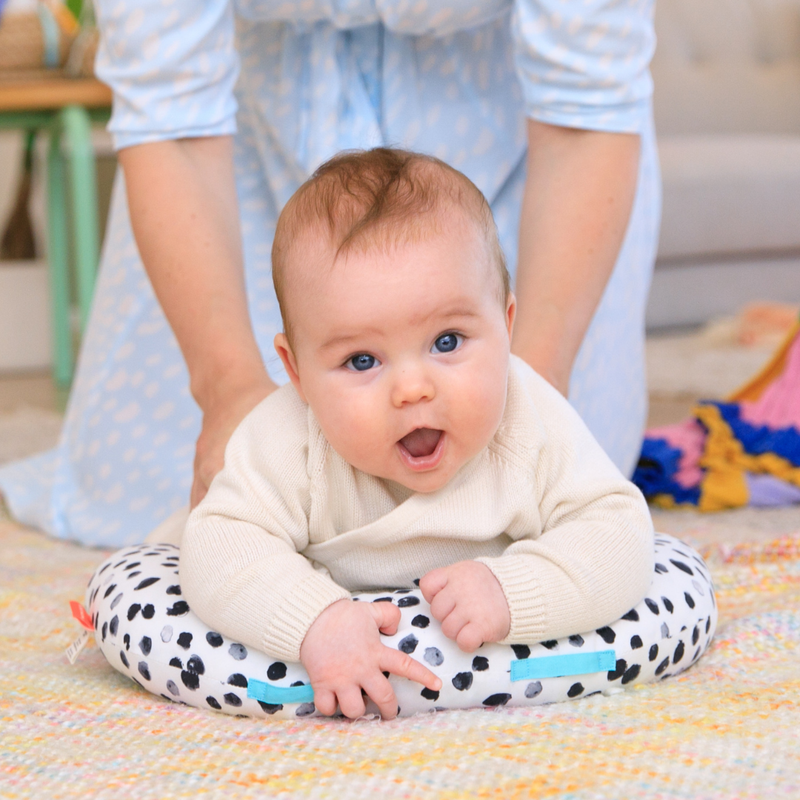
2-in-1Tummy Time pillow
Made to support tummy time as your baby grows
Why this matters?
Tummy time helps your baby build the neck, shoulder, arm, and upper-body strength they need for later milestones like rolling, sitting, and crawling. This pillow offers gentle support in the early months, then firmer support as your baby gets stronger and more confident.
How to use it?
- Stage 1 (0–3m): Place baby on the smaller U, with the elbows tucked inside the curve. Keep the high-contrast side facing them for added visual stimulation during tummy time.
- Keep sessions short and frequent; start with 30 seconds to 1 minute. The goal is consistency, not duration.
- Stage 2 (3–6m): Tie both pillows together and place baby on top for higher support. The extra elevation creates more of a challenge, encouraging stronger push-up practice and building head, neck, arm, and chest strength.
- Don't be surprised if they fuss at first. Stay close, talk to them, and keep it brief. They'll build tolerance quickly.
Read more
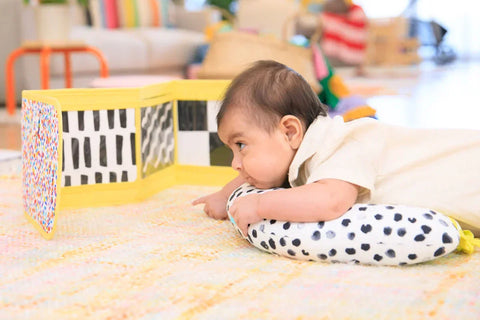 The Benefits of Tummy Time: Why Your Newborn Baby Needs Tummy Time Every Day
Read →
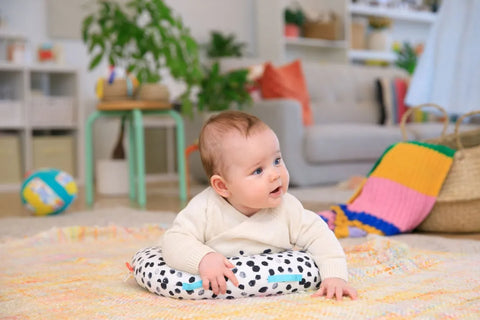 Tummy Time Ideas your Baby Won't Hate
Read →
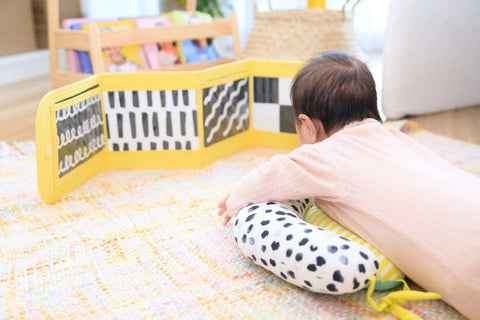 Week 2: Why Is It Important to Schedule Tummy Time for Your Baby?
Read →
 Baby Developing a Flat Spot? 6 Activities to Prevent Flat Head Syndrome
Read →
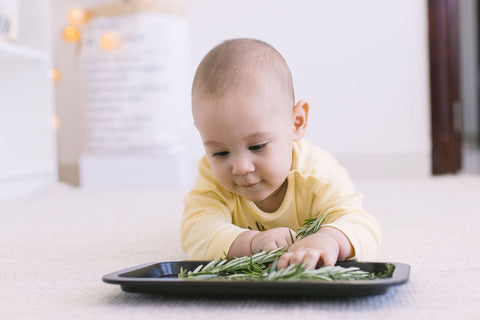 Fun & Easy Sensory Ideas for Tummy Time
Read →
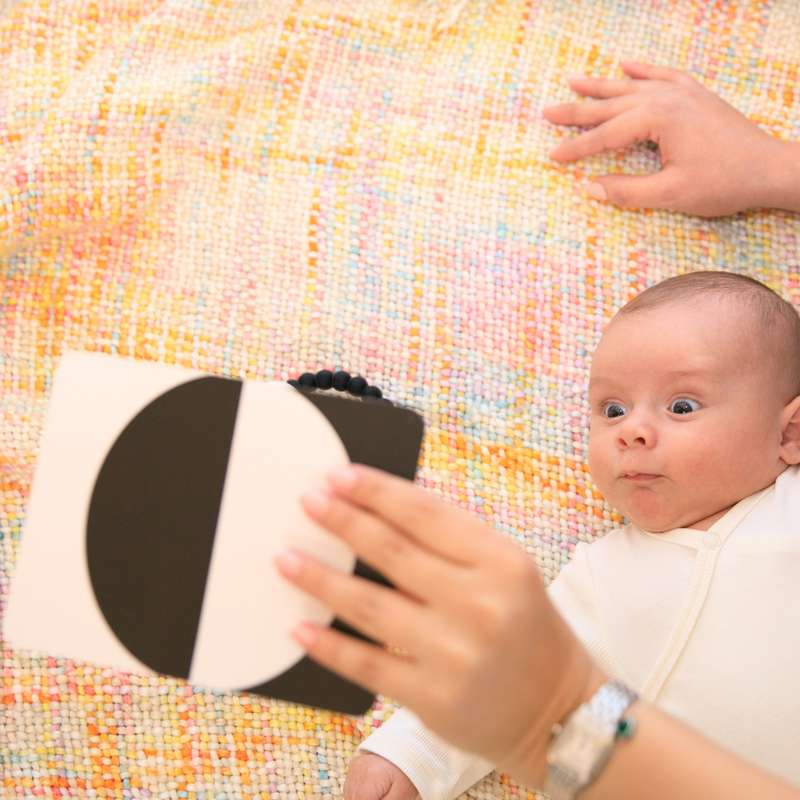
Simple Black and White Stimulation Cards
Simple patterns first. More complexity as your baby grows.
Why this matters?
A newborn's vision is blurry beyond 15–30 cm. In the early months, your baby is drawn to strong contrast and simple shapes. As their vision develops, they can begin to notice and engage with more detailed patterns too. Every time they lock onto a card, hold it, and look away, they are building attention span, visual memory, and the neural pathways that underpin all future learning.
How to use it?
- Place the cards within your baby’s line of sight.
- Prop or tape cards on the wall next to the crib and changing table. Alternate which side you place them on so your baby practises looking both left and right.
- Use them during tummy time or calm alert moments
- During tummy time or massage, spread cards around your baby at face level; they become visual anchors that encourage head lifting and turning.
- Start with one or two images at a time, not too many at once
- As your baby grows and becomes more visually engaged, introduce the complex cards.
Read more
Why High-Contrast Visuals Matter: For your baby, it really is all black & white
Read →
Week 3: For Your Baby, It's All Black & White
Read →
6 Easy Ways to Help Develop Your Baby's Vision
Read →
Easy Ways to Develop your Baby’s Visual & Auditory Tracking Skills
Read →
10 Everyday Activities That Support Your Newborn's Brain Development
Read →
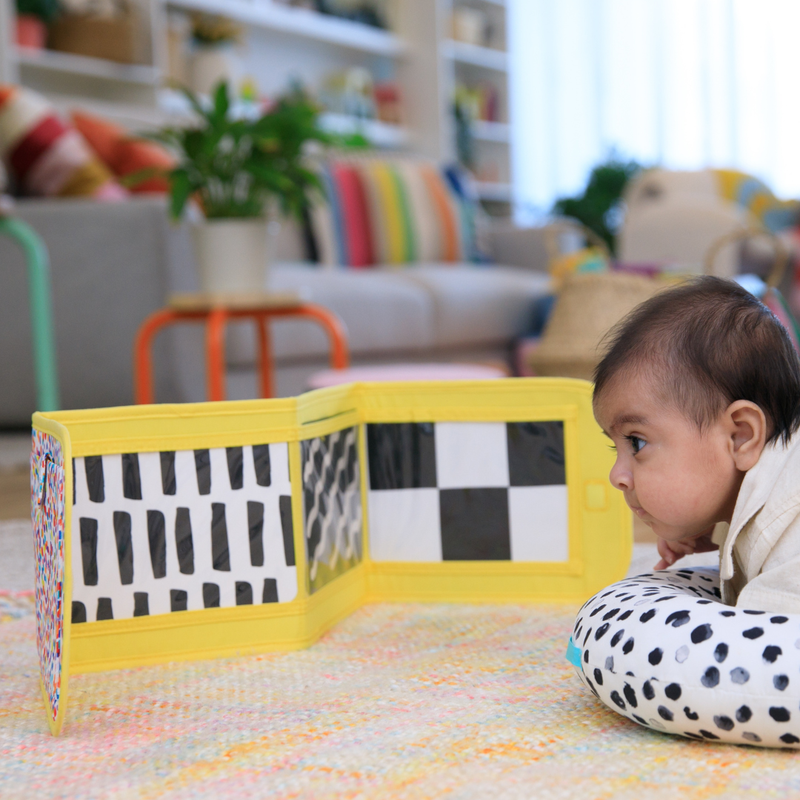
Standing Card Holder
Made to support tummy time, little by little
Why this matters?
Tummy time helps your baby build the neck, shoulder, and upper-body strength they need for later milestones like rolling, sitting, and crawling. The card holder gives them a reason to lift something worth looking at, right at their level.
How to use it?
- Start from 2 weeks old with short sessions, 30 seconds to 1 minute. Place the card holder to one side; newborns naturally turn their head when on their belly.
- Start with short sessions and follow your baby’s cues
- Alternate sides each session to avoid flat spots and prevent the neck from favouring one direction.
- As your baby gets stronger, place it a little farther in front of them to encourage lifting their chin to see it.
- Swap in new cards, simple images, or even family photos over time.
- Swap the cards out as they grow new images, family photos, and cards from later boxes. Fresh visual motivation throughout their first year.
Read more
Week 2: Why Is It Important to Schedule Tummy Time for Your Baby?
Read →
Easy Ways to Develop your Baby’s Visual & Auditory Tracking Skills
Read →
Why High-Contrast Visuals Matter: For your baby, it really is all black & white
Read →
Tummy Time Ideas your Baby Won't Hate
Read →
Week 3: For Your Baby, It's All Black & White
Read →
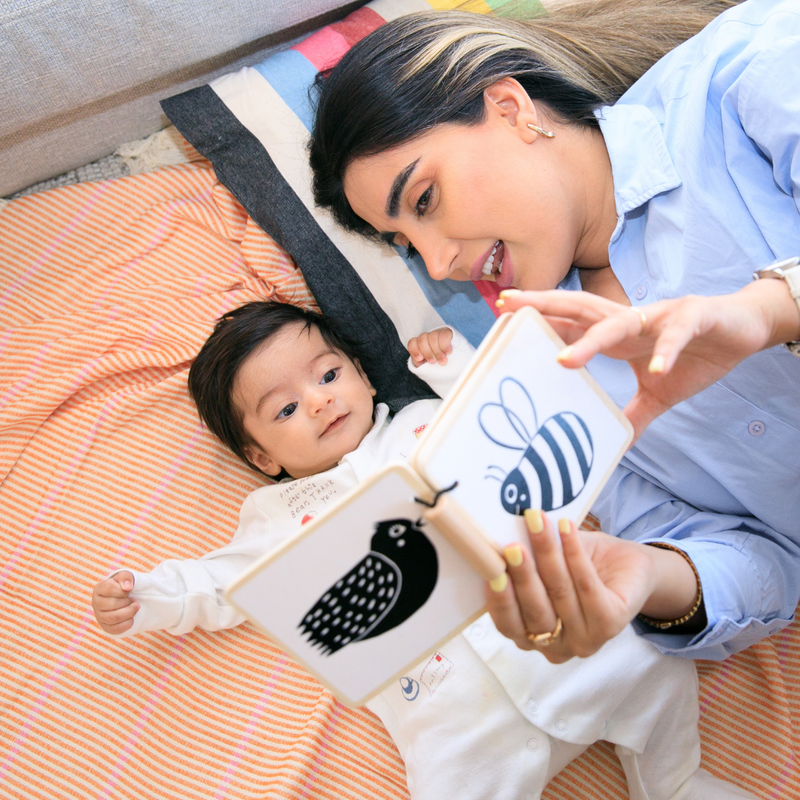
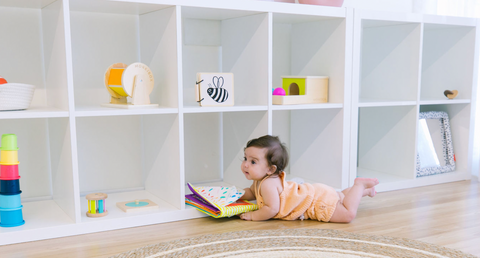
Wooden Book
Developing roots for language development
Why this matters?
Language begins long before words. Every time you read aloud, your baby is learning that sounds carry meaning, that pages have a sequence, and that sitting with a book is something worth doing. High-contrast images can also help hold your baby’s attention in the early months.
How to use it?
- Keep the book on the shelf with all their other toys as your baby gets older. Adding books to play areas will make reading a game, just like playing with a ball.
- Even though your baby might want to chew on the book, encourage them to explore it with their eyes and hands.
- The sturdy pages will soon have your baby turn the pages. Narrate your actions to teach them these simple actions. When you say “Let’s turn the page,” emphasize “turn” to introduce a new verb.
Read more
 Your Baby’s First Library: A Stage-by-Stage Guide to Building a Love for Books
Read →
 Why Wooden Toys Are the Smart, Safe & Beautiful Choice for Your Baby’s Development
Read →
 Why wooden toys are the best your child's development and growth
Read →
 Top 10 Montessori Toys for Baby’s First Year
Read →
 The Best Way to Talk to Your Baby to Help with Language Development
Read →

Black and White Rattle
Made for early listening, tracking, and reaching
Why this matters?
Sound and movement together teach the eyes to track, predict, and follow. Every time your baby turns toward the rattle, they're building the eye muscle strength that underpins hand-eye coordination and eventually, reading and writing. The rattle is simple. What it's building is not.
How to use it?
- Hold the rattle about 30 cm from your baby.
- Move it slowly from side to side so they can follow it with their eyes and head.
- Shake it gently to encourage them to turn toward the sound.
- Pause between shakes to give them time to respond.
- Try a rhythm: shake, shake, shake - pause. Repeat and change it. Your baby will begin to feel the difference between patterns. That's their first math lesson.
Read more
 Baby Grasping Milestones: When Babies Start Reaching and Grasping
Read →
Easy Ways to Develop your Baby’s Visual & Auditory Tracking Skills
Read →
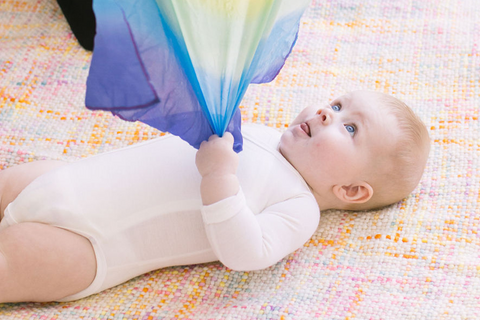 Reaching & Grasping: Why It’s Important and How to Encourage It
Read →
 Week 14: Reaching & Grasping — Why It’s Important and How to Encourage It
Read →
 Week 16: Your Baby’s Stages of Grasping Objects
Read →
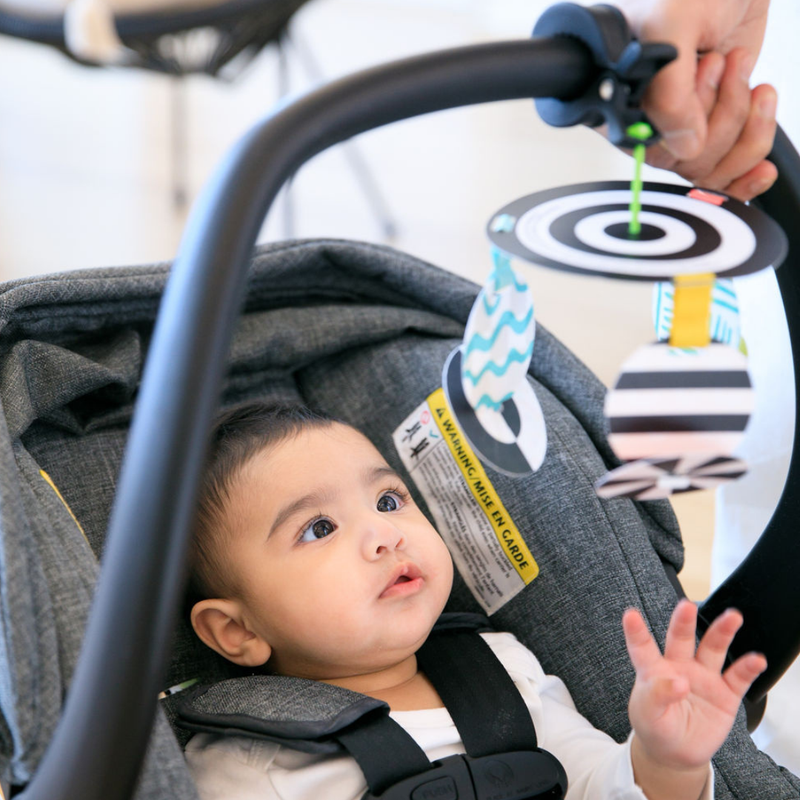
On-The-Go Mobile
Made to bring visual play wherever your baby goes
Why this matters?
Newborns are still learning how to focus and follow what they see. The eyes and brain need consistent visual input to build the connections that will later support coordination, focus, and spatial awareness. This mobile is designed to support that visual development over time, with interchangeable double-sided cards that can be reversed as your baby’s vision grows from simple black-and-white contrast to more colorful patterns.
How to use it?
- Clip it to the stroller frame and position it above their face, over the chin and nose. Their eyes will find it and begin to track.
- Use it during stroller walks or calm playtime at home.
- At home, attach it to the play gym.
- As your baby grows, reverse the cards to the color side. Switch and rearrange the cards from time to time to keep the visuals fresh.
- Keep it within view, but always safely out of reach.

Complex Black and White Stimulation Cards
Simple patterns first. More complexity as your baby grows.
Why this matters?
A newborn's vision is blurry beyond 15–30 cm. In the early months, your baby is drawn to strong contrast and simple shapes. As their vision develops, they can begin to notice and engage with more detailed patterns too. Every time they lock onto a card, hold it, and look away, they are building attention span, visual memory, and the neural pathways that underpin all future learning.
How to use it?
- Place the cards within your baby’s line of sight.
- Prop or tape cards on the wall next to the crib and changing table. Alternate which side you place them on so your baby practises looking both left and right.
- Use them during tummy time or calm alert moments
- During tummy time or massage, spread cards around your baby at face level; they become visual anchors that encourage head lifting and turning.
- Start with one or two images at a time, not too many at once
- As your baby grows and becomes more visually engaged, introduce the complex cards.
Read more
6 Easy Ways to Help Develop Your Baby's Vision
Read →
Easy Ways to Develop your Baby’s Visual & Auditory Tracking Skills
Read →
Week 3: For Your Baby, It's All Black & White
Read →
Why High-Contrast Visuals Matter: For your baby, it really is all black & white
Read →
10 Everyday Activities That Support Your Newborn's Brain Development
Read →
Pick a toy 9
Shop Bond With Me →Months 3,4+
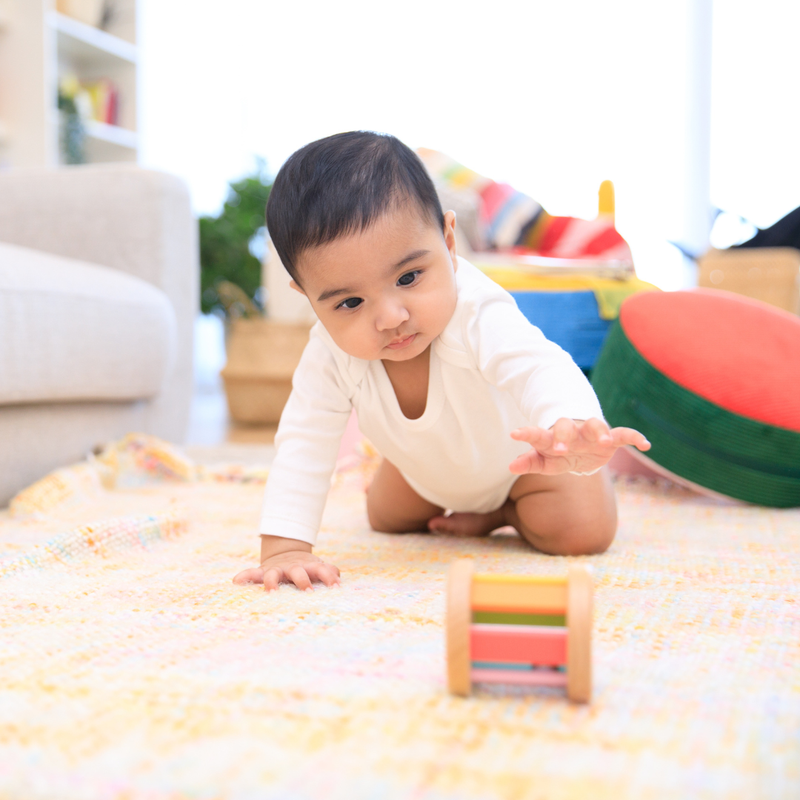
Rolling Bell
Following sound encourages movement
Why this matters?
A bell rattle is a classic Montessori toy because it is simple, purposeful, and responsive to your baby’s movement. The gentle sound encourages auditory tracking, while the shape and movement invite reaching, turning, and early coordination. As your baby follows the sound and works toward it, they are building body awareness and motor control, which later support bigger movements like rolling, crawling, and getting across the floor with purpose.
How to use it?
- Place the rattle just out of reach during tummy time to encourage lifting, stretching, and reaching.
- Shake it gently to one side so your baby turns their head and shoulders toward the sound.
- Move it slowly side to side to support tracking with both the eyes and the body.
- Bring it slightly farther to one side sometimes to encourage weight shifting, which helps prepare for rolling.
- Place the bell within sight and just out of reach, then encourage your baby to look, reach, and bat toward it.
Read more
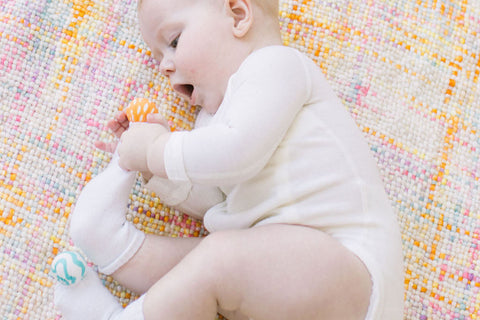
Crinkle Pocket
Reaching with purpose through sound and texture
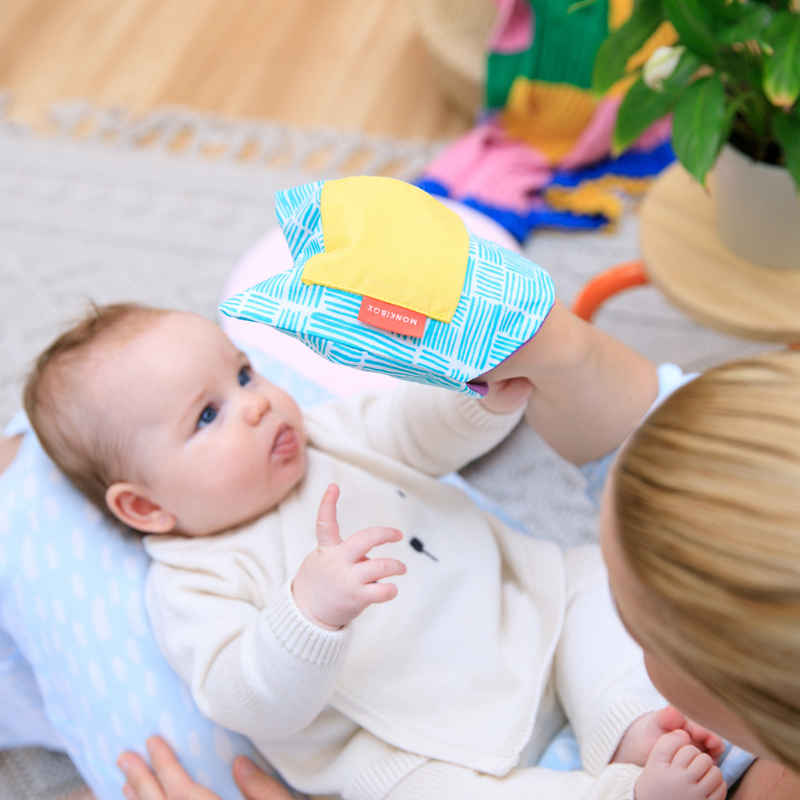
Why this matters?
At this stage, babies begin reaching with more intention. The crinkle pocket is exciting because it responds right away. That helps build an early understanding of cause and effect, while also strengthening reaching, grasping, and curiosity through repetition.
How to use it?
- Hold or crinkle the pocket slowly in front of your baby while they are on their back, tummy, or in supported sitting.
- Pause after each sound and give them a chance to respond with reaching, kicking, smiling, or leaning toward it.
- Keep it close enough to reach, but not so close that it falls into their hands without effort.
- Once they grab it, let them squeeze, wave, mouth, and explore it.
- Show them how their movement creates the sound. Cause and effect is part of the learning.
- Tuck a familiar teether partly inside to encourage pulling and peeking.
Read more
 Why Sensory Play Is Important for Development
Read →
Baby Grasping Milestones: When Babies Start Reaching and Grasping
Read →
Reaching & Grasping: Why It’s Important and How to Encourage It
Read →
Fun & Easy Sensory Ideas for Tummy Time
Read →
 The Why and How of Treasure Baskets During Play Time
Read →

Hand to Hand Transfer Discs
Learning to use both hands together
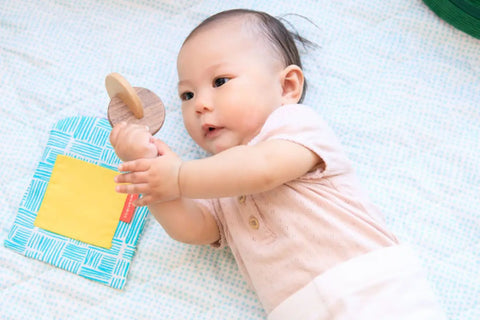
Why this matters?
Holding an object near the centre of the body encourages both hands to work together. At this stage, your baby may grasp the discs with one or both hands, bring them toward the middle, and begin adjusting their grip.
This supports bilateral coordination and prepares your baby to move across the body with more control — an early foundation for self-feeding, dressing, drawing, and coordinated play.
How to use it?
- Notice how the shape encourages your baby to bring the toy toward the centre of their body.
- At first, your baby may mostly hold it with one fist, mouth it, or briefly touch it with the other hand. That is part of the learning.
- As they get stronger, they may begin adjusting their grip from one side of the tool to the other.
- During back play, floor play, or supported sitting, hold it near the middle of the body to invite both hands into the play.
- Give your baby lots of repeated chances. Grasp strength and controlled transfer take time.
Read more
 Why Hand-to-Hand Transfer Is an Underrated but Important Milestone
Read →
 Week 19: An underrated milestone: hand-to-hand transfer
Read →
Week 16: Your Baby’s Stages of Grasping Objects
Read →
Reaching & Grasping: Why It’s Important and How to Encourage It
Read →
Baby Grasping Milestones: When Babies Start Reaching and Grasping
Read →
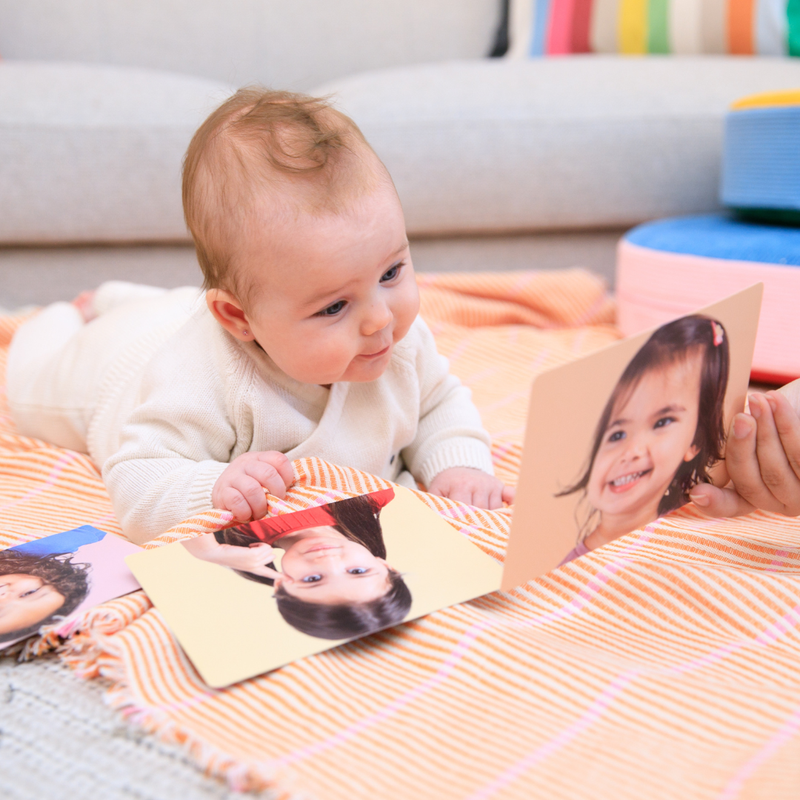
Face Cards
Made for recognizing faces, features, and expressions
Why this matters?
Babies are naturally drawn to faces. Looking at face cards helps your baby notice familiar patterns — eyes, nose, mouth, expressions, and the way faces change. These simple moments support visual attention, early recognition, communication, and social connection.
How to use it?
- Place one face card in the cardholder during tummy time, side-lying, or calm floor play.
- Show one card at a time and give your baby time to study the face.
- Point to and name one feature: “eyes,” “nose,” “mouth,” “hair,” or “smile.”
- Copy the expression, then bring your own face close for your baby to watch.
- Pause and wait for a look, smile, sound, wiggle, or reach.
- Change the card every few days to introduce new faces and expressions.
Read more
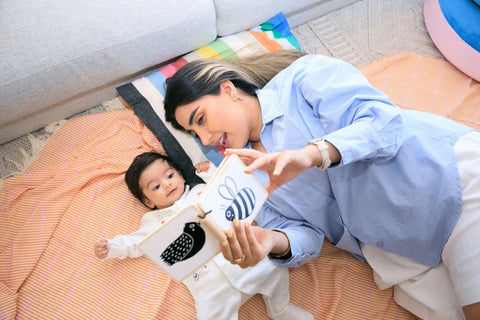 How to Talk to Your Baby to Build Their brain - One Word At a Time
Read →
The Best Way to Talk to Your Baby to Help with Language Development
Read →
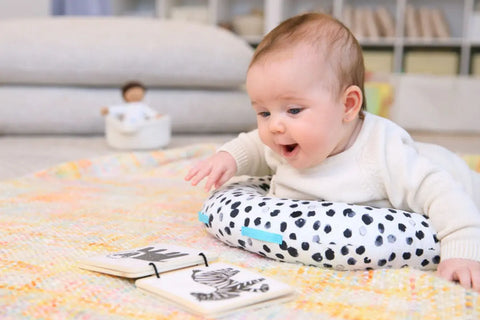 How to Support Your Baby's Milestones Through Play at 12 Weeks Old
Read →
 Why Mirrors Are Good for Babies (and How to Use Them Safely)
Read →
10 Everyday Activities That Support Your Newborn's Brain Development
Read →
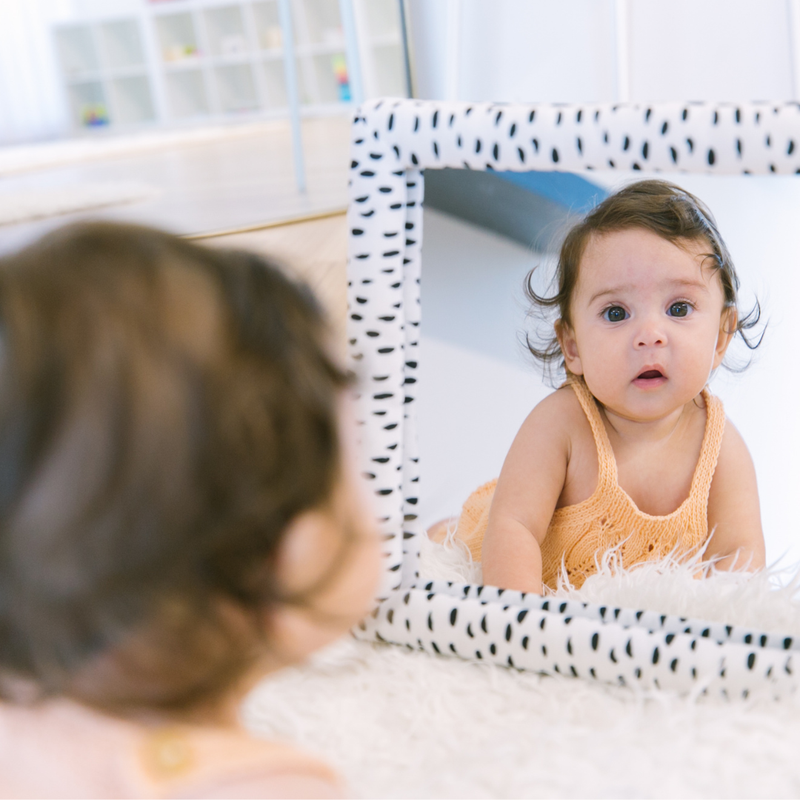
Everyday Mirror
Made for tummy time strength, visual tracking, and head turning
Why this matters?
Tummy time helps your baby build strength in their neck, shoulders, arms, back, and core. But babies often need something interesting to look at before they want to lift their head. A mirror gives your baby a face, movement, and reflection to focus on, encouraging them to look up, turn their head, and stay engaged a little longer.
How to use it?
- Place the mirror in front of your baby during tummy time.
- Lie down beside them and let them see your face in the mirror.
- Slowly move the mirror from side to side to encourage head turning and visual tracking.
- Flip to the high-contrast side for a different visual experience during tummy time or side-lying.
- Use the straps to hang the mirror in safe places, like near a changing area or later as part of a little dressing station.
Read more
Why Mirrors Are Good for Babies (and How to Use Them Safely)
Read →
Tummy Time Ideas your Baby Won't Hate
Read →
Week 2: Why Is It Important to Schedule Tummy Time for Your Baby?
Read →
6 Easy Ways to Help Develop Your Baby's Vision
Read →
Easy Ways to Develop your Baby’s Visual & Auditory Tracking Skills
Read →
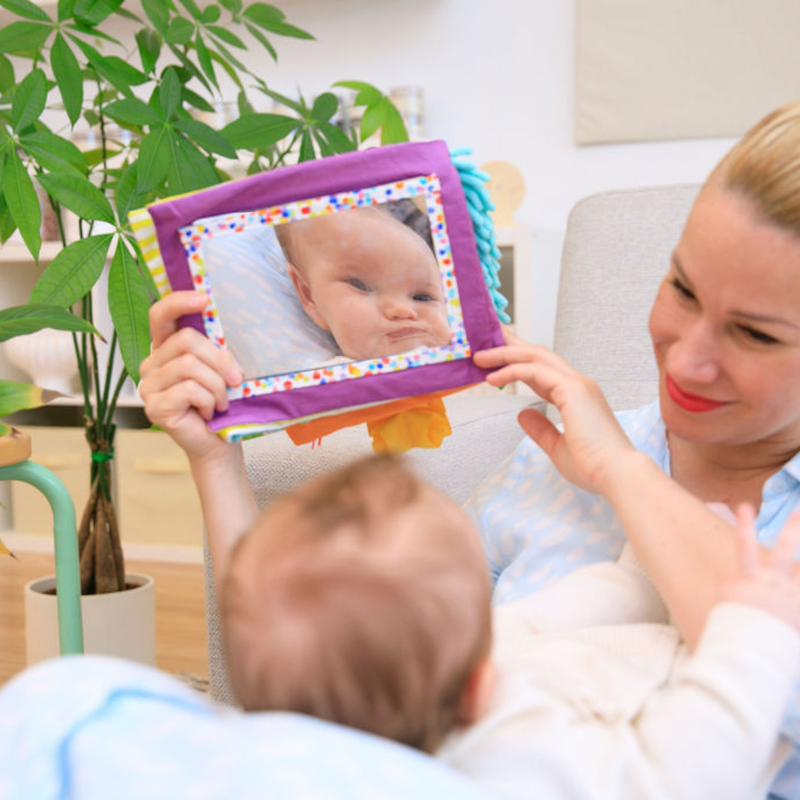
Mirror Card
Made for peekaboo, attention, and playful connection
Why this matters?
At 4 months, your baby is starting to notice patterns in play. A mirror card gives them a simple way to watch faces, movement, and light while interacting with you.
Your baby does not yet understand that the reflection is “them.” For now, mirror play is about looking, waiting, responding, and connecting. Simple peekaboo games help your baby begin to expect what comes next: something disappears, then comes back.
How to use it?
- Use the mirror card during lap time, side-lying, or calm floor play.
- Let your baby look at the reflection and notice faces, movement, and light.
- Bring your face close to the mirror and make gentle expressions.
- Try peekaboo: cover part of the mirror with your hand or a soft cloth, then reveal it again.
- Pause after each reveal and watch for a look, smile, sound, kick, or reach.
Read more
Why Mirrors Are Good for Babies (and How to Use Them Safely)
Read →
 What Is Object Permanence? How This Brainy Milestone Shapes Your Baby’s Development
Read →
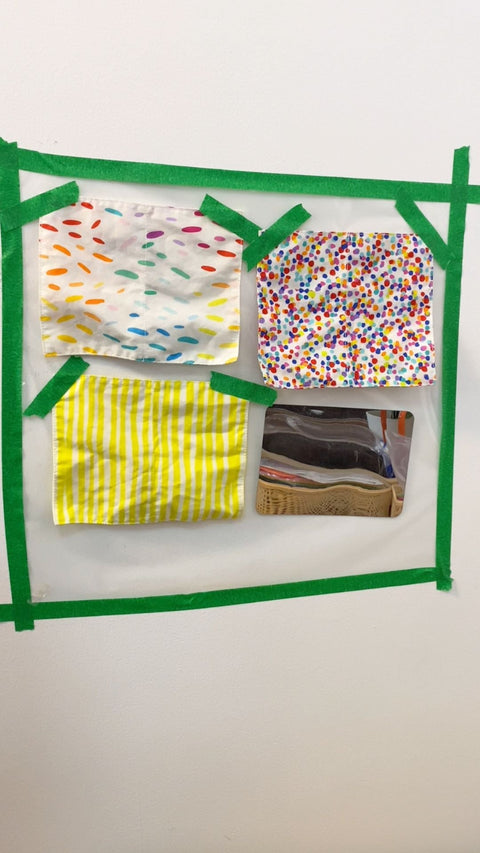 Peek-a-boo Windows Activity
Read →
How to Talk to Your Baby to Build Their brain - One Word At a Time
Read →
How to Support Your Baby's Milestones Through Play at 12 Weeks Old
Read →
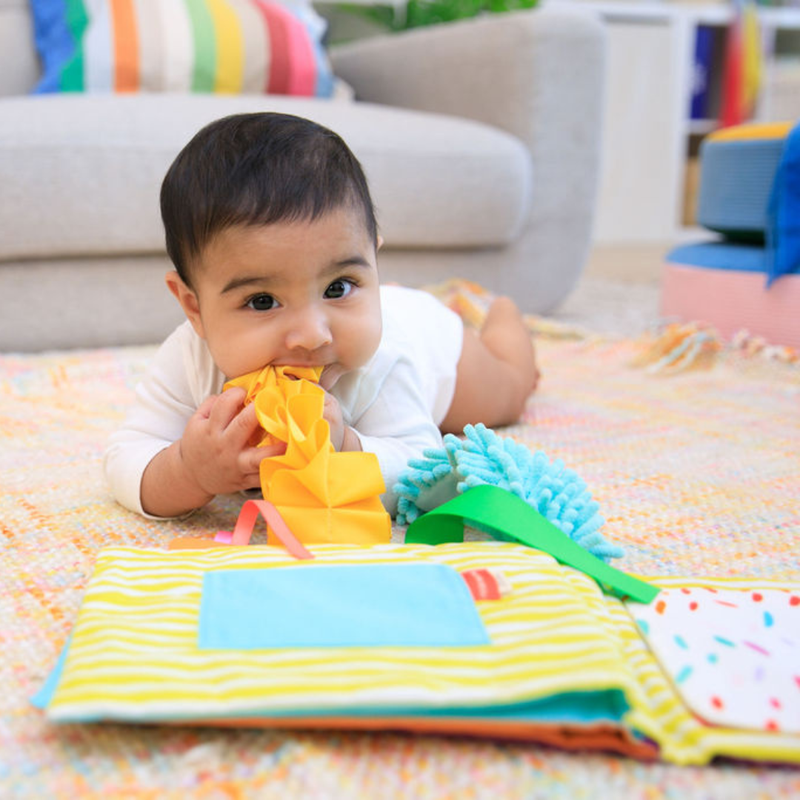
Soft Sensorial Book
Learning through textures and sounds
Why this matters?
At this stage, your baby is beginning to connect what they see, hear, touch, and feel. A soft sensory book supports multisensory learning, meaning your baby takes in information through touch, sight, sound, and movement at the same time. That kind of rich input helps build curiosity, attention, and early hand-to-mouth and hand-eye coordination.
How to use it?
- Let your baby bring the book to their mouth, touch the crinkly pages, and explore it freely.
- Crinkle a page gently and pause so your baby can notice the sound and respond.
- Explore the hidden pocket together and let your baby “discover” the toy inside.
- Talk through the experience as you go: “Hear the crinkle?” “What’s inside the pocket?” “Can you feel the ribbon?”
- Keep the experience slow and simple. If your baby is interested in one page, stay there.
- As your baby grows, switch up the pictures inside and keep making new little stories with it. You can use cards from later boxes, family photos, or real-life pictures.
Read more
Your Baby’s First Library: A Stage-by-Stage Guide to Building a Love for Books
Read →
Why Sensory Play Is Important for Development
Read →
 How to Encourage Early Reading and Writing Skills Through Play
Read →
How to Talk to Your Baby to Build Their brain - One Word At a Time
Read →
The Best Way to Talk to Your Baby to Help with Language Development
Read →

Silicone Grasping Teether
Sensory exploration through mouth, hands, and texture
Why this matters?
At this age, your baby learns a lot through their mouth. Mouthing helps them explore texture, temperature, shape, and resistance, while also giving useful sensory feedback. Mouthing provides sensory feedback and supports hand-to-mouth coordination. It also gives your baby a safe way to explore different textures, shapes, and resistance.
How to use it?
- Place the teether in your baby’s hand and give them time to explore it
- Let them mouth it, turn it, and feel the different textures
- If needed, guide it gently from hand to mouth at first
- Encourage both hands to get involved as their grasp gets stronger
- Chill it in the fridge for extra soothing if needed
Read more
 Why Babies Put Everything in Their Mouth (and Why It's Important for Speech Development)
Read →
Baby Grasping Milestones: When Babies Start Reaching and Grasping
Read →
Reaching & Grasping: Why It’s Important and How to Encourage It
Read →
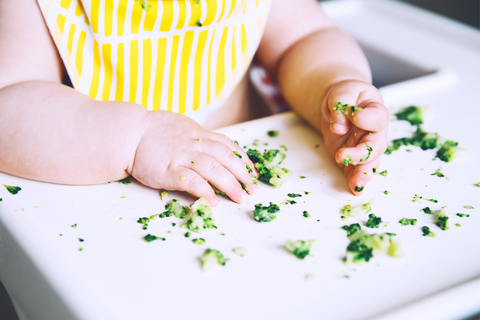 How to Choose Your Baby’s First Foods
Read →
10 Everyday Activities That Support Your Newborn's Brain Development
Read →
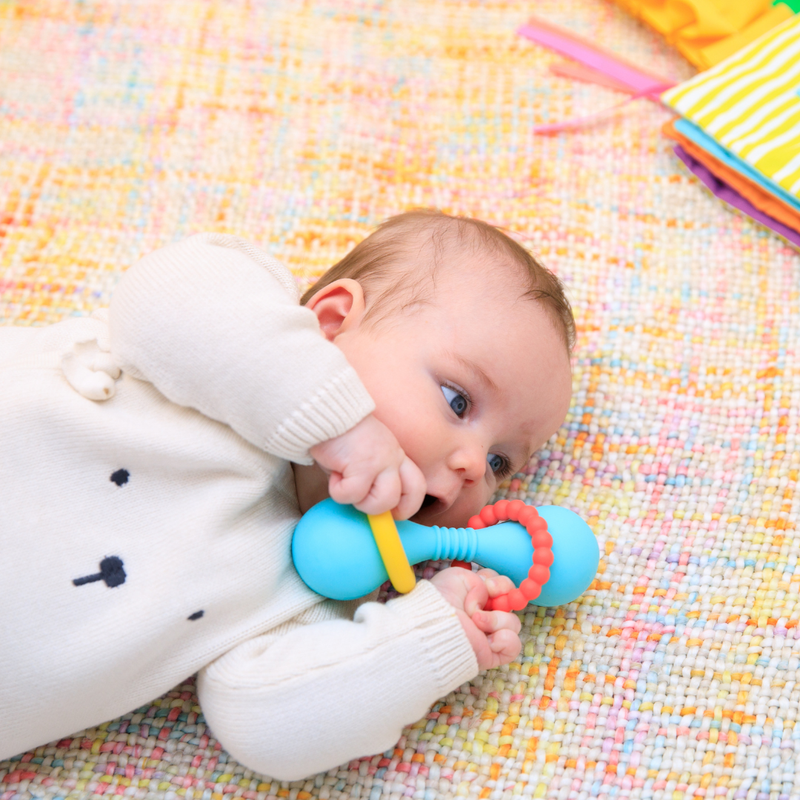
Grip & Shake Rattle
Made for listening, grasping, and early cause-and-effect
Why this matters?
At this stage, your baby is learning to notice sounds, watch movement, and use their hands with more purpose. A simple rattle helps your baby connect what they hear, see, and do.
When your baby grips, shakes, mouths, or watches the rattle, they are building early hand control, sensory awareness, and an understanding of cause and effect: “When I move this, something happens.”
How to use it?
- Offer the rattle slowly and let your baby explore it with their hands, eyes, and mouth.
- Place it in your baby’s hand and give them time to hold, wave, or accidentally shake it.
- Gently shake the rattle near one side, then the other, and pause to see if your baby turns toward the sound.
- During tummy time, hold the rattle in front of your baby or slightly to one side to encourage looking, lifting, and reaching.
- Try offering different ends of the rattle so your baby can practise adjusting their grasp.
Read more
Baby Grasping Milestones: When Babies Start Reaching and Grasping
Read →
Reaching & Grasping: Why It’s Important and How to Encourage It
Read →
Week 16: Your Baby’s Stages of Grasping Objects
Read →
Week 14: Reaching & Grasping — Why It’s Important and How to Encourage It
Read →
Easy Ways to Develop your Baby’s Visual & Auditory Tracking Skills
Read →
Pick a toy 7
Shop Sense With Me →Months 5,6+
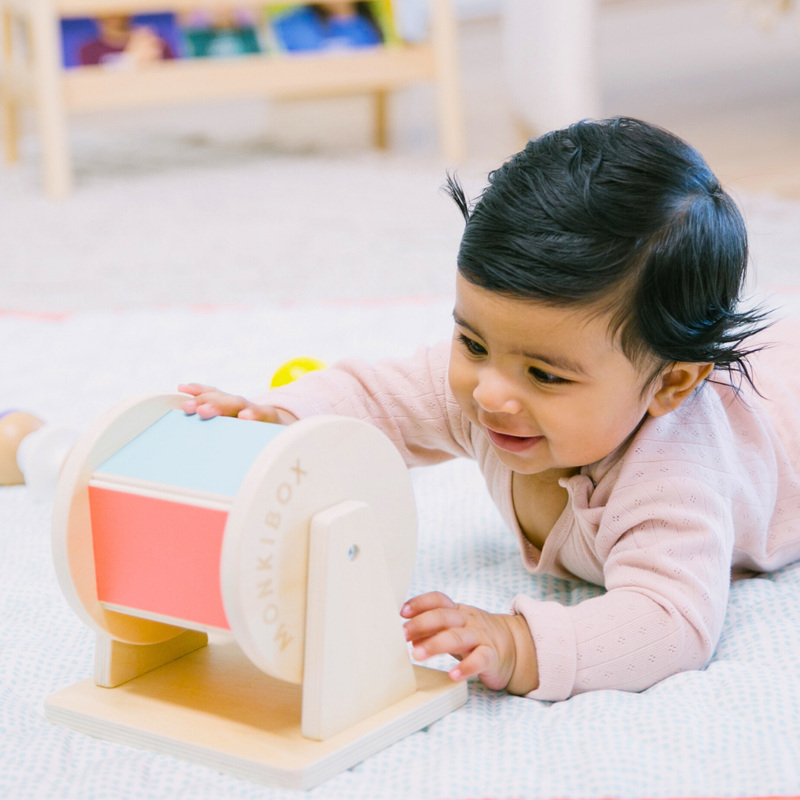
Spinning Rainbow Drum
Intentional Arm Movements
Why this matters?
As your baby is working their way up to mastering some gross motor skills, the spinning drum will also give them plenty of opportunities to master their fine motor skills. In addition, as your baby plays with the drum, they strengthen their arm and wrist muscles which will come in handy when using utensils.
How to use it?
- Let your baby spin the drum using one or both hands while on their belly.
- Move the drum slightly out of reach to encourage a big stretch. If your baby becomes frustrated, move it closer, but allow them to problem solve how to reach the drum.
- Once your baby has reasonable head control, let them sit between your legs as you spin the drum. They will start by leaning back but eventually lean forward, propped up on both hands. The drum will encourage them to lift one arm to spin the drum at a time.
Read more
Reaching & Grasping: Why It’s Important and How to Encourage It
Read →
Baby Grasping Milestones: When Babies Start Reaching and Grasping
Read →
Week 14: Reaching & Grasping — Why It’s Important and How to Encourage It
Read →
 Understanding Play Schemas: How Repetitive Movement Builds Your Baby’s Brain
Read →
Top 10 Montessori Toys for Baby’s First Year
Read →
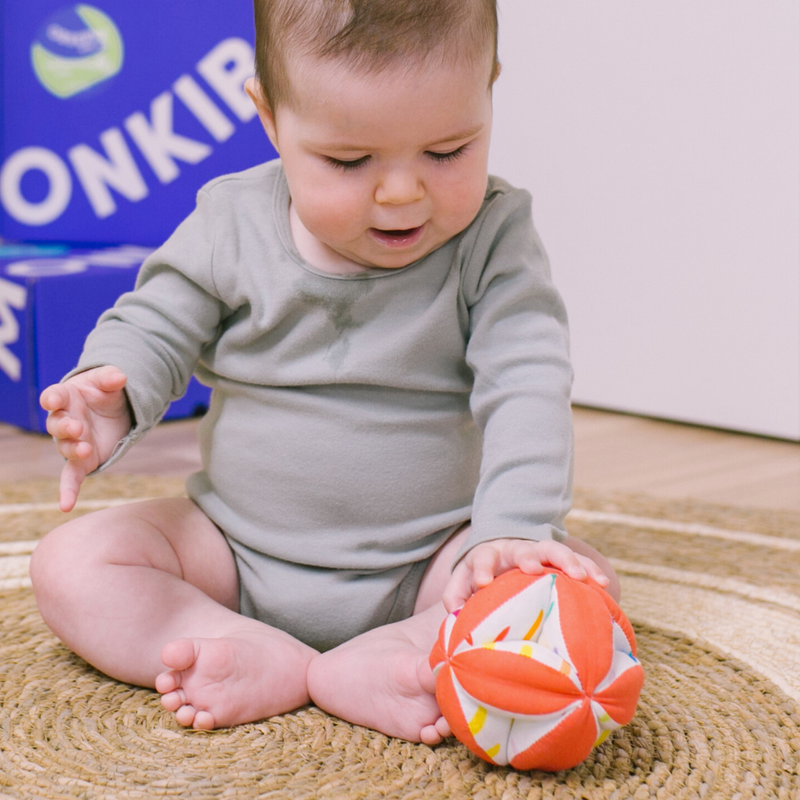
Montessori Knot Ball
Grasping & Holding
Why this matters?
Crossing the midline is vital in your baby's development. As adults, we cross our midline every time we button a shirt, write, or put on shoes - allowing the brain's hemispheres to communicate. This easy-to-hold ball will allow your baby to move a toy from one hand to the other, and giving your baby ample opportunity to practise this skill will strengthen the connections in their brain.
How to use it?
- Encourage your baby to grasp it, squeeze it, and mouth it!
- Roll the ball back and forth in front of your baby to showcase how spheres work.
- Place the ball just out of reach for your baby during tummy time. Help them reach for the ball or use it to help them roll over if they are yet to reach that milestone.
- Encourage your baby to grab and discover different materials and sounds.
Read more
Baby Grasping Milestones: When Babies Start Reaching and Grasping
Read →
Week 16: Your Baby’s Stages of Grasping Objects
Read →
Top 10 Montessori Toys for Baby’s First Year
Read →
Reaching & Grasping: Why It’s Important and How to Encourage It
Read →
Week 14: Reaching & Grasping — Why It’s Important and How to Encourage It
Read →
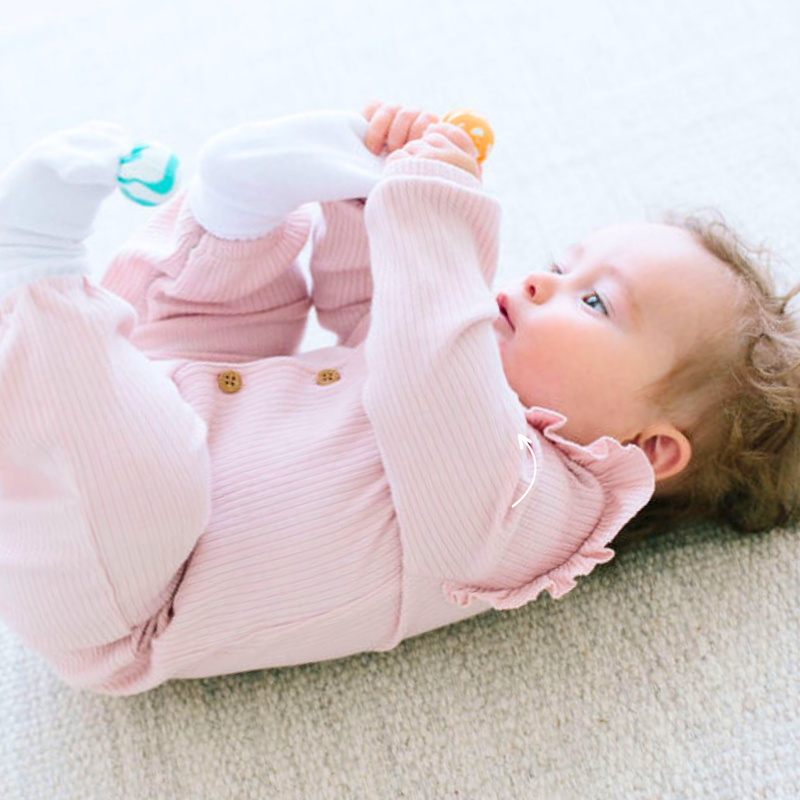
Rattle Socks
Finding Sounds
Why this matters?
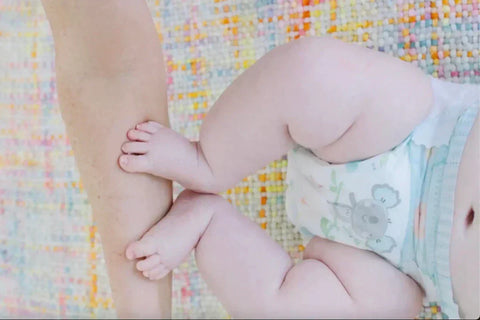
Your baby is still trying to understand that their feet and legs are part of them. This understanding is the first part of them doing more and more with their legs and feet, making them stronger. As your baby moves their feet, they will discover they are making the sound, and learning how to control their feet is a precursor to crawling and walking.
How to use it?
- Show your baby they can make a sound when moving their feet.
- Encourage your baby to reach for their toes and touch the bells. Encouraging this will help develop their core strength and help their hand-eye coordination.
- Understanding cause & effect is a fundamental cognitive concept. Your baby will remember that when they shake the rattle, it makes a sound, giving them an introduction to cause and effect.
Read more
 Play Ideas to Strengthen Your Baby's Leg Muscles for Crawling and Walking
Read →
Easy Ways to Develop your Baby’s Visual & Auditory Tracking Skills
Read →
Reaching & Grasping: Why It’s Important and How to Encourage It
Read →
Baby Grasping Milestones: When Babies Start Reaching and Grasping
Read →
Top 10 Montessori Toys for Baby’s First Year
Read →
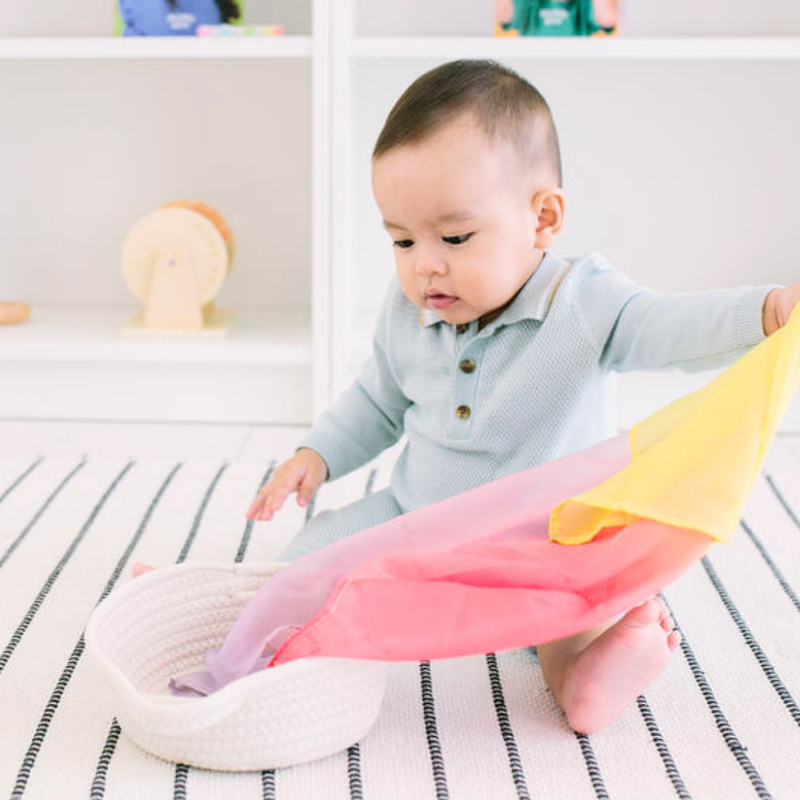
The Play Silk
Open-ended Play
Why this matters?
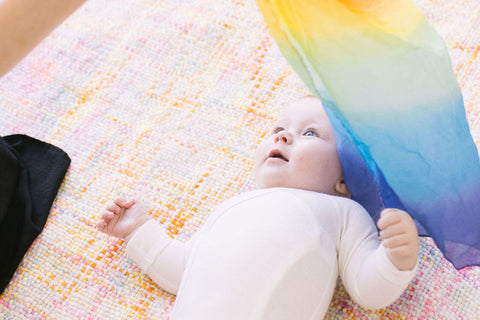
Play silks support fine and gross motor skills, language development, and sensory exploration and provide hours of creative play once your baby is older. Babies are naturally drawn to the silk's bright colours and soft sensory feel. Since it is a classic open-ended "toy," you can keep it on the toy shelf for a long time.
How to use it?
- Invite your baby to reach for and touch the play silk as it hangs from a play gym.
- Add it to a treasure basket filled with textured fabrics.
- When playing, use the opportunity to develop your baby's language skills. "Look at it blowing in the wind," "Can you touch the play silk? How does it feel?".
- Use it to play peek-a-boo. Your baby can either be lying on their back or sit supported against your legs facing you.
- Gently let the play silk drop down onto them or sway it over their naked belly.
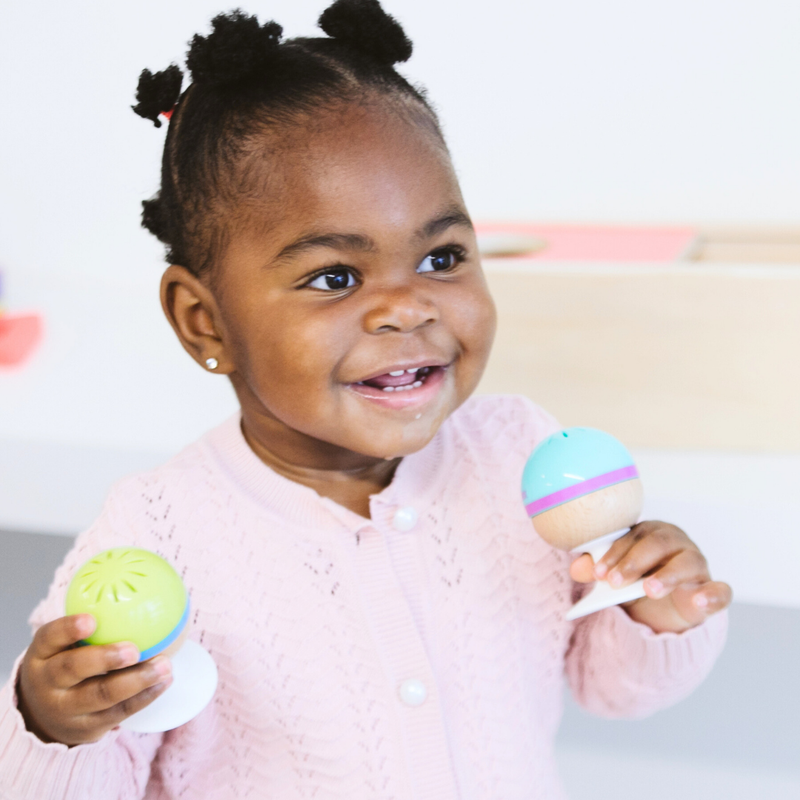
Sensory Music Set
Grasping & Manipulating
Why this matters?
At this stage, your baby is becoming more aware of their surroundings and developing essential auditory discrimination skills, which help them learn to process and make sense of the auditory information they receive, laying the foundation for more complex language and cognitive skills.
How to use it?
- Perfect for tummy time play, place the rattles just outside baby’s reach during tummy time. The color and sound will capture their attention and encourage them to reach out and grasp it.
- Hold the rattles one by one in your hand and gently shake them. Encourage your baby to listen and pay attention to the different sounds they make.
- Take it with you anywhere and everywhere; the suction base makes it a great on-the-go Playtool!
Read more
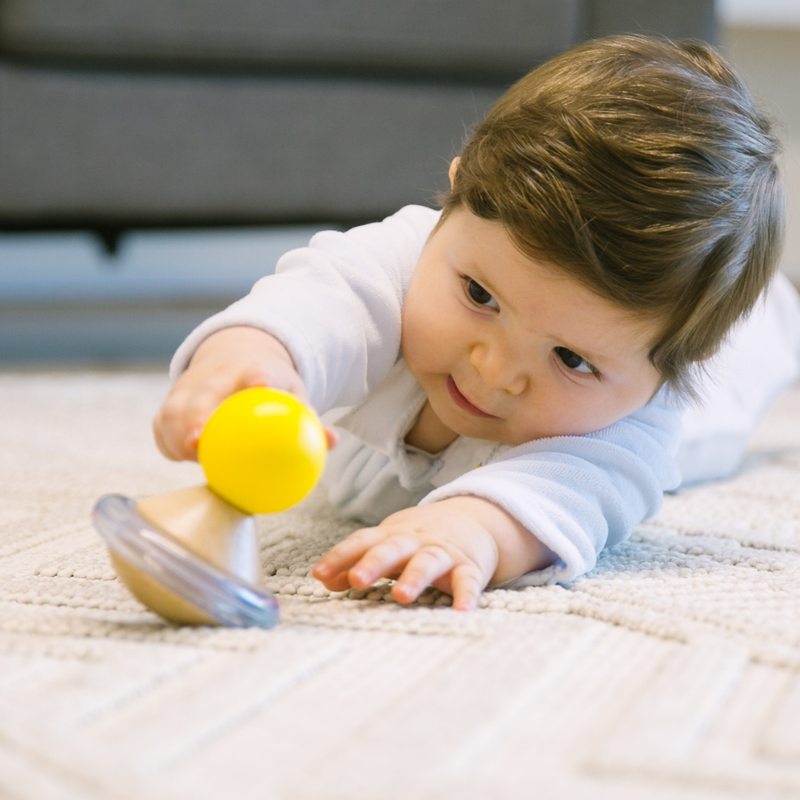
Tummy Time Roly-Poly
Grasping & Manipulating
Why this matters?
Trying to catch a moving object is hard work for your baby as it requires the ability to predict the object's future trajectory. They must tackle it with their eyes and then plan when and how to reach for it, which requires hand-eye coordination and shoulder, neck, and arm strength.
How to use it?
- While your baby is on their tummy, place the tumbler on a hard surface in front of them. Gently tip it over for them to demonstrate the movement.
- Help guide their hand to knocking it over. The motion will help your baby understand cause & effect and hand-eye coordination.
- Place the toy slightly off-centre for your baby to help them use both hands equally.
- The roly-poly is also an excellent toy for crawling babies to chase, so keep it close over the next couple of weeks.
- Remember, even if your baby is sitting up, lots of tummy time is still essential to building their core strength to master skills such as crawling and walking.
Read more
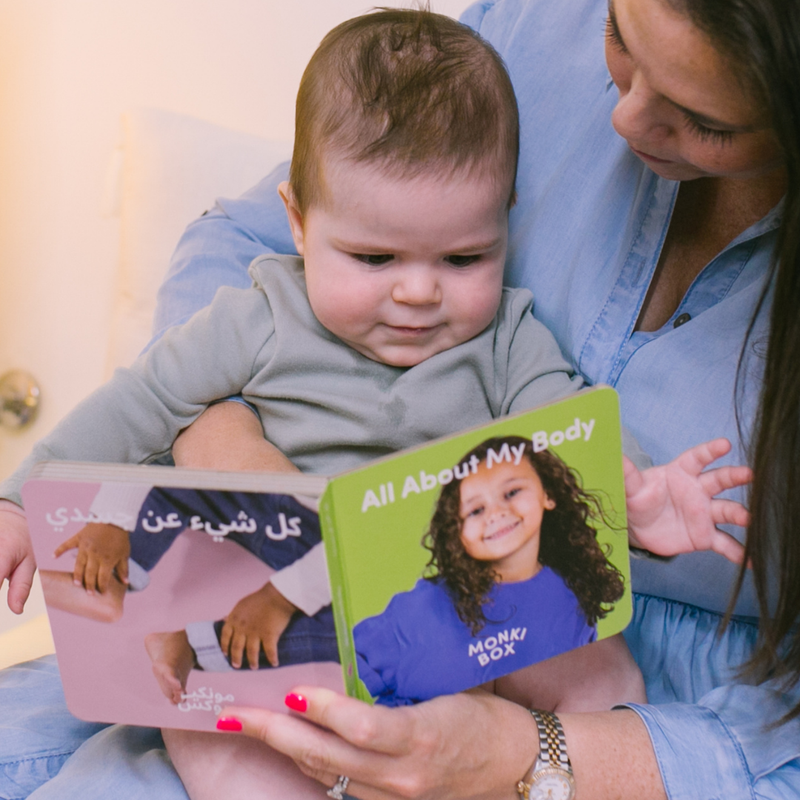
All About My Body
Developing Language Skills
Why this matters?
Learning about the body can become very complicated, so it is essential to include age-appropriate books to engage your baby. Learning their body parts is a fun and practical way to expand their vocabulary, teach them self-awareness and encourage movement in your little one.
How to use it?
- Show and point to the book's pictures and the corresponding part on you and your baby's body.
- As you read the body parts' names, engage your baby by showing their fingers, toes, and legs. Incorporate tickles or blowing raspberries on their tummy to make reading time extra fun.
- Try singing head, shoulders, knees, and toes while pointing to your baby's body parts.
Read more
 Helping Your Child Understand and Name Body Parts
Read →
How to Talk to Your Baby to Build Their brain - One Word At a Time
Read →
The Best Way to Talk to Your Baby to Help with Language Development
Read →
Is Your Toddler Going Through a Language Explosion?
Read →
Why Mirrors Are Good for Babies (and How to Use Them Safely)
Read →
Pick a toy 7
Shop Observe With Me →Months 7,8+
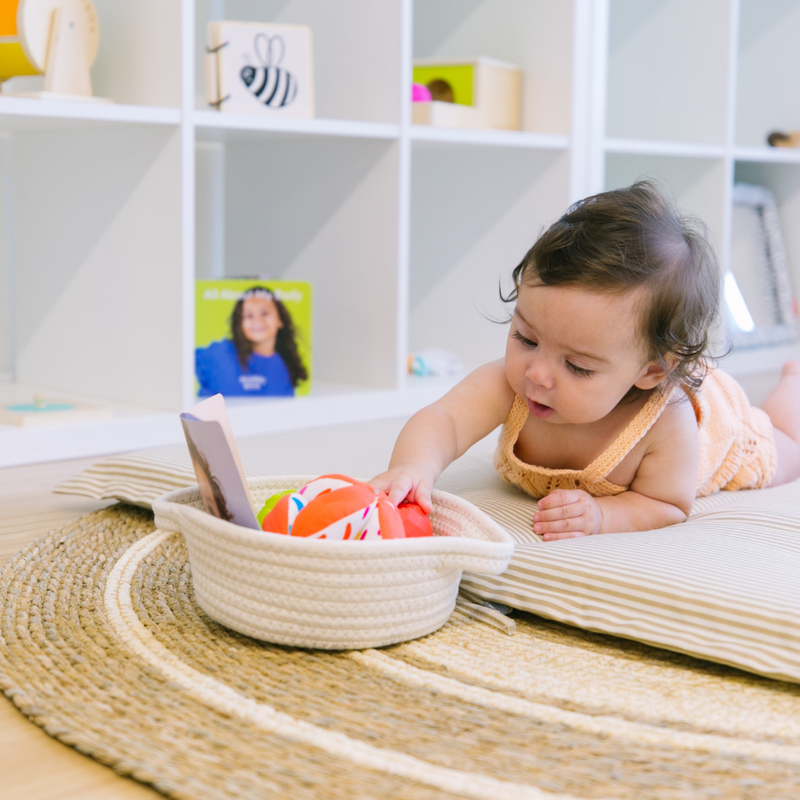
Treasure Basket
Finding Treasures
Why this matters?
The treasure basket is a Montessori classic that encourages babies to explore independently. Starting around 6-8 months, as they sit up, they engage with objects through touch and taste. Approaching their first birthday, they begin to hold and bang objects together. Once they start walking, they enjoy carrying the basket, enhancing their balance while moving their favorite items. This simple activity fosters sensory exploration and supports their development as they grow.
How to use it?
- Gather objects around your house, and you will find many interesting items from a sensory point of view for your baby.
- Choose things with different textures, sizes, smells and shapes.
- Create themes for the basket to help your baby categories. For example, colours, metal, brushes, balls.
- Allow your baby to discover the basket on their own without intervention.
- Keep the basket interesting by changing the objects regularly.
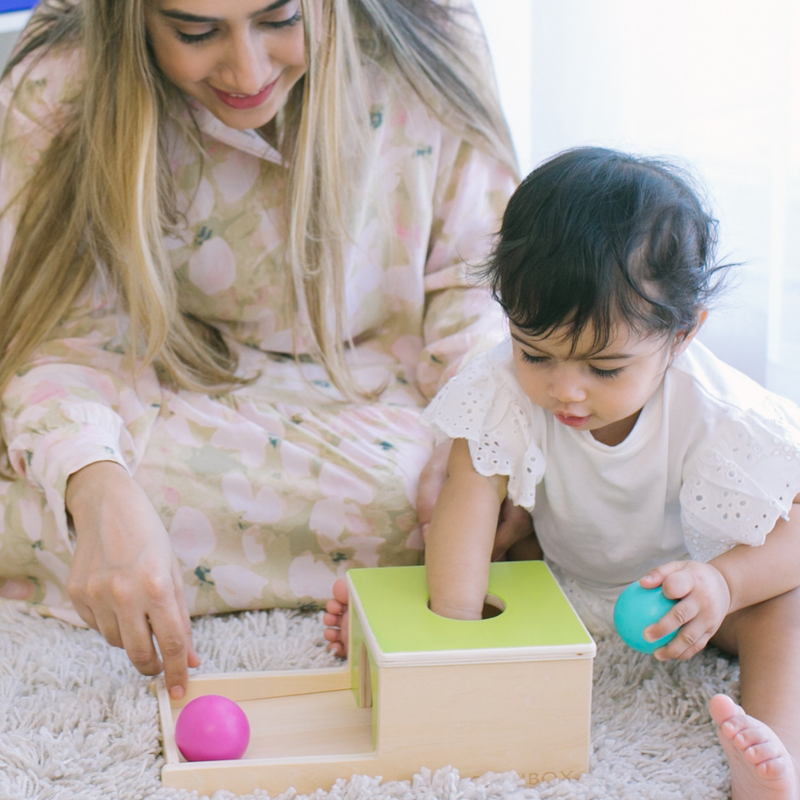
Ball Drop Box
Understanding something exists
Why this matters?
By 6 to 9 months, your baby will discover object permanence, which means your baby understands that things they can’t see - you, their cup, a pet... still exist.
A ball dropbox helps reinforce this concept. Your baby places a ball in an opening, watches it disappear, and then sees it reappear, learning that the ball, and other unseen objects, continue to exist.
How to use it?
- Introduce your baby to the ball box and show him how it works by dropping the ball in the hole.
- Once they are focused on the ball, slowly and deliberately place the ball in the hole. When the ball rolls to a stop in the tray, smile and pick it up.
- Encourage your baby to try it themselves by gently guiding their hand. As they practice, they’ll begin to anticipate the ball's reappearance, enhancing their comprehension of object permanence.
Read more
What Is Object Permanence? How This Brainy Milestone Shapes Your Baby’s Development
Read →
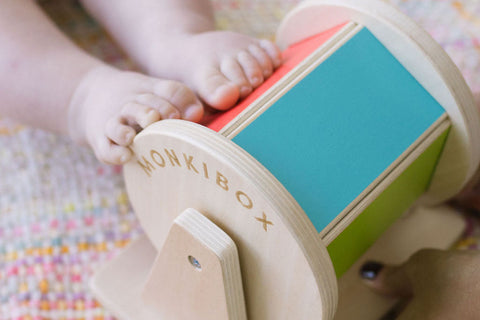 Why Babies Love Knocking Things Down (and Why It's Good for Learning)
Read →
Understanding Play Schemas: How Repetitive Movement Builds Your Baby’s Brain
Read →
 Teaching Toddlers About Gravity Through Play: Fun and Simple Activities
Read →
 5 Ways To Prolong Baby Playtime
Read →
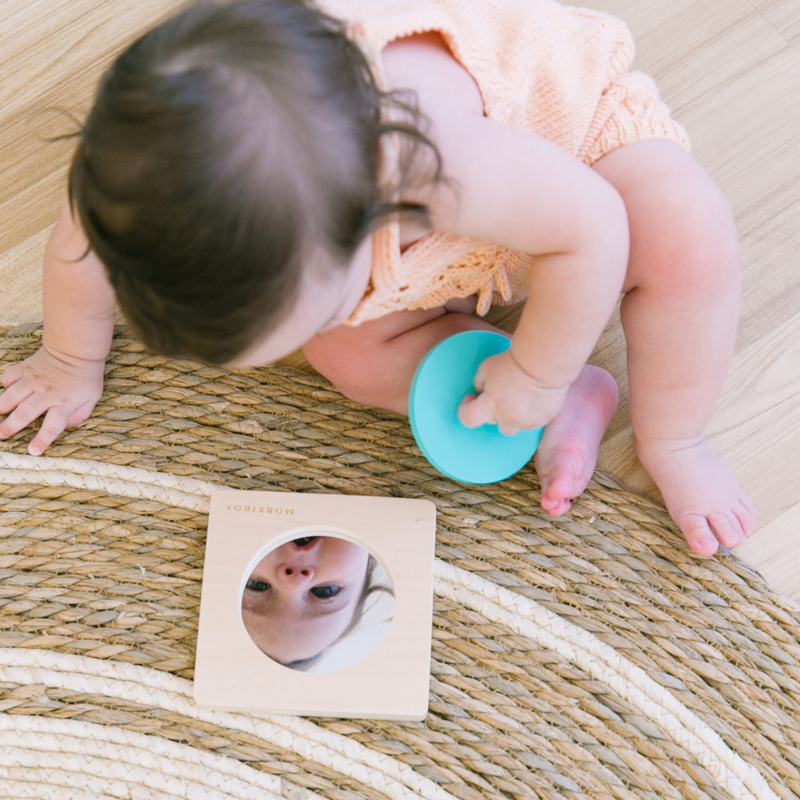
Peekaboo Puzzle
Problem Solving
Why this matters?
A simple circle puzzle helps your baby solve problems as his hands and eyes work to remove and place the puzzle piece. The circle is the most straightforward shape since there is no wrong way of fitting it. As your baby gains skills with their hands and the ability to discriminate between shapes, you will be able to introduce multiple puzzles at once and let them discover which shapes fit into which
How to use it?
- Your baby will first learn to pull the puzzle out before putting it back in.
- Sit facing your baby and show them how to remove the circle and put it back in.
- Show your baby their face in the mirror before placing the puzzle piece back down.
- Play peek-a-boo with the mirror inside the puzzle.
- Allow your baby to freely work on this PlayTool without interruption and let them form concentration and patience.
Read more
What Is Object Permanence? How This Brainy Milestone Shapes Your Baby’s Development
Read →
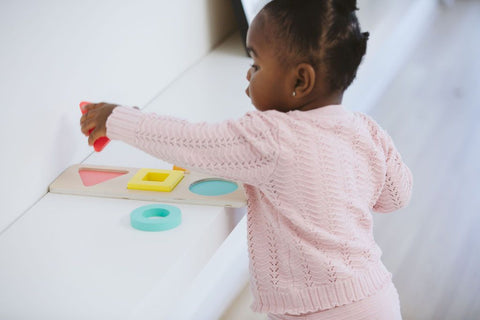 How Puzzles Can Be Positive for Your Little One's Brain Development
Read →
Peek-a-boo Windows Activity
Read →
 5 Simple Ways to Support Your Baby's Brain Development Through Play
Read →
5 Ways To Prolong Baby Playtime
Read →
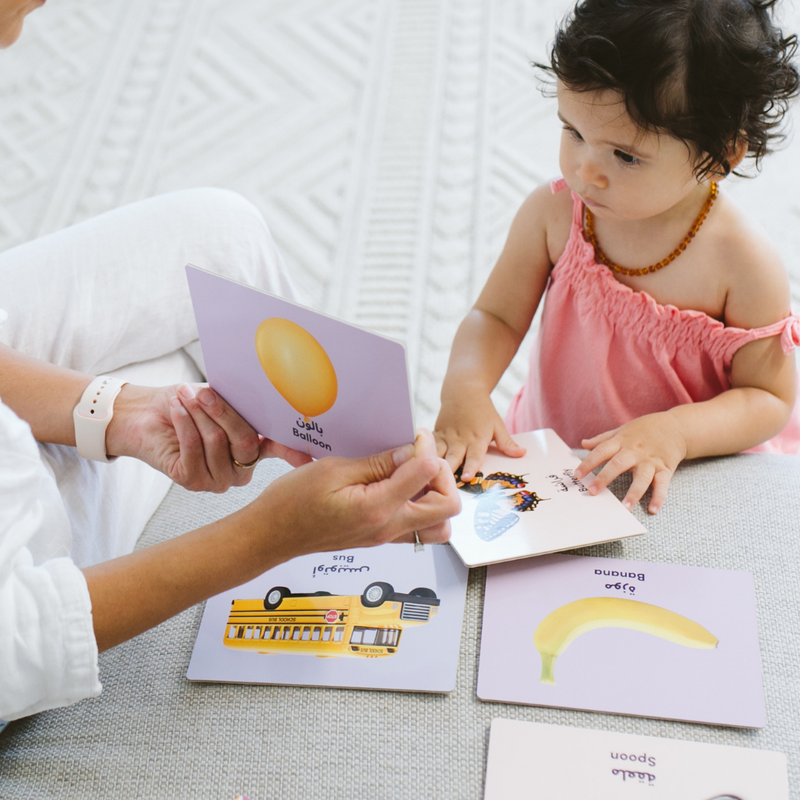
Bilingual Object Cards
Reinforce Baby’s First Words
Why this matters?
Babies learn best when they see real-world objects and prefer to see pictures rather than illustrations. Your baby is introduced to new objects daily, learning their names. These images must be of "real" items and not illustrations. Babies need to learn that things exist before they understand that they can be conceptual or interpretative.
How to use it?
- Placing the cards in his Sensory Book or Standing Card Holder, encourage your baby to look forward and eventually lift his chest during tummy time.
- Find some objects on the cards, let your baby play, and see them with the card. Seeing the object matched with the picture will reinforce that things have a name and that these objects have unique properties (the ball is round, a dog is fluffy)
- Baby responds to a higher-pitched voice (called “Parentese”), so speak in a slightly higher, sing-song manner when you describe each card to help them pay attention.
Read more
How to Talk to Your Baby to Build Their brain - One Word At a Time
Read →
 Baby Sign Language – Why and When to Start
Read →
 What’s a Language Basket and Why Should You Make One for your Toddler?
Read →
5 Simple Ways to Support Your Baby's Brain Development Through Play
Read →
 Signs Your Toddler Is Starting to Talk
Read →
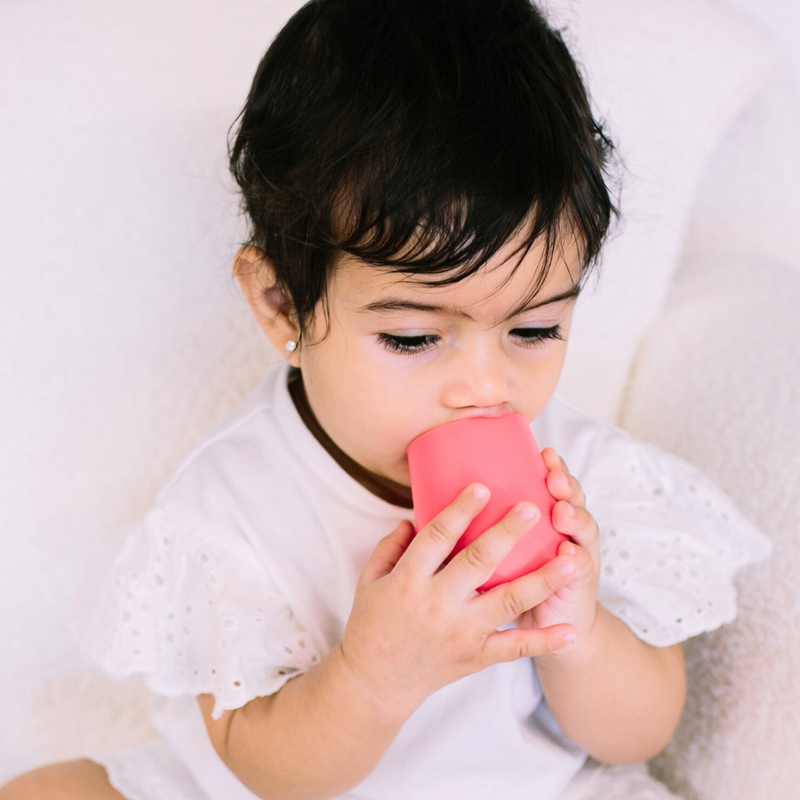
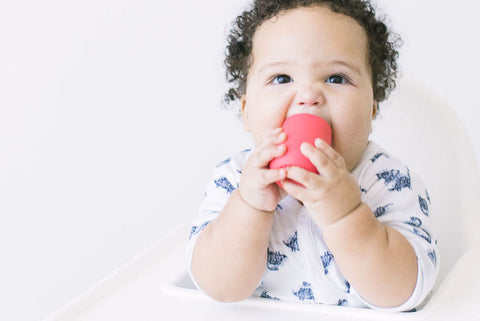
First Drinking Cup
Support Healthy Oral & Speech Development
Why this matters?
Open cup drinking supports healthy oral and speech development, aids with teething, helps baby learn to have a strong swallow.
Speech pathologists recommend it since they help baby develop the muscles in the mouth that support speech development
How to use it?
- Start by adding some breastmilk or formula to the cup. Your baby will be excited to taste something they are familiar with.
- Start with a small amount so that there is less to spill.
- Help guide the cup to their mouth. You can gently place your hands over theirs and help bring it up to their mouth slowly.
- Model drinking from an open cup. Finish your sip with a big "AAH" so your baby can see you got your drink.


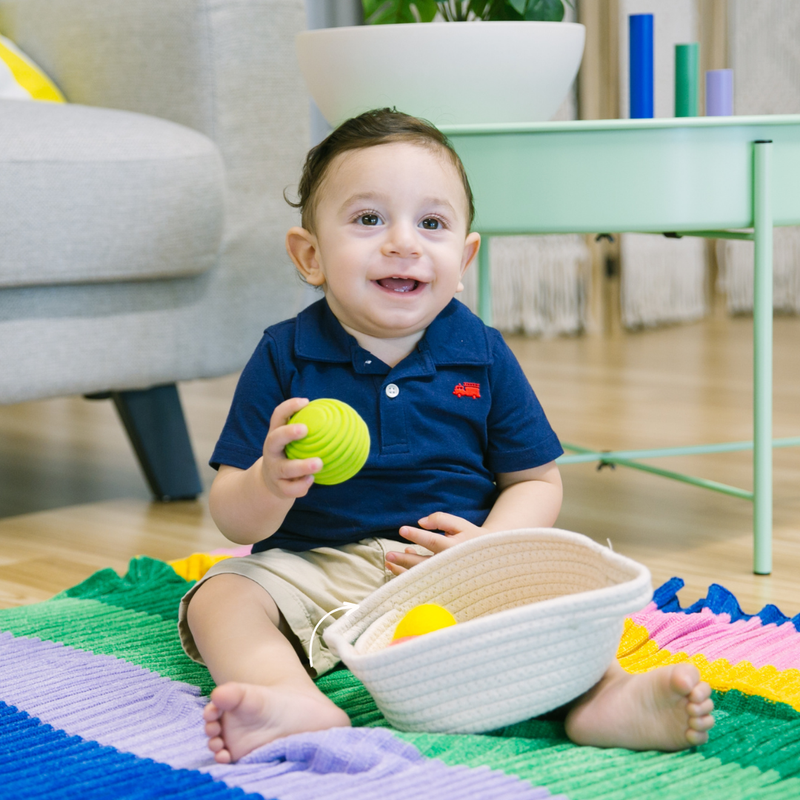
Sensory Balls
Stimulate Sense of Touch
Why this matters?
Ball play provides a ton of developmental benefits for you baby. Ball play builds hand-eye coordination, gross and fine motor skills, spatial awareness, grasping skills, problem-solving skills, balance, and even language and social skills.
While your baby is enjoying the challenges ball play provides, the texture of the balls adds additional sensory input.
How to use it?
- Add the balls to the treasure basket for a tactile rich sensory exploration.
- Make some jello in a large container and add the balls to it before you let it set. Let your baby dig out the balls while enjoying the slippery, slimy jelly. Best to do this activity in the bathtub!
- As your baby reaches the end of month 8, he might be displaying an interest in crawling. Encourage this by placing the balls slightly out of reach, allowing him to move from one ball to the next.
Read more
Why Sensory Play Is Important for Development
Read →
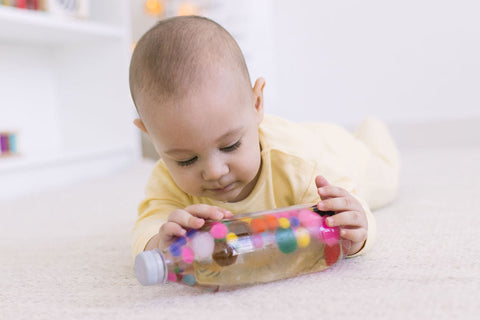 How to Prepare Sensory Bottles and How they Help your Baby
Read →
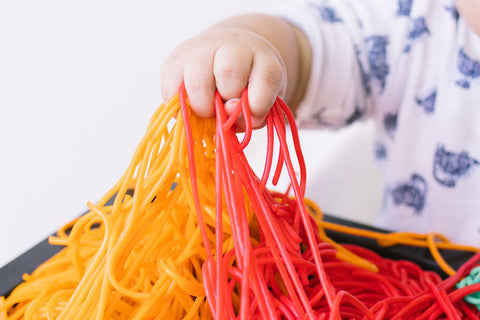 Messy Play for Babies: Why It’s Essential for Development (Plus Fun Ideas!)
Read →
Baby Grasping Milestones: When Babies Start Reaching and Grasping
Read →
The Why and How of Treasure Baskets During Play Time
Read →

Ribbon Pull Cube
Little pulls, big discoveries.
Why this matters?
Pulling ribbons helps your baby discover cause and effect as they watch one side get shorter while the other gets longer. Holding the cube steady with one hand while pulling with the other also strengthens fine motor skills, hand-eye coordination, and the ability to use both hands together.
How to use it?
- Show how it works: Slowly pull one ribbon and let your baby watch it move through the cube.
- Let them explore: Encourage your baby to grasp and pull a ribbon independently. Give them time to discover what happens.
- Use both hands: Help your baby hold the cube steady with one hand while pulling a ribbon with the other.
- Find the other end: Turn the cube around and show your baby where the ribbon went. Encourage them to pull it back through.
- Take turns: Gently pull a ribbon back and forth with your baby, introducing a playful game of give and take.


Pick a toy 8
Shop Discover With Me →Months 9,10+

Montessori Egg Cup
Developing Concentration
Why this matters?
This simple Montessori tool is a baby favorite! Its simplicity is perfect for mastering concentration and helping babies develop fine motor skills. This activity is crucial as it requires moving objects to their midline and using both sides of their body simultaneously - an important skill for independent feeding or dressing.
How to use it?
- Your baby will start by mouthing either the egg or the cup. Let them explore the smooth, hard texture with their mouth as they become more familiar with the parts.
- Slowly show your baby how to place the egg in the cup. Once the egg is in the cup, allow your baby to dump the egg out of the cup.
- Have your baby put the cup in one hand and the egg in the other and see if she can bring them together.
- If not, guide them to put the egg in the cup with your hands.
Read more
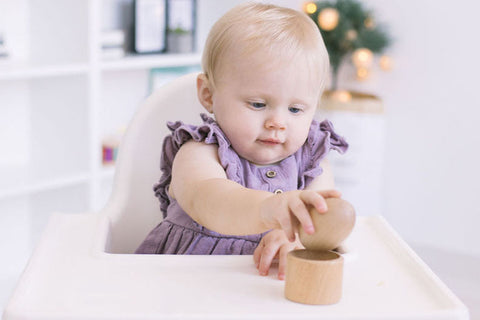 How to Help Your Baby Develop Focus with the Montessori Egg & Cup
Read →
What Is Object Permanence? How This Brainy Milestone Shapes Your Baby’s Development
Read →
Top 10 Montessori Toys for Baby’s First Year
Read →
5 Ways To Prolong Baby Playtime
Read →
 Should You Let Your Baby Struggle During Play?
Read →

Magic Tissue Box
Pulling & Emptying
Why this matters?
Babies become obsessed with pulling tissues or wipes out of the container-a little more stressful is them attempting to eat it. However, this seemingly simple activity helps your baby understand containment as they empty and later fill the box. Pulling the magic tissues out also supports your baby’s natural curiosity, developing fine motor skills, and teaching them to focus on a single task.
How to use it?
- When your baby is on their tummy, lay the tissue box to the side, help them grasp one of the tissues, and show them how to pull it out.
- Replace the tissues with a small toy and help your baby reach into the box and remove the toy. Ask them, "what’s in the box?" Act surprised as they reveal it.
- You can also play peekaboo with the different pieces.

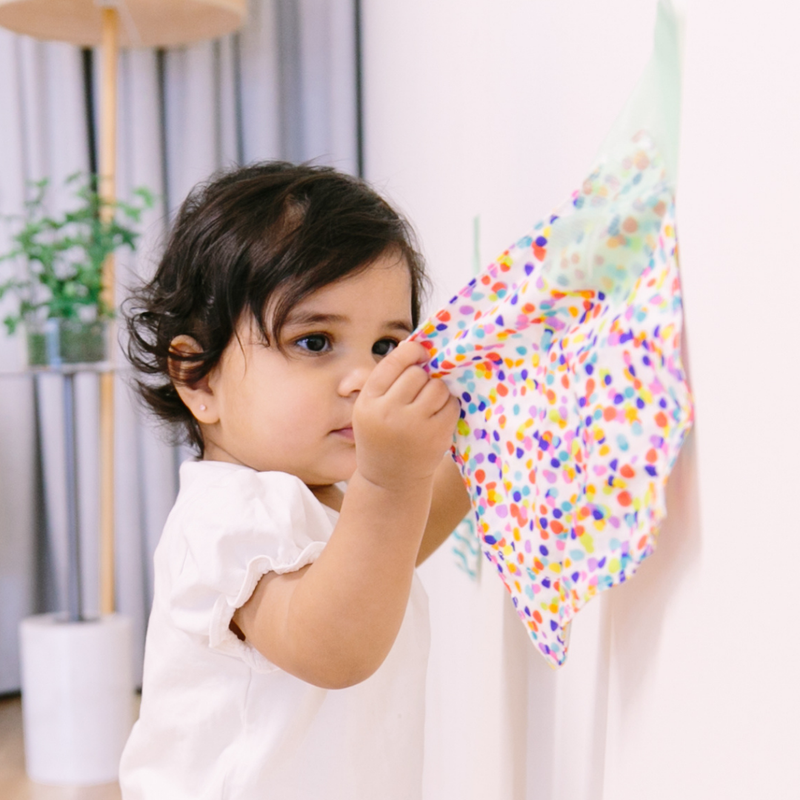
Magic Tissues
Tissue Tugging: Developing Strength
Why this matters?
It builds arm strength, refines visual skills, promotes crossing the midline, and helps with fine motor skills. Also, it's a super fun activity; supervise for safety!
How to use it?
- Here’s a fun new way to use the favorite tissue box.
- You only need the MonkiBox tissues, painter’s tape, and scissors.
- Grab the MonkiBox tissues, put painter’s tape on the top of each tissue, and place it on the wall close enough so your baby can reach it while sitting.
- Supervise for safety, and let the fun begin!
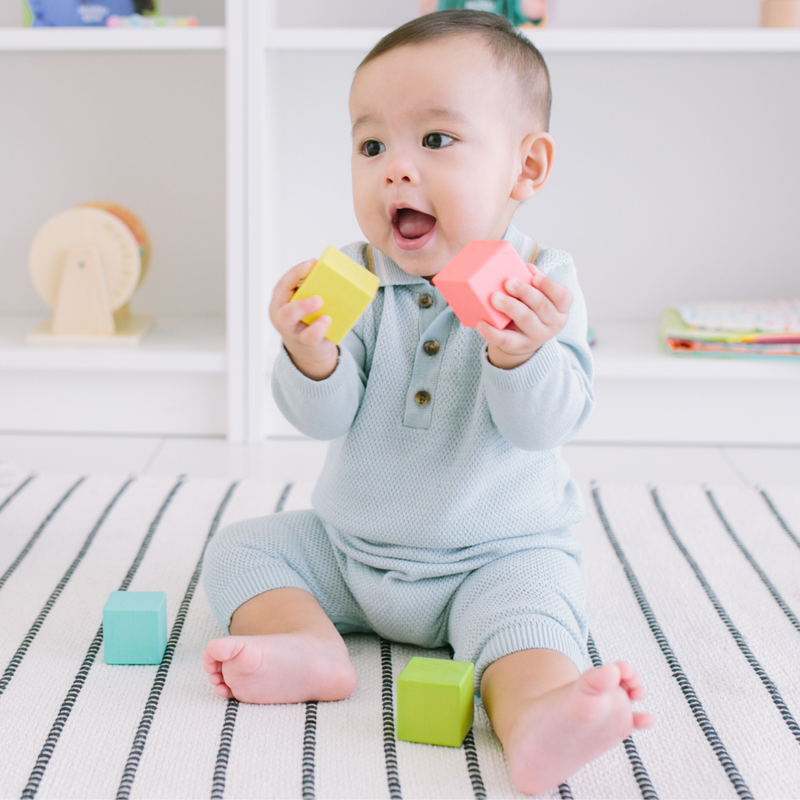
First Block Set
Improving Hand Eye Coordination
Why this matters?
Despite their simplicity, blocks can function as powerful learning tools. Research shows that playing with blocks helps children develop their vocabularies and early introduction to gravity, balance, and geometry. Your baby will work on picking them up, ranking them, and using both sides of their body at once to bang them together. They will also quickly realize that cubes behave differently from spheres.
How to use it?
- Build a tower for your baby to knock over. If your baby is showing signs of walking, help them along to kick to blocks over.
- Show your baby how to bang two blocks together.
- By 11 or 12 months of age, your baby may be able to stack one block on top of the other. By 22 months, they will be able to stack four blocks. (Remember, every child is different)
- Stick the blocks to the wall using some painter's tape. Help your baby free the blocks. Higher blocks will encourage your baby to keep their balance when standing and use their hands.
- Keep the blocks in the treasure basket (from box 7,8) as part of exploring shapes (a basket with square objects), texture (a basket filled with smooth/ wooden toys), and sounds (banging the blocks together).
Read more
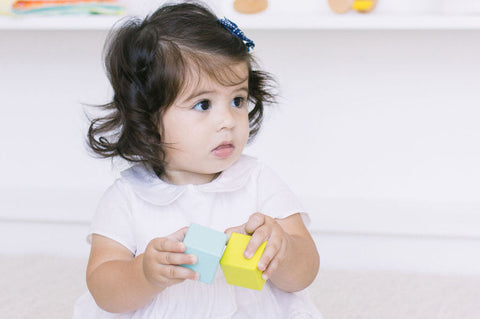 Why Playing With Blocks Is Important for Baby Development
Read →
 The Developmental Importance and Stages of Playing With Blocks
Read →
 Playing with blocks. What are the benefits for your child?
Read →
Why Babies Love Knocking Things Down (and Why It's Good for Learning)
Read →
 Fun Ways to Build Early Math Skills in Your Toddler Through Play
Read →
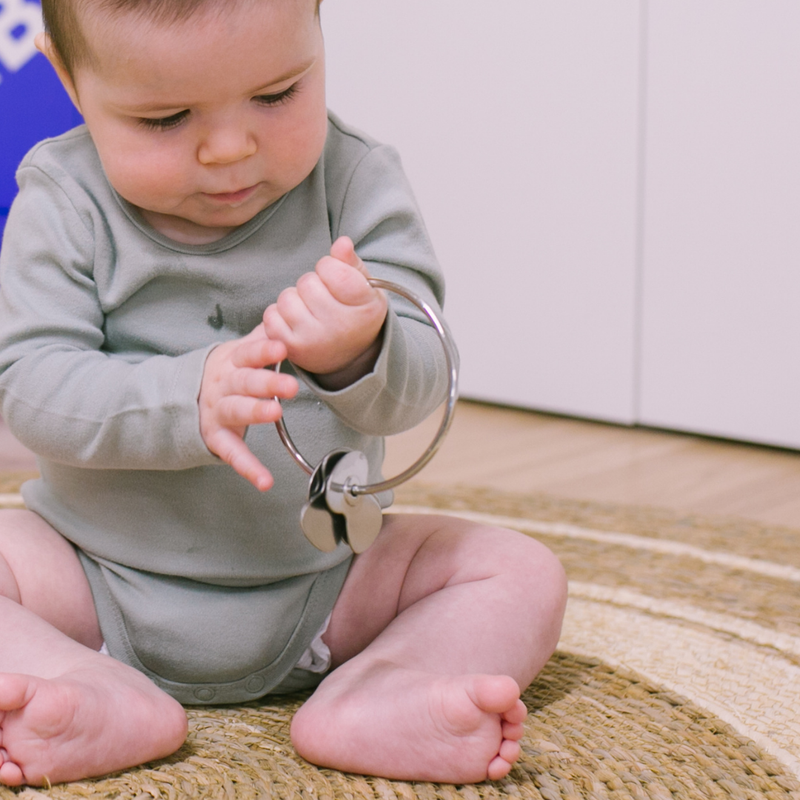
Stainless Steel Jingle Keys
Real-world Objects Play
Why this matters?
Babies are fascinated by objects they see every day. And every parent knows that the more dangerous a thing is, the more excited your baby is to grab it and stick it in their mouth! This stainless steel option is the perfect key and keychain imitation. It’s lightweight and easy to grasp for tiny hands, promoting fine motor skills. In addition, the rounded shapes make a beautiful click-clack sound your baby will love.
How to use it?
- Gently shake the keys in front of your baby and let them reach for them.
- If your baby is sitting independently or still with support, allow them to reach forward to grab the keys from you to their left or right hands.
- They will shake the keys and even bang them against the floor - but be careful that they don’t hit themselves in the process.
- Stainless steel is a perfectly safe and natural material to put in your mouth, so allow your baby to enjoy the cool, smooth texture of the ring and the keys.
Read more
 Fun Ways to Introduce Your Little One to Music
Read →
Why Sensory Play Is Important for Development
Read →
The Why and How of Treasure Baskets During Play Time
Read →
Baby Grasping Milestones: When Babies Start Reaching and Grasping
Read →
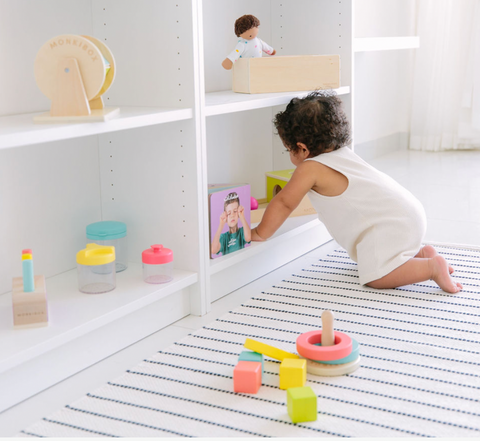 Toy Rotation for Babies: Why It Matters and How to Start
Read →
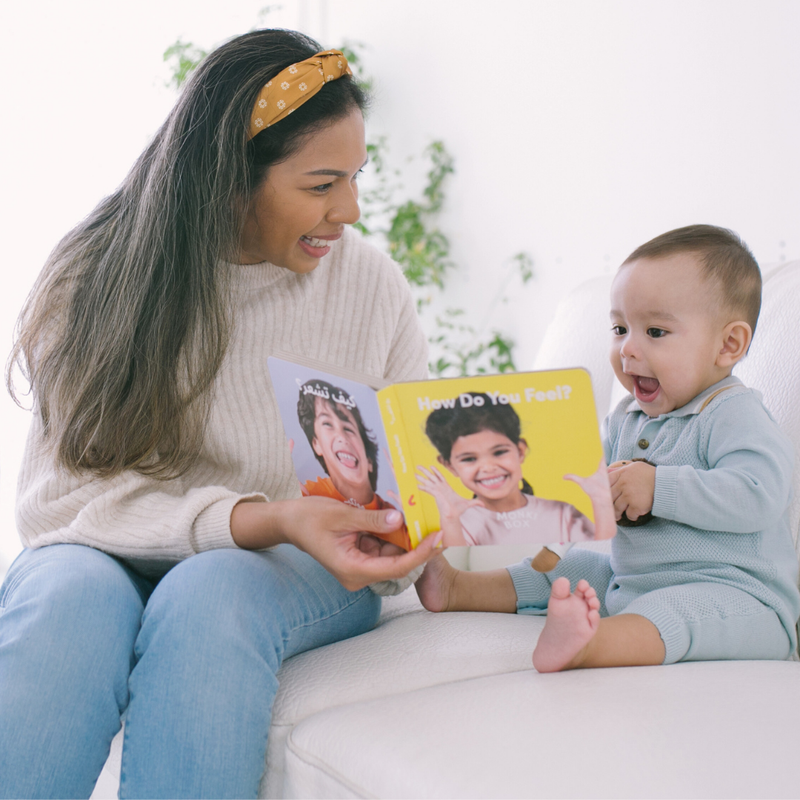
How Do I Feel?
Learning About Feelings
Why this matters?
Faces are one of the most critical social stimuli for humans, and even newborns come into the world preferring to look at anything that looks like a face. Babies learn a lot of important information by looking at faces. For example, when you read to your baby, they will pay attention to the parts of your face that move, such as your eyebrows and mouth. They will learn that these movements go with the sounds they hear as they observe you. They will also learn that faces can signal emotions like happiness, sadness, or anger and that specific faces can belong to certain people, like "mommy" and "daddy."
How to use it?
- Make sure books are as easy to reach, hold, and look at as toys. Making it accessible can mean placing a book on a low toy shelf or an easy-to-reach bookshelf. A plate holder can help books stand upright and easy to grab.
- Talk about the pictures in the book. Even if your baby doesn't answer, ask them questions about the images they are seeing, "What do you think made that baby laugh?". By listening, your child learns words, ideas, and how language works.
- Sit in front of your baby when reading so they can easily see your face.
Read more
 Why Toddlers Cry: Understanding Emotions and How to Respond with Empathy
Read →
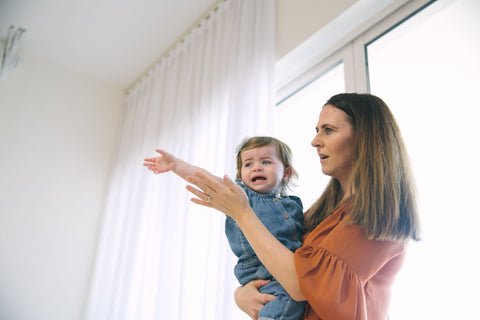 Toddlerhood and the Feelings That Come With It: How to Navigate Newfound Frustrations
Read →
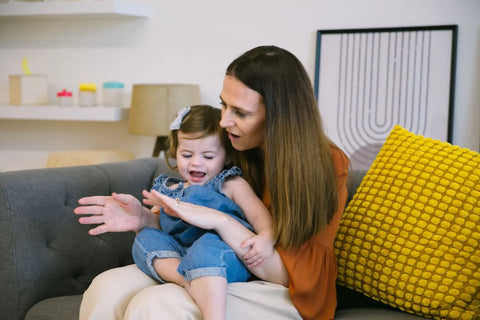 How to Use Positive Language With Your Child
Read →
 Tips for Handling Toddler Transitions
Read →
 Why Toddlers Kick, Bite, Hit and How to React
Read →
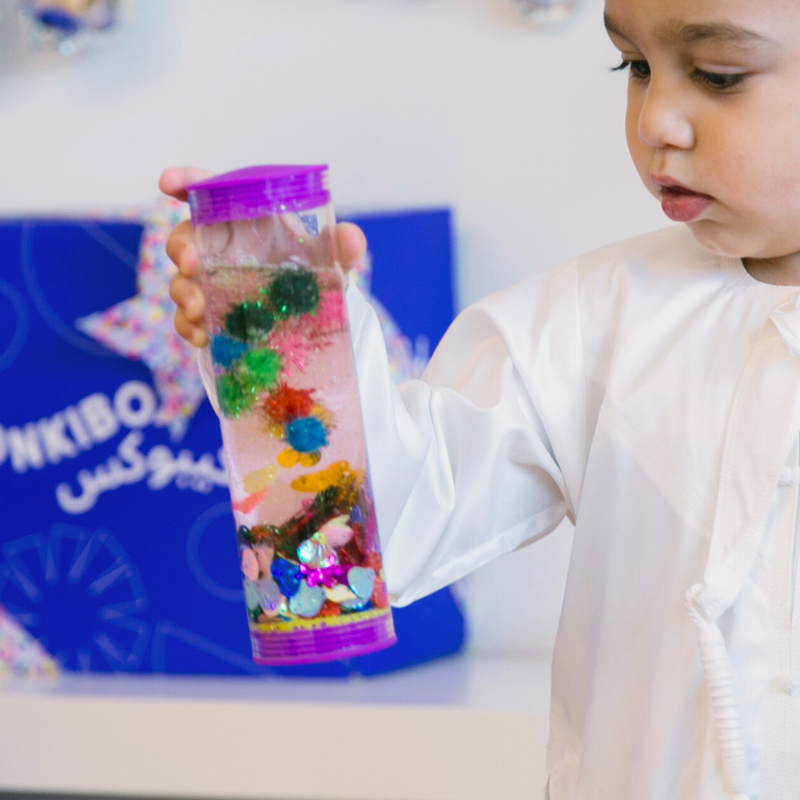
Sensory Tube with Silicone Lids
Placing Objects Inside Containers
Why this matters?
Your baby is learning that objects can fall from tubes and stay in containers, a concept that will interest them until around 18 months. They'll experiment with putting things in containers and tubes, discovering how objects fit and move, which helps them understand spatial relationships and cause and effect.
How to use it?
- Show your baby how a ball or scarf goes through a tube and comes out.
- Give them a big object that won't fit in the tube and explain why it doesn't fit.
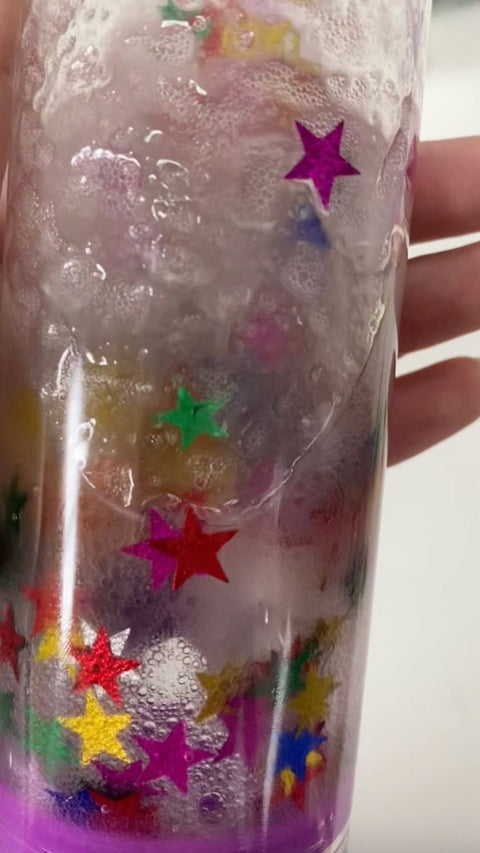
- Make a sensory bottle by putting water, glitter, beads, or pompoms in the tube. Shake, roll, and tilt the sensory bottle to see how the contents move and change. Talk about the colors, shapes, and sounds you notice.
- At 10 to 11 months, your baby might take rings off the tube or tip it to drop the rings.
- By 15 months, your baby could stack rings on the tube and see that taking the tube away lets the rings go.
Read more


Stacking Rings
Develop Fine Motor Skills
Why this matters?
Merely moving a ring onto the peg requires a remarkable amount of coordination and strength. As your baby sits and plays with this toy, they build the muscles in their back, arms, and wrists to support themselves through crawling and eventually writing.
How to use it?
- Remember that your baby is developing their skill in performing tasks, so it's best not to overwhelm them with all the rings. Start by showing them how to complete the activity using one ring at a time.
- If you discover that your baby is mastering this level, you can choose to introduce the second ring.
- An alternative is introducing the activity with one ring on the peg and showing your baby how to remove it.
Read more
The Developmental Importance and Stages of Playing With Blocks
Read →
Top 10 Montessori Toys for Baby’s First Year
Read →
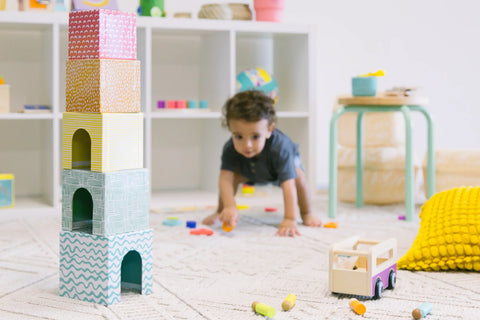 Understanding Placement Play Schemas: How Your Baby Learns Through Organizing, Wrapping & Arranging
Read →
5 Ways To Prolong Baby Playtime
Read →
Understanding Play Schemas: How Repetitive Movement Builds Your Baby’s Brain
Read →
Pick a toy 6
Shop Explore With Me →Months 11,12+

Nesting Container Set
Understanding Inside & Out
Why this matters?
Your baby will attempt to put small objects into larger ones from about nine months. Filling and dumping activities help develop fine motor skills, planning, and problem-solving. As their hand-eye co-ordination and focus improve, you can expect the filling to become more accurate. Although rudimentary, your baby is practicing their spatial awareness - is a toy on top, inside, or next to them?
How to use it?
- Show your baby how to open the lids and put objects into each container. Help your baby reach into each to remove it.
- Build your baby's vocabulary by using phrases such as “in” “out” “remove” “put back” “open” and “close” to develop your baby's understanding of opposites.
- Use the containers during bath time. Fill them up and dump the water before it runs out the holes in the bottom.
- Take the containers out and let your baby fill them with water, sand, or small rocks to help develop their fine motor skills and give an additional sensory experience.
Read more
 Container Play for Babies: Benefits, Activities, and Why It Matters
Read →
Understanding Placement Play Schemas: How Your Baby Learns Through Organizing, Wrapping & Arranging
Read →
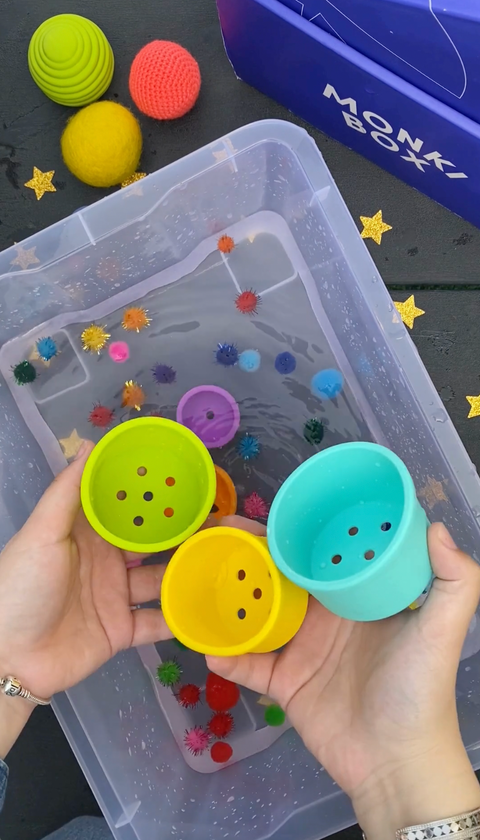 Silicon Cups Water Play Activity
Read →
Understanding Play Schemas: How Repetitive Movement Builds Your Baby’s Brain
Read →
The Why and How of Treasure Baskets During Play Time
Read →
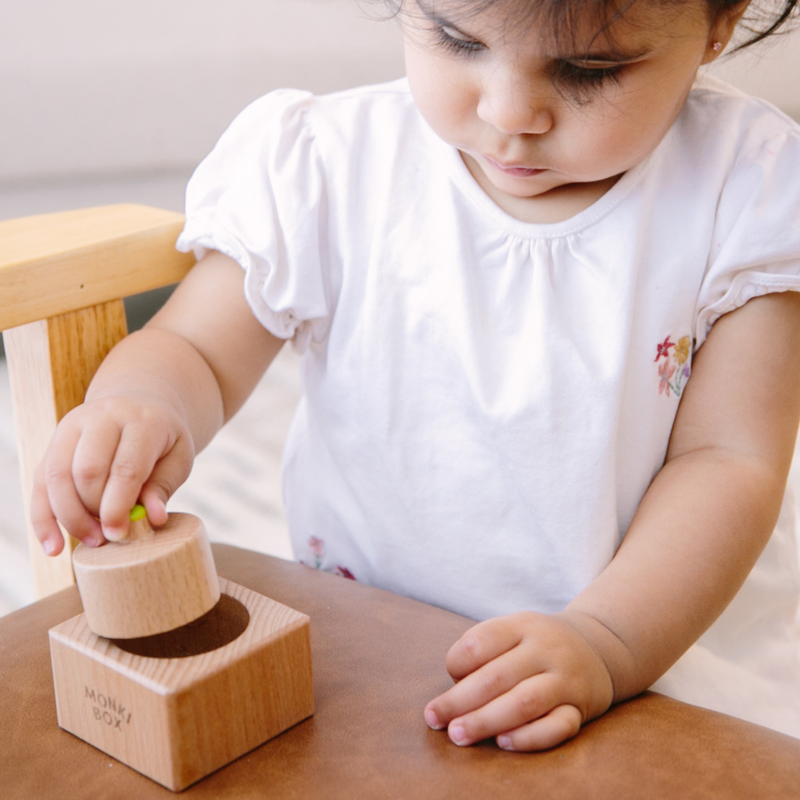
Pincer Puzzle
Practicing the Pincer Grasp
Why this matters?
Between months 10 and 12, your baby learns to grasp small objects with their thumb and index finger–this is called a pincer grasp. This simple Montessori activity is designed to help them practice, concentrate, and reinforce the cylinder from the hole. Watch as your baby can concentrate on this simple work for long periods of time.
How to use it?
- Once your baby tries to pick up things using two fingers, offer them the pincer puzzle.
- First, present the work to them. Show them slowly and quietly how to remove it and put it back using the knob. Try doing this quietly, so your child can concentrate on your hand motions.
- Now it’s their turn! Guide your baby’s fingers to the top of the knob. Let your baby try as many times as possible.
- If you notice they keep making mistakes, reintroduce the activity another day and follow the same process.
Read more
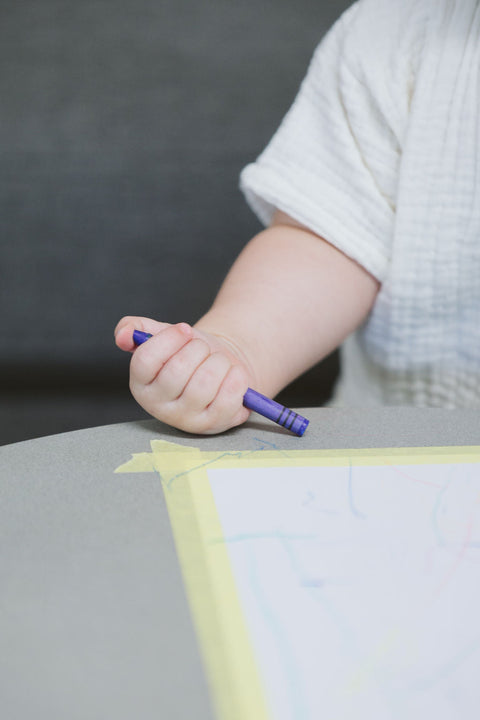 Peeling Activities for Babies: How to Strengthen the Pincer Grasp Through Play
Read →
How Puzzles Can Be Positive for Your Little One's Brain Development
Read →
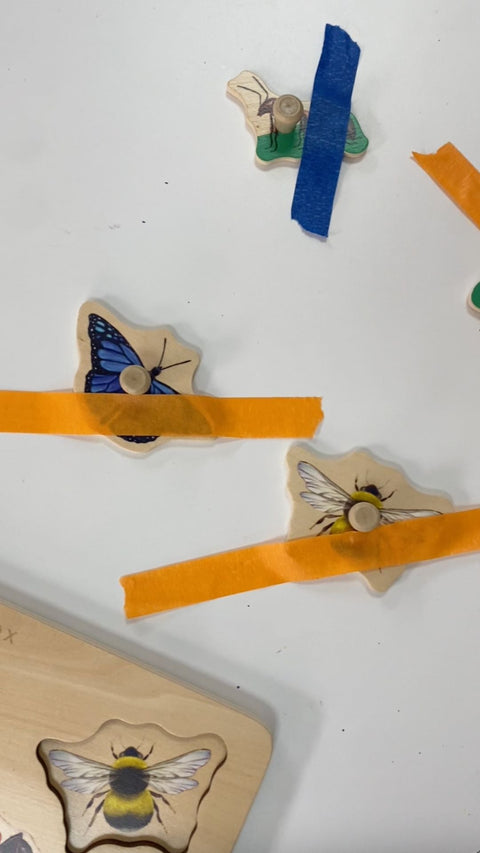 Puzzle Rescue Activity
Read →
Baby Grasping Milestones: When Babies Start Reaching and Grasping
Read →
Week 16: Your Baby’s Stages of Grasping Objects
Read →

Drop Pegs
Cause & Effect
Why this matters?
Around this stage, your child is becoming more interested in activities that challenge their hands and mind together. Posting helps strengthen fine motor control while introducing early problem-solving through trial, repetition, and cause and effect. Posting is a fine motor activity that helps your child practice hand control, coordination, and problem-solving. As they explore placing each peg into the slot, they’re building the concentration and precision needed for more complex hand skills later on.
How to use it?
- Offer the peg drop with the pegs already in place
- Let your child explore the toy and discover what happens when the tab is pulled.
- Encourage them to pull the tab and watch the pegs drop.
- Once the pegs fall, encourage your child to place them back into the openings.
- If they get frustrated, gently show them how to reset it and keep the experience playful.
Read more
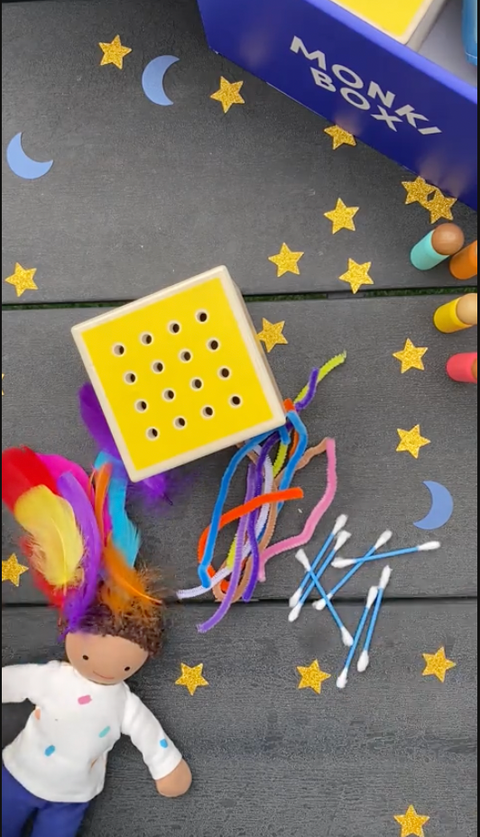 Fun with Posting Activity
Read →
 Pompoms Tubes Wall Drop Activity
Read →
Understanding Play Schemas: How Repetitive Movement Builds Your Baby’s Brain
Read →
Understanding Placement Play Schemas: How Your Baby Learns Through Organizing, Wrapping & Arranging
Read →
 What is Control of Error and Why is It Important?
Read →
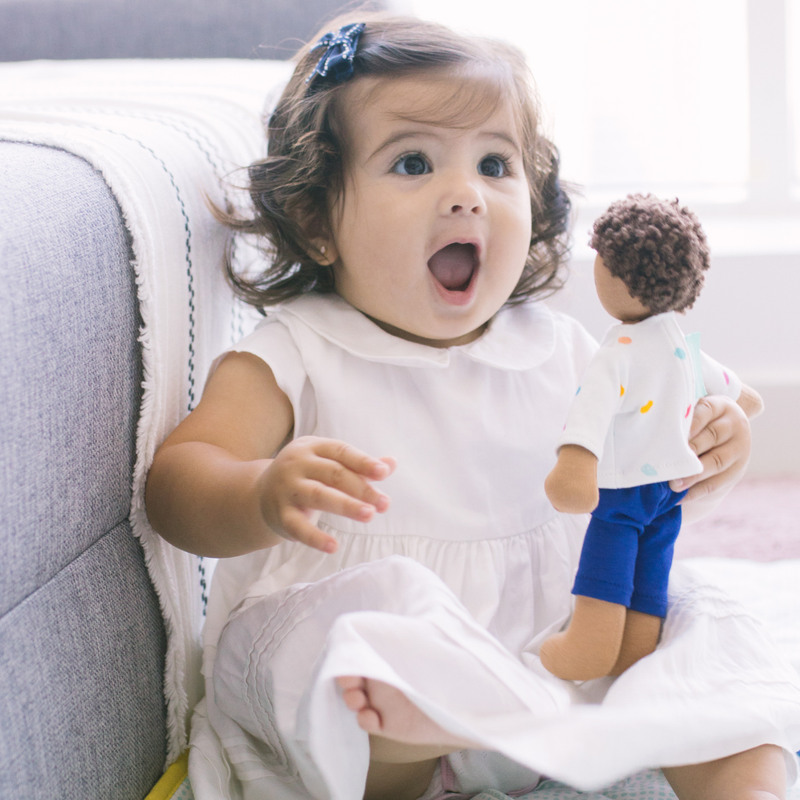
Baby Soli
First Play Friend
Why this matters?
This classic Waldorf doll might be thrown when your baby feels frustrated or hugged and kissed when feeling affectionate. A soft doll encourages valued qualities such as empathy, affection, and bonding, helping solidify social skills gained during the early developmental years. Baby Soli’s appearance is designed to be neutral to promote creativity and imagination.
How to use it?
- Early on, the doll may function as a security item for a baby as holding a doll replicate the feeling of being held by a parent.
- Talking to your baby is an excellent way to build language skills. Use the doll to have conversations, pretend play or make him part of your daily life.
- Taking care of a doll strengthens caring and nurturing skills.
- Help your baby brush the doll’s hair or change Soli's clothes.
- Dolls are important for BOTH boys and girls to play with as they learn to nurture and empathise.
Read more
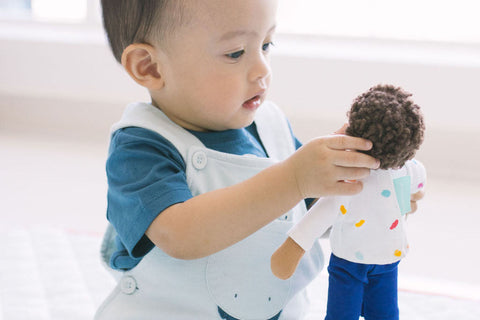 Why It’s Great for Boys to Play With Dolls Too (And What They Learn From It)
Read →
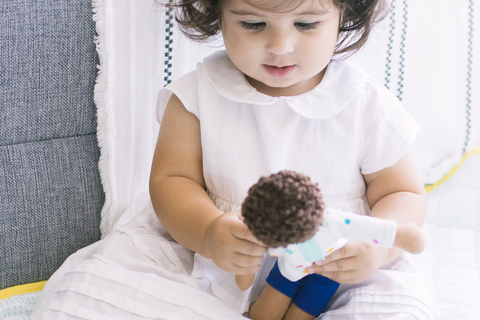 What is open-ended play?
Read →
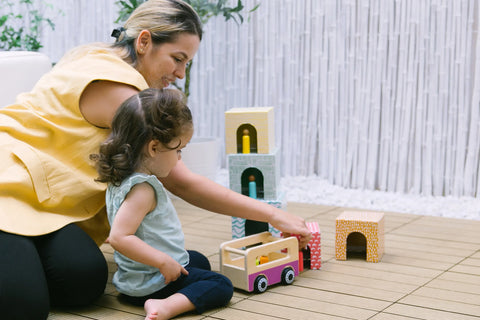 Pretend Play: Why It Matters and How to Encourage It
Read →
 Separation Anxiety in Toddlers: What It Is and How to Cope
Read →
Toy Rotation for Babies: Why It Matters and How to Start
Read →
Sliding Box
Problem Solving
Why this matters?
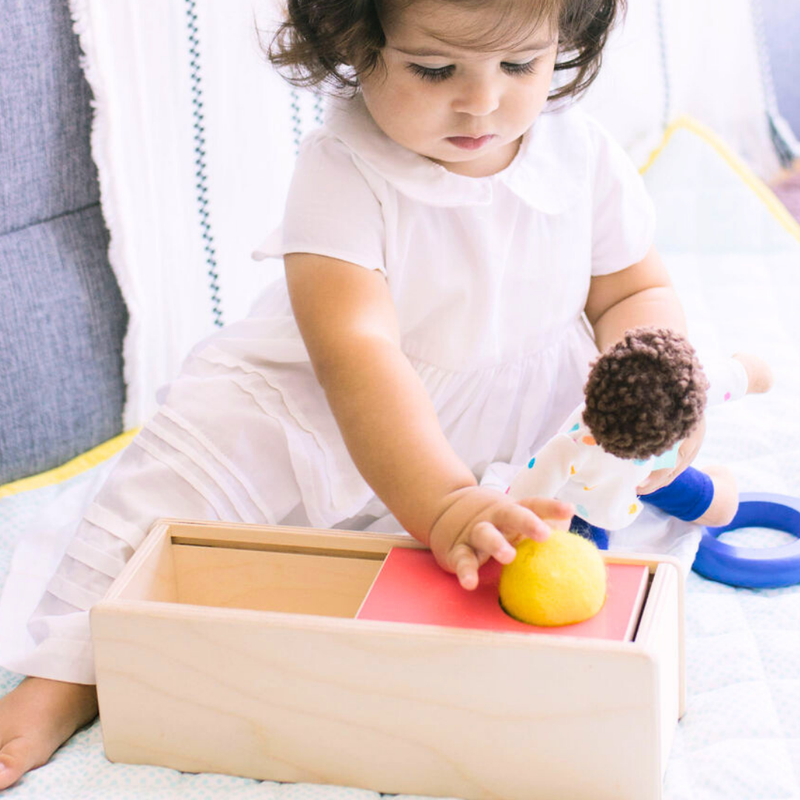
Your baby is building their hand and fine motor skills and hand-eye coordination. While your baby will still further explore their sense of object permanence, they will discover that they can reveal where the ball is by sliding the lid.
How to use it?
- Sit in front of your baby with the box between you. Show your baby slowly and deliberately how to drop the ball through the hole.
- Next, show them how to slide the lid to reveal the ball.
- You can also do the reverse. Place an object in the box and slide the lid to reveal where it is.
- Once they have grasped the concept and the rhythm, they can post other objects, e.g., a small toy. Please give them a couple of options in a basket next to them and let them explore which ones will fit and which won’t. Maybe your baby will display some problem-solving skills or even some frustration. This is ok and a part of their growth.
Read more
What Is Object Permanence? How This Brainy Milestone Shapes Your Baby’s Development
Read →
Fun with Posting Activity
Read →
Understanding Play Schemas: How Repetitive Movement Builds Your Baby’s Brain
Read →
 Why Is Categorizing and Sorting Important?
Read →
Container Play for Babies: Benefits, Activities, and Why It Matters
Read →

Opposites Book
Understanding the World
Why this matters?
One way to increase your child’s vocabulary is to teach them how to describe things, and one such way is to use opposites. For your baby to use words and concepts in their vocabulary, they first need to understand them. Therefore, understanding the concept of opposites is crucial as it helps them learn how to compare two different things.
How to use it?
- Sit in front of our baby as you help them turn the book's pages.
- Point to the picture and slowly pronounce each word.
- Invite some movement into your reading time by stretching your baby’s arms up high and bringing them back down.
- Use some PlayTools to help bring words to life, e.g., bang two blocks together for LOUD or tap it gently for SOFT. Use the Montessori egg to explain HARD and the treasure basket to explain SOFT.
Read more
Your Baby’s First Library: A Stage-by-Stage Guide to Building a Love for Books
Read →
What’s a Language Basket and Why Should You Make One for your Toddler?
Read →
The Best Way to Talk to Your Baby to Help with Language Development
Read →
Signs Your Toddler Is Starting to Talk
Read →
Is Your Toddler Going Through a Language Explosion?
Read →
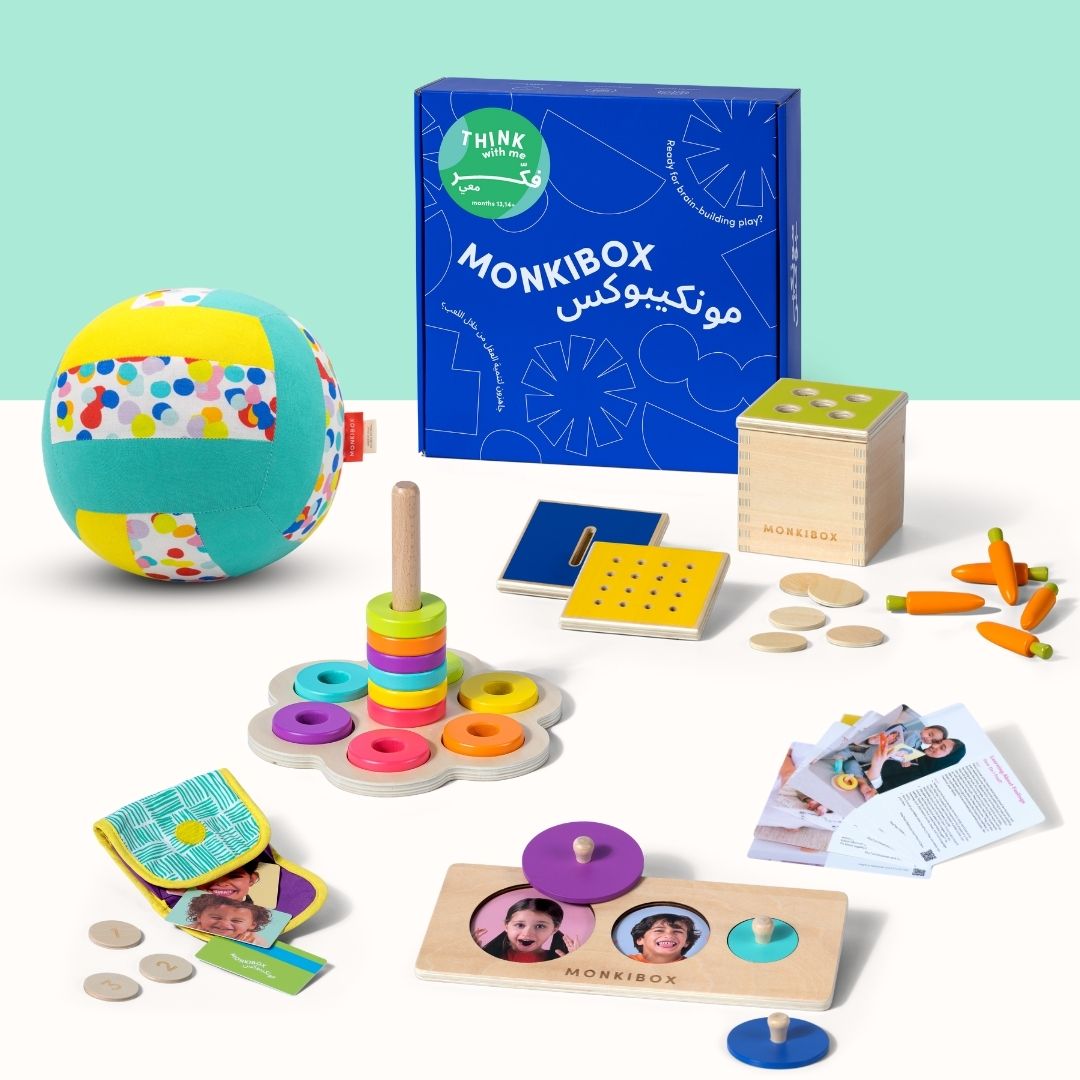
Pick a toy 8
Shop Think With Me →Months 13,14+

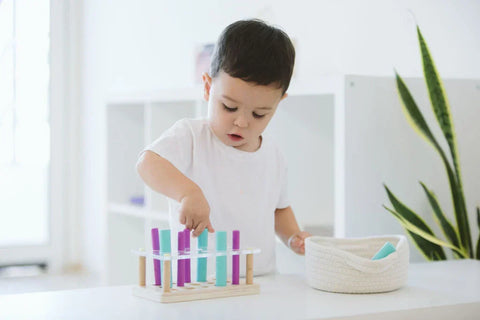
First Wallet, Wooden Coins, and Spending Cards
Developing Language Skills
Why this matters?
You might notice your child is touching things that you might not want them to handle, the remote control, your keys, or even your wallet. This is because toddlers love to mimic what you do and are interested in everyday items. We have created our wallet set to not only support your child’s fine motor skills with our velcro snap, learning opening and closing, and counting numbers, but you can rest assured your own wallet, which can end up being very unsafe, is not being used. They now have their own!
How to use it?
- When your toddler takes out coins and credit cards from their wallet, they are engaging both sides of their brain and honing their fine motor skills. They learn about spatial awareness as they figure out how objects fit inside one another.
- As your toddler's imaginative play develops, they will imitate you and the items you use. So, the next time you go out with your toddler, bring along their wallet during car rides or visits to the grocery store.
- As your child grows older, the wallet will continue to captivate their interest.
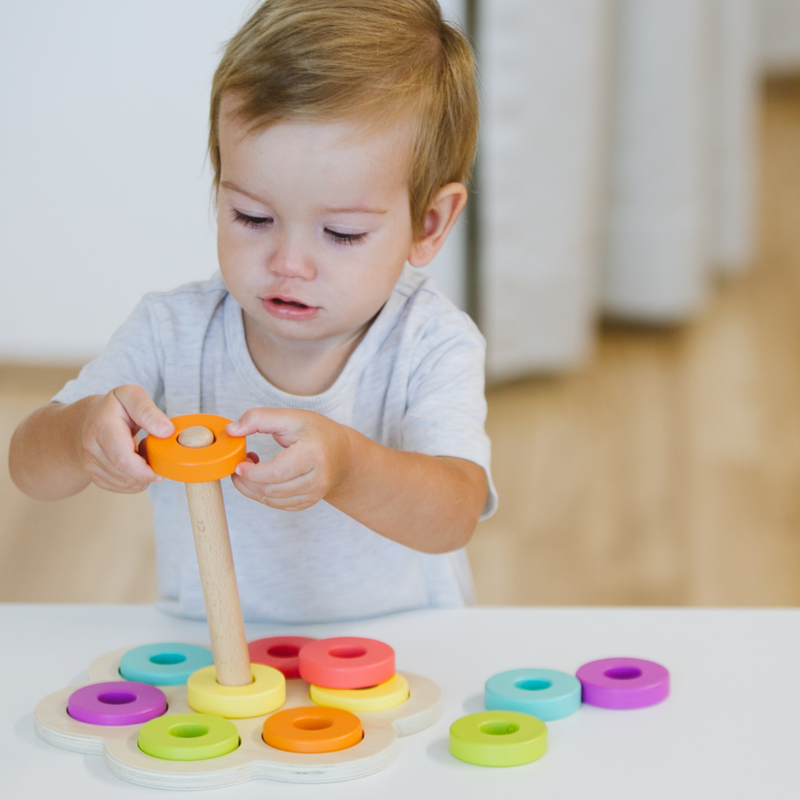
Flexible Stacker
Creating a Whole
Why this matters?
As your toddler grows, they learn to stack rings onto a peg instead of just taking them off. This develops their eye-hand coordination, fine motor skills, problem-solving, and understanding of colors, shapes, sizes. It's like an early introduction to math, geometry, and cause/effect.
How to use it?
- Teach your child to remove and replace one or two rings from the post.
- The initial step involves learning how to take the rings off. With practice, they may develop the ability to put the rings back on the post between 13 and 15 months.
- Threading rings onto the post requires more advanced fine motor skills. Begin with just two or three rings on the post.
- If they struggle, tilt the flexible post towards them, partially remove the ring, and let them place it back over the post and push it in place.
Read more
The Developmental Importance and Stages of Playing With Blocks
Read →
Playing with blocks. What are the benefits for your child?
Read →
Fun Ways to Build Early Math Skills in Your Toddler Through Play
Read →
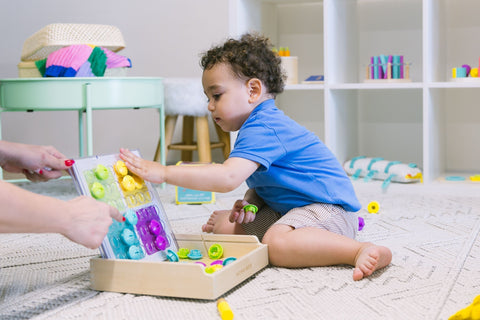 Introducing Math Skills Through Patterns
Read →
Why Babies Love Knocking Things Down (and Why It's Good for Learning)
Read →

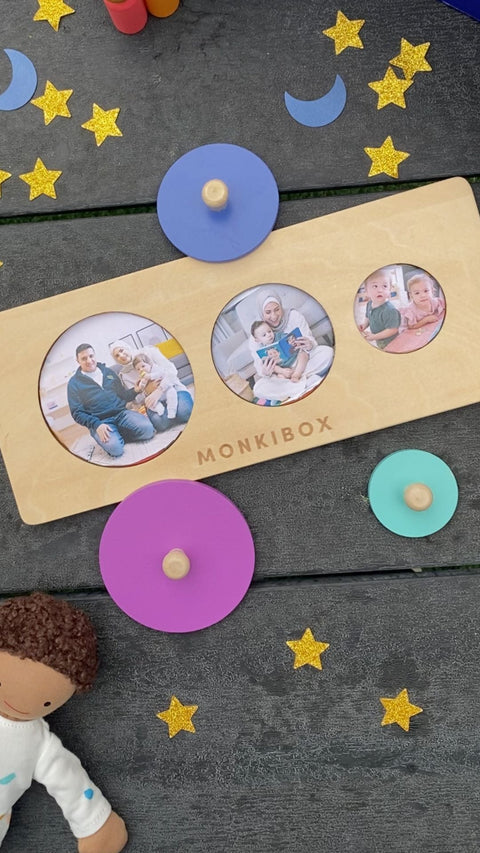
Circle Puzzle
Develop Memory Skills
Why this matters?
Puzzles are a great way to help children improve their spatial skills. Among different shapes, a circle is the easiest shape for children to match because it doesn't have any corners. By starting with a flat circle, children can learn how shapes fit together. This is an important step in solving more complex puzzles later on.
How to use it?
- Allow them plenty of time to independently explore the puzzle pieces.
- Begin by placing all the puzzle pieces on the board and demonstrating how to remove them. At this stage, it is easier for your child to take the pieces out rather than put them in.
- If your child becomes frustrated, try removing the middle three pieces and covering the empty spaces with taped paper. This way, only the largest and smallest circles will be visible.
- For an added touch of excitement, cut out circular pictures of family members and loved ones to personalize your child's puzzle.
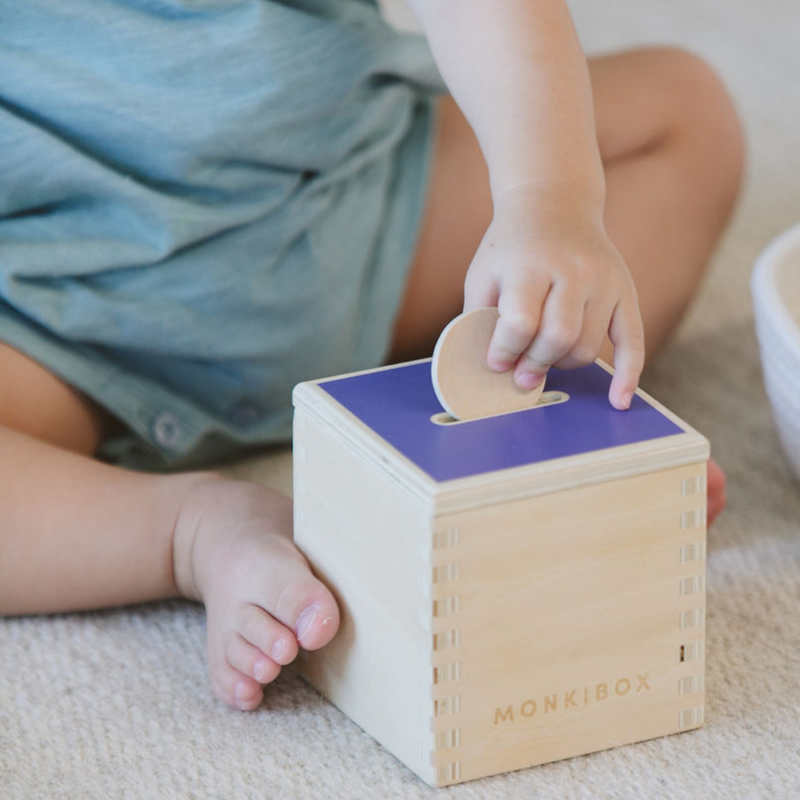
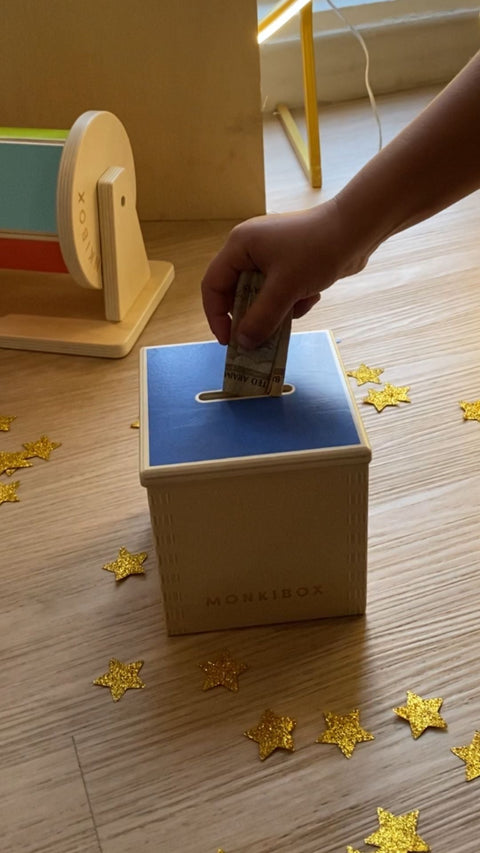
Coin Box with Progression Lids
Little hands, growing problem-solvers.
Why this matters?
Dropping objects into holes and slots helps your toddler develop hand-eye coordination, spatial awareness, and fine motor skills. As they figure out how to turn, position, and fit each piece, they're learning to problem-solve and understand how objects relate to one another. Each interchangeable lid introduces a new challenge, allowing their skills and confidence to grow through play.
How to use it?
- Start with the peg lid: Show your toddler how to place a peg into one of the holes. Encourage them to try, giving them time to find the right position.
- Push and discover: Once they're comfortable placing the pegs, encourage them to push each one through and watch it disappear into the box.
- Introduce the coin slot: Swap to the coin lid and demonstrate how to turn and position a coin to fit through the slot. Let your toddler experiment with different angles.
- Try the next challenge: Introduce the final lid and encourage your toddler to push the matching pieces through the openings.
- Explore freely: Let your toddler experiment with the different lids and pieces, discovering new ways to fit, drop, and retrieve objects.
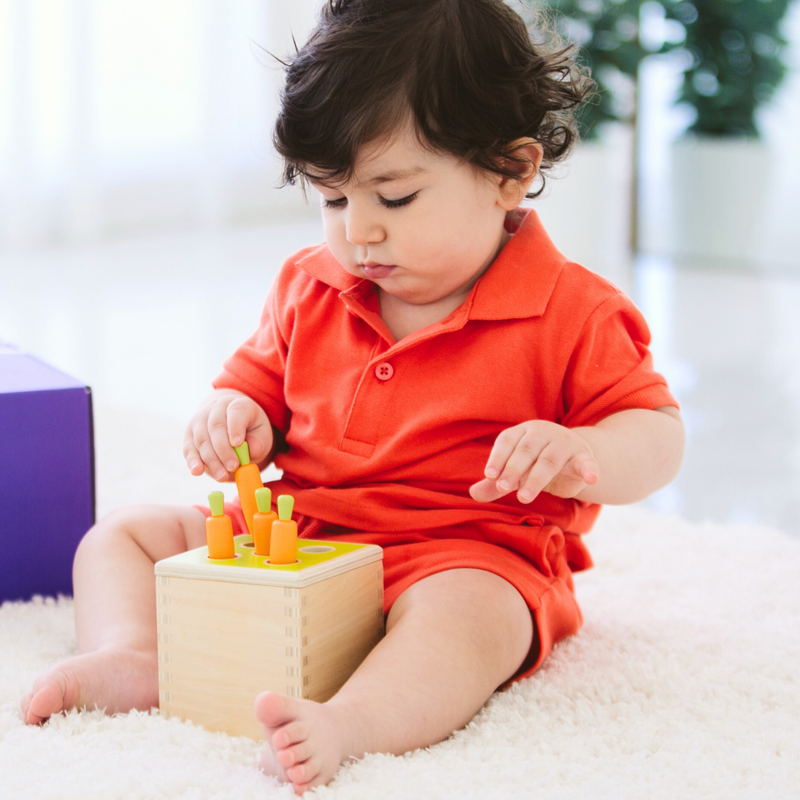
Carrot Lid with Carrots for Coin Box
Carrot Adventures: Plant, Post, and Pick
Why this matters?
Posting is the term used when manipulating objects to match their shape and size to corresponding openings. Like the Coin Slot Lid, the Carrot Lid securely fits on top of the Wooden Coin Bank, promoting fine motor skills, visual-spatial practice, and imaginative play.
How to use it?
- Place the lime green Carrot Lid onto the Wooden Coin Box.
- Give your child a single carrot.
- Ask them to fit the carrot into a hole on the lid.
- Help them push it if needed to make it fit snugly or go all the way through.
- If your child gets frustrated, offer help and support.
- This lid offers pretend play opportunities: fit the carrots so they don't go all the way through to create a carrot garden ready for harvest.
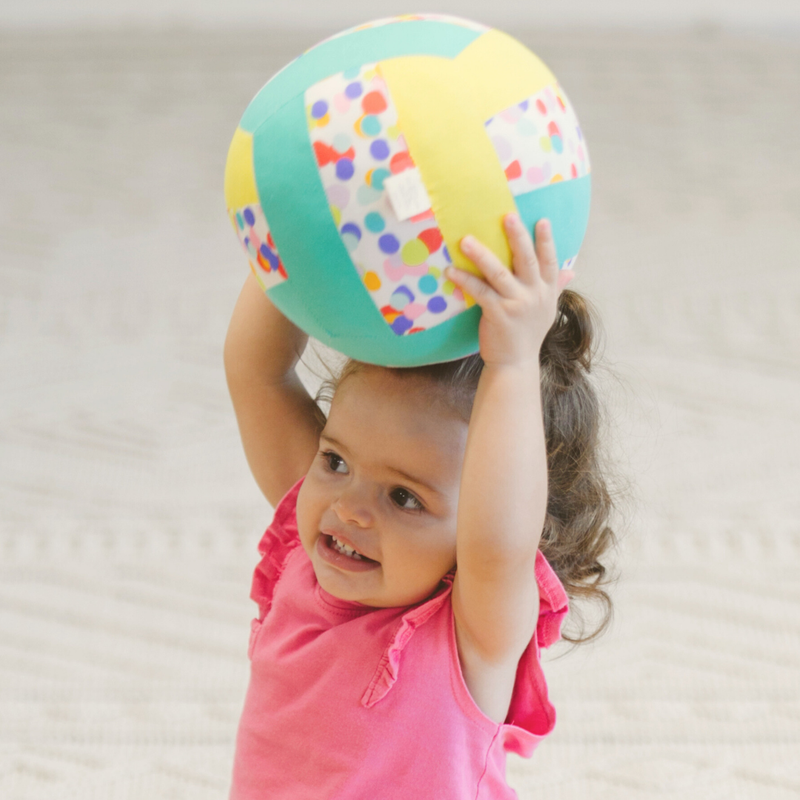
Big Kid Soft Ball
Throw it and kick it
Why this matters?
Toddlers are like little scientists, constantly testing hypotheses to understand how their world works. As early as 12 months, you'll observe them dropping or throwing objects to explore their surroundings and observe the outcomes. By 14 months, they can throw objects overhand and at least 3 feet in the air. As they reach their second birthday, they can balance and walk to kick a ball by 18 months.
How to use it?
- When your toddler throws their toys, encourage them to throw their soft ball.
- Play a game where you throw the ball to them and have them throw it back to you.
- Encourage them to kick the ball to you with each foot.
- Get a basket and show your toddler how to throw the ball into the basket. Have your toddler practice throwing the ball into the basket.
Read more
 Why Toddlers Throw Things (and How to Teach Them to Do It Safely)
Read →
Teaching Toddlers About Gravity Through Play: Fun and Simple Activities
Read →
 Benefits of Setting Up an Obstacle Course and How to Do It
Read →
 Why Your Toddler's Destructive Play Is Normal (and When to Step In)
Read →
Understanding Play Schemas: How Repetitive Movement Builds Your Baby’s Brain
Read →

Posting Lid for Coin Box
Target & Push
Why this matters?
Introducing the yellow-colored lid, specially designed for smaller and more precise fine-motor posting. With the Posting Lid in place, your child will have to navigate the task of working with small objects such as Q-Tips. They will need to skillfully fit these objects into the small openings and exert extra effort to push them through, making them drop into the box. This challenge enhances their fine-motor skills while providing an engaging and rewarding experience.
How to use it?
- Fit the yellow-colored Posting Lid onto the Wooden Coin Box.
- Offer your child a single Q-Tip.
- Show them how to press firmly onto the end of the Q-Tip until it disappears into the box.
- Encourage your child to try posting multiple Q-Tips at the same time.
- Explore other items that can be pushed through - craft pipe cleaners!
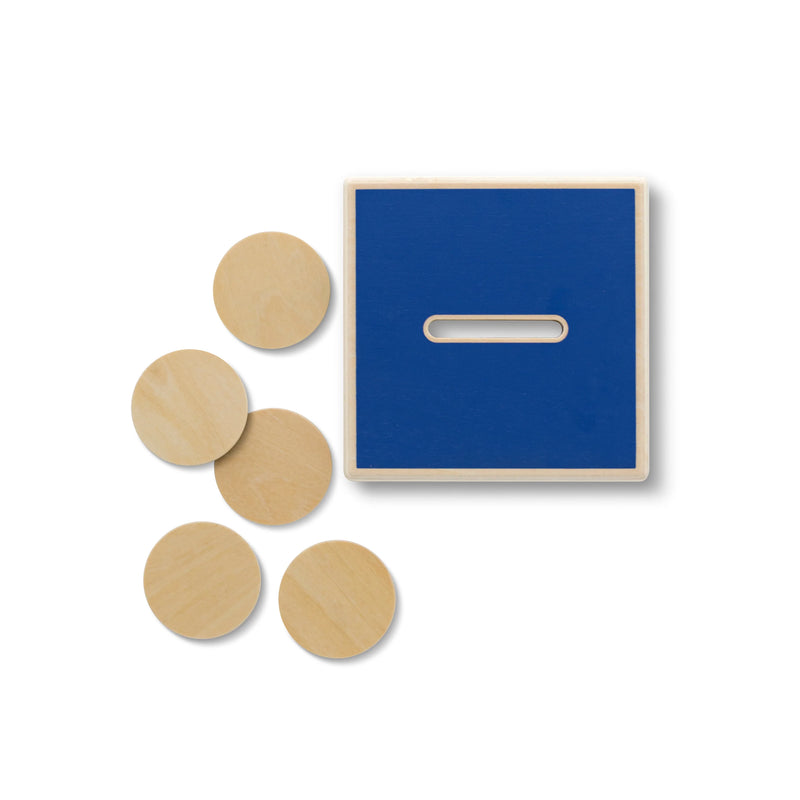
Coin Lids & Coins for Coin Box
Coin Lid & Coins
Why this matters?
Coin manipulation is a great way to improve fine-motor skills and problem-solving. As your child plays with coins, they are presented with a 3D puzzle. Over time, they learn that rotating objects affects their alignment. This activity fosters problem-solving and spatial awareness. With practice, your child will become better at manipulating objects. Coin manipulation is an engaging experience that promotes development.
How to use it?
- Begin by attaching the dark blue Coin Slot Lid to the Wooden Coin Box.
- Initially, give your child a single coin and encourage them to insert it into the slot. Once they have successfully done so, offer them additional coins to continue working with.
- Explore the sound of the coin box by shaking it gently. Ask your child to listen carefully!
- Show how to remove the lid from the box, showing your child how to open and close it.
Pick a toy 5
Shop Inspect With Me →Months 15,16+
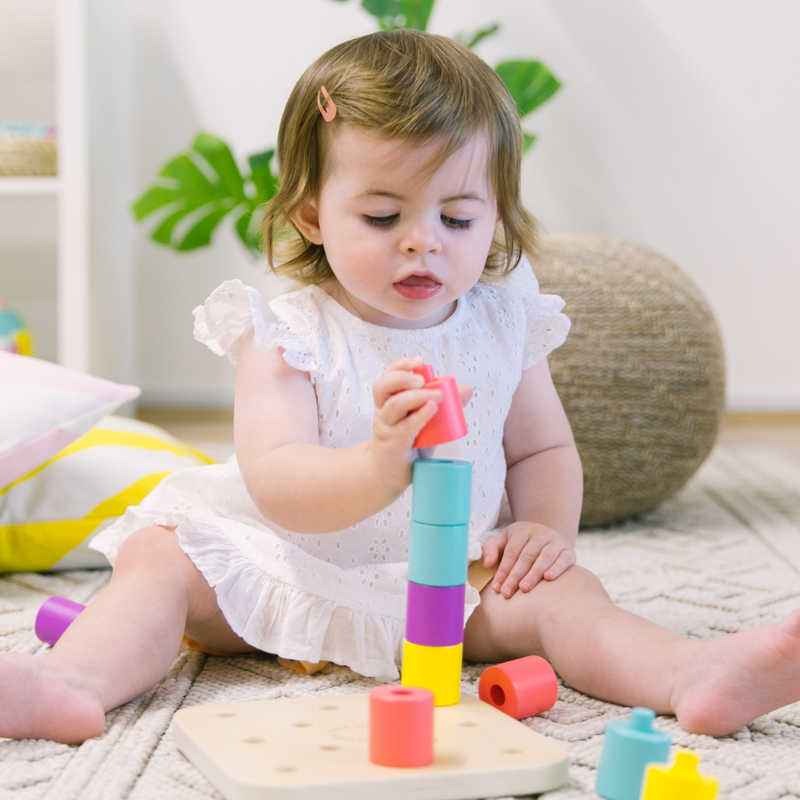
Peg Board
Grouping Objects Together
Why this matters?
“Subitizing” is the ability to mentally represent an amount without counting. Before toddlers can verbally count, they naturally grasp the concept of quantity through subitizing. For example, they understand that combining one object with another gives them a total of two objects, and removing one object from a group of two leaves them with one.
How to use it?
- While your toddler engages in stacking and removing pegs, use simple language to discuss the quantity. For example, you can say, "You have more pegs than me", “You have all the pegs off/on the board“
- Let them hear you say the numbers aloud and show them how to count using their fingers or objects.
- Show your toddler how to group the pegs based on colors.
- Your toddler is starting to understand more and more what colors are, and it is common for them to make mistakes and say the wrong color.
Read more
Introducing Math Skills Through Patterns
Read →
Why Is Categorizing and Sorting Important?
Read →
Fun Ways to Build Early Math Skills in Your Toddler Through Play
Read →
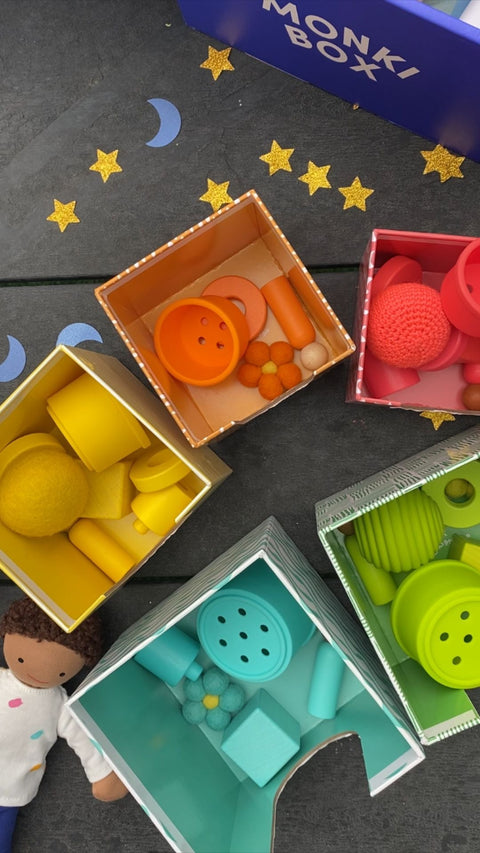 Color Sorting Activity
Read →
Understanding Placement Play Schemas: How Your Baby Learns Through Organizing, Wrapping & Arranging
Read →

Shapes Puzzle
Fitting Shapes Within Each Other
Why this matters?
At around 18 months old, children often find excitement in exploring new shapes in puzzles, such as triangles, squares, and circles. The 3-D puzzle adds an intriguing twist, as they get to match smaller shapes inside larger ones and then fit them all into the puzzle base. It's a delightful and engaging way for them to play and learn.
How to use it?
- This puzzle is all about discovering how things fit together. Start simple: give your child the big circle and see if they can put it in the base.
- Next, give them the smaller circle and encourage them to find a place for it.
- After your child successfully fits all the pieces onto the board, you can remove the board and encourage them to play solely with the puzzle shapes.
- This puzzle is quite challenging and it may take your child several months to fully master it.


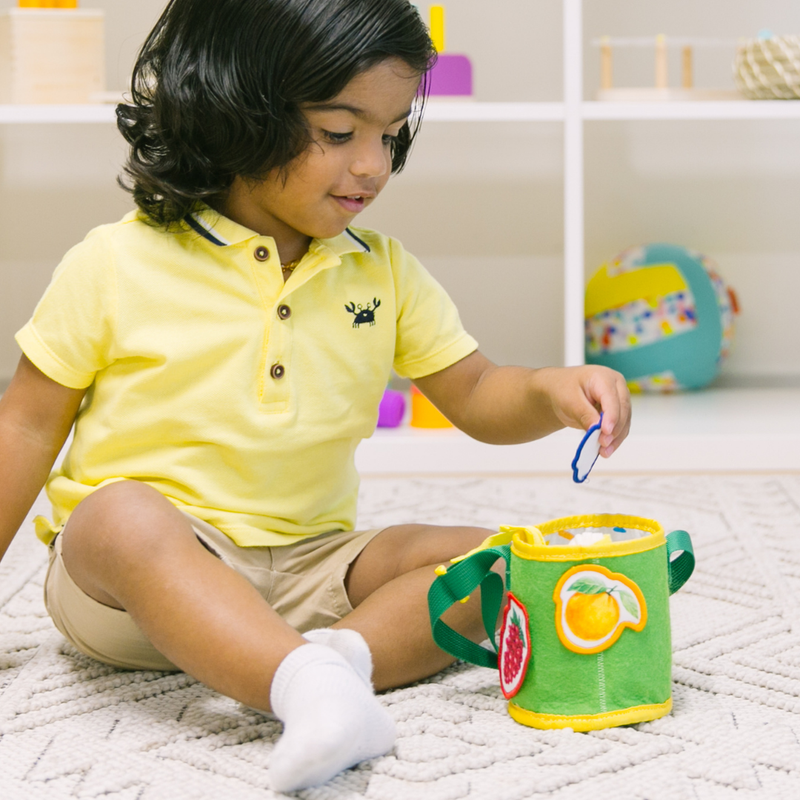
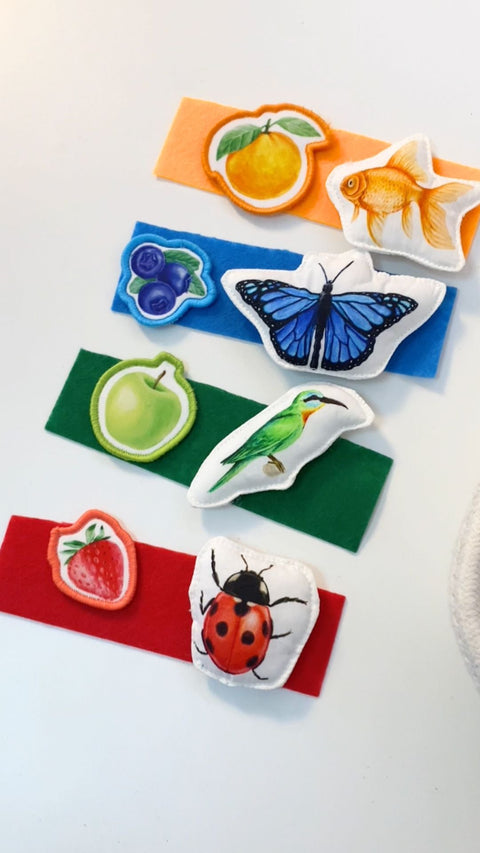
Sticky Felt Fruit Basket
Developing Finger Strength & Agility
Why this matters?
Your baby will enjoy learning to peel and stick the fruits and open and close the basket. These activities are great for developing "bilateral integration," which happens when your child uses both hands to move an object or complete a task. They'll practice using both hands to lift lids and improve their finger skills by taking fruits out of a basket and sticking them back on.
How to use it?
- Show your toddler how to peel the fruits. Your toddler will love putting the fruits in and dumping them back out.
- Name the objects while they peel the fruits; even if they might not be able to say the fruit's name, they are listening and working on repeating what you say.
- Over time, your toddler will work on opening and closing the basket, a useful skill they'll want to master.
- They may also enjoy hiding objects in the basket and carrying them around the house.
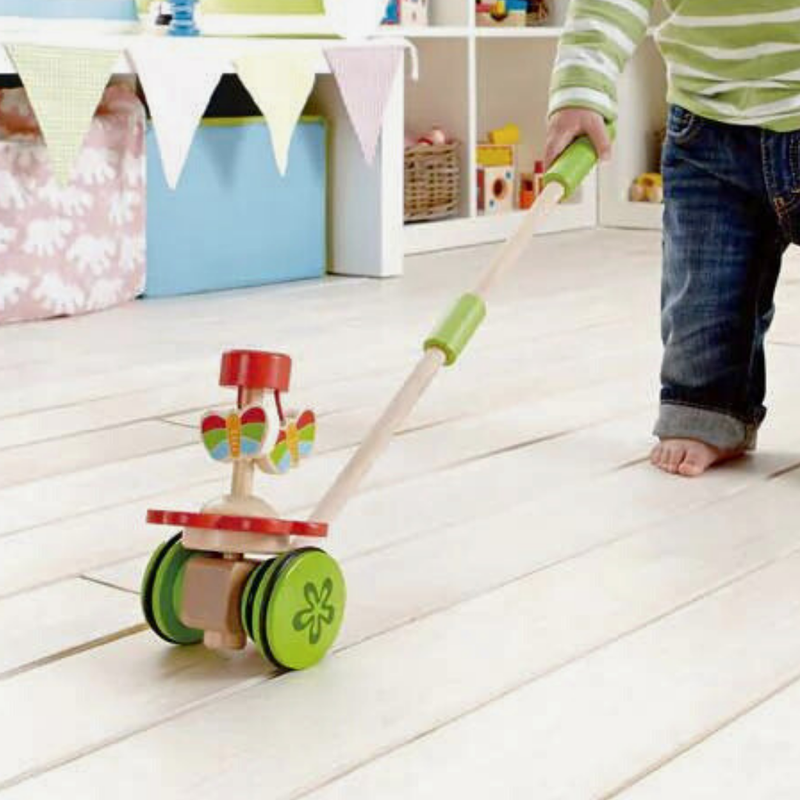
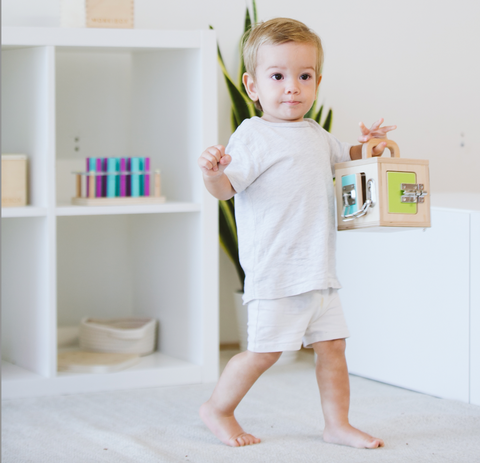
Dancing Butterflies
Practising Walking & Exploring Cause and Effect
Why this matters?
When your toddler pushes the wheels turn and the butterflies move. Seeing the toy respond to their actions encourages them to try again, building an early understanding of cause and effect. As they walk, stop, and change direction, they also practise coordinating their steps and adjusting their balance. You can add simple words like “go,” “stop,” “fast,” and “slow” to connect movement with language.
How to use it?
- Offer the handle to a toddler who is already walking. Give them space to set their own pace; this toy is for play, not for supporting their weight while learning to walk.
- Play “go and stop.” Say “Go!” as they push and “Stop!” when they pause. At first, follow their actions with your words. Later, see if they respond to your cue.
- Try a new route. Once they can push comfortably, invite them to steer around a cushion or walk towards you.
Read more
 How to Help Your Baby Learn to Walk: Tips & Play Ideas
Read →
 How to Support Your Toddler’s First Steps: 6 Fun and Effective Ways to Encourage Walking
Read →
 When Will My Baby Start Walking? Milestones, Tips, and What to Expect
Read →
 How to Help Your Child Learn to Walk
Read →
Play Ideas to Strengthen Your Baby's Leg Muscles for Crawling and Walking
Read →
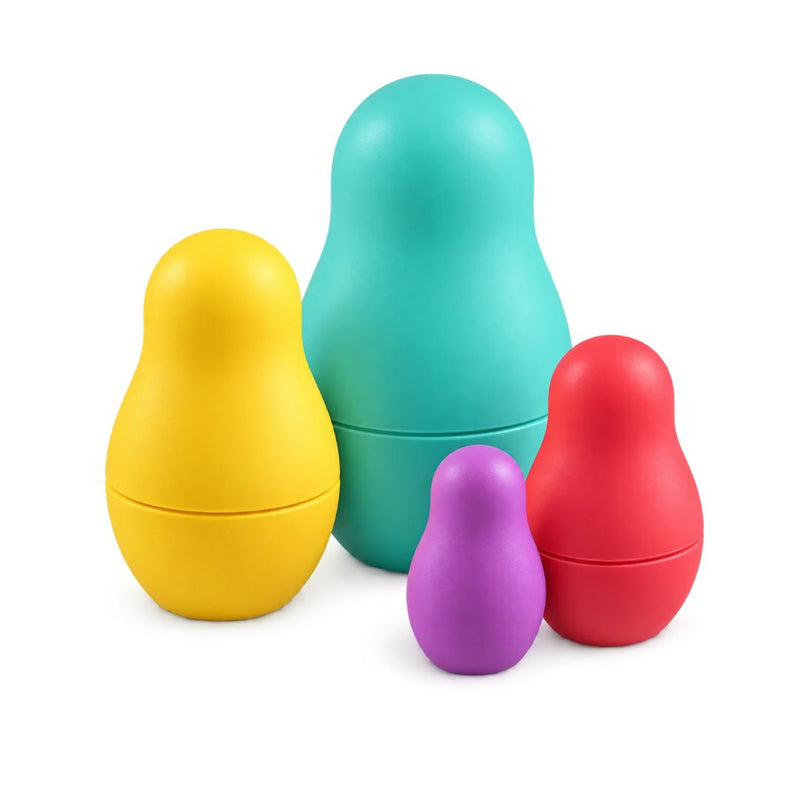
Nesting Friends
Discovering How Sizes Fit Together
Why this matters?
Nesting helps your toddler explore size and space: a smaller doll fits inside a larger one, but the larger one won’t fit inside the smaller one. Opening, placing, and closing the dolls also asks them to use both hands together. At first, they may simply enjoy taking the dolls apart; with practice, they’ll begin trying different combinations to see what fits.
How to use it?
- Start with two dolls. Hide the smaller one inside the larger one and let your toddler open it to find the surprise.
- Offer both pieces and let them try putting the smaller doll back inside. Give them time to turn and adjust it.
- Add another doll when they’re ready. Explore “big,” “small,” “inside,” and “outside” together as they play.
Read more
Container Play for Babies: Benefits, Activities, and Why It Matters
Read →
Understanding Placement Play Schemas: How Your Baby Learns Through Organizing, Wrapping & Arranging
Read →
What Is Object Permanence? How This Brainy Milestone Shapes Your Baby’s Development
Read →
Why Is Categorizing and Sorting Important?
Read →
Pretend Play: Why It Matters and How to Encourage It
Read →
Pick a toy 6
Shop Wonder With Me →Months 17,18+

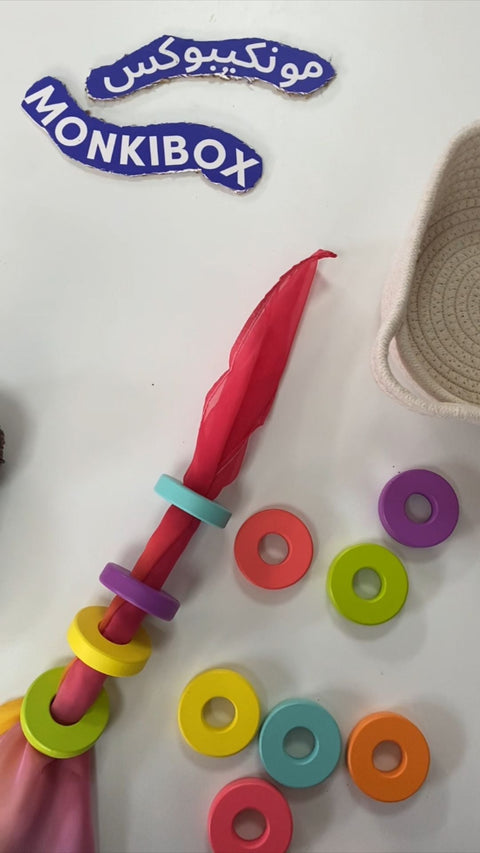
Threadable Beads Set
Using Two Hands Together
Why this matters?
Your baby is discovering how to use both hands together during play, where each hand plays a different role. One hand holds while the other manipulates. This skill development takes time. A task like stringing beads is a complex fine motor skill for many babies. They typically don't master it until they are around 20-23 months old, so giving them plenty of practice is important.
How to use it?
- Initially, your toddler might find using the Threading Bead Set challenging. Begin with the flat, disc-shaped beads, which are simpler to handle.
- After your child masters stringing these discs, introduce the shorter cylindrical beads and then move on to the larger wooden beads.
- This step-by-step approach simplifies the complex task, helping to boost their confidence along the way.
- After playtime, ask your toddler to collect the beads and put them in the bag. This easy task helps your toddler practice using their fingers to pick up beads of different shapes.

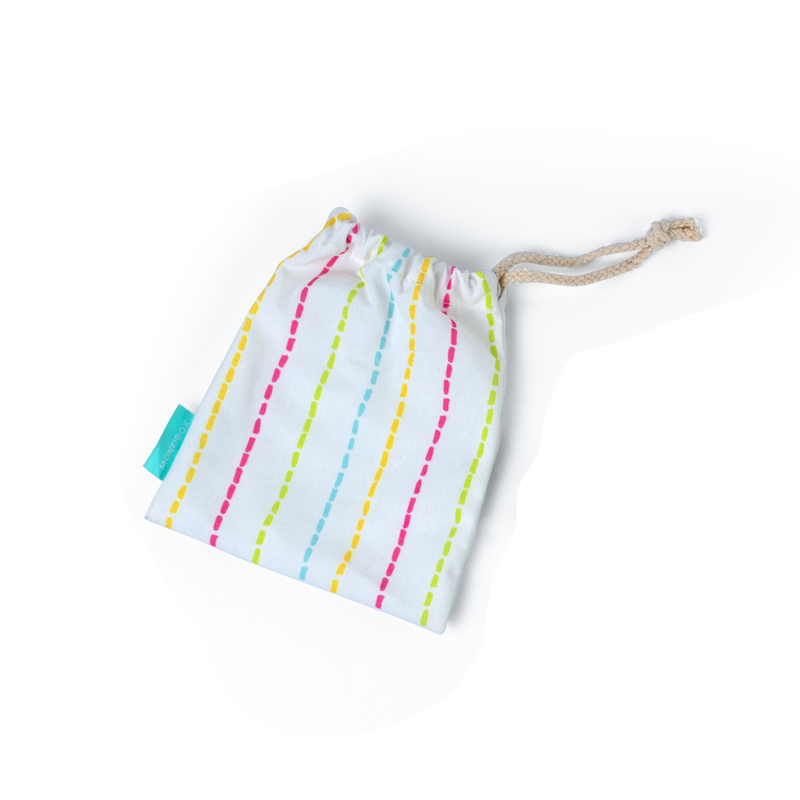
Cotton Storage Pouch
Why this matters?
Keeps toys and tools organized in a durable, easy-to-carry cotton pouch.
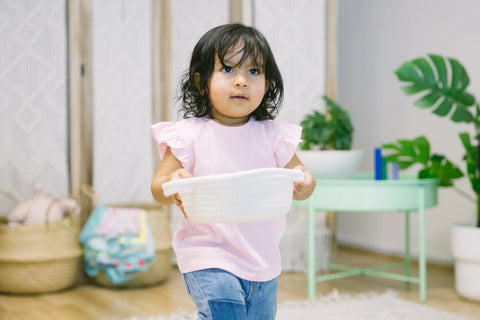
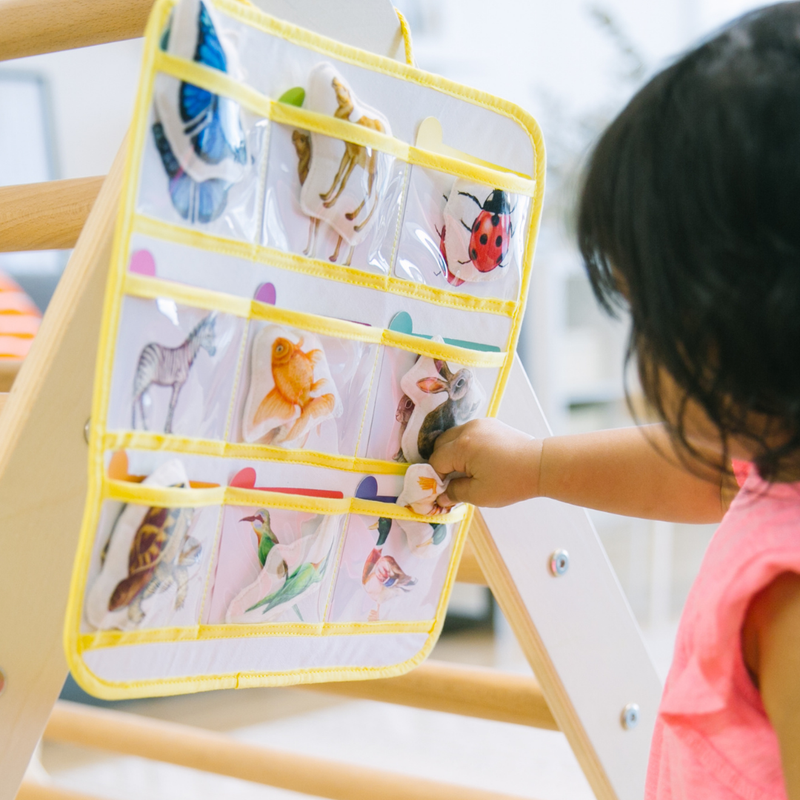
Animal Match Packets
Focus and perseverance
Why this matters?
Your toddler will enjoy placing the quilted animals into the pockets and then taking them out again—a task requiring focus, fine motor skills, and learning persistence. In time, they might start matching the animals with their corresponding image cards, but initially, the simple act of moving them in and out will be entertaining.
How to use it?
- Place the Animal Match Pockets at your child's eye level with the animals sticking out from their matching pockets, encouraging your toddler to pull them out. Soon, they'll also start enjoying putting them back!
- As your child mixes and matches the animals and cards and tries stuffing as many as they can into one pocket, they're learning about space and size in a fun way.
- While playing, talk about the animals and ask about their types and the sounds they make. For more fun, imitate the animals together, bringing the game to an exciting new level!
- This playtool is versatile and grows with your child, as you can use the pockets for various matching games.


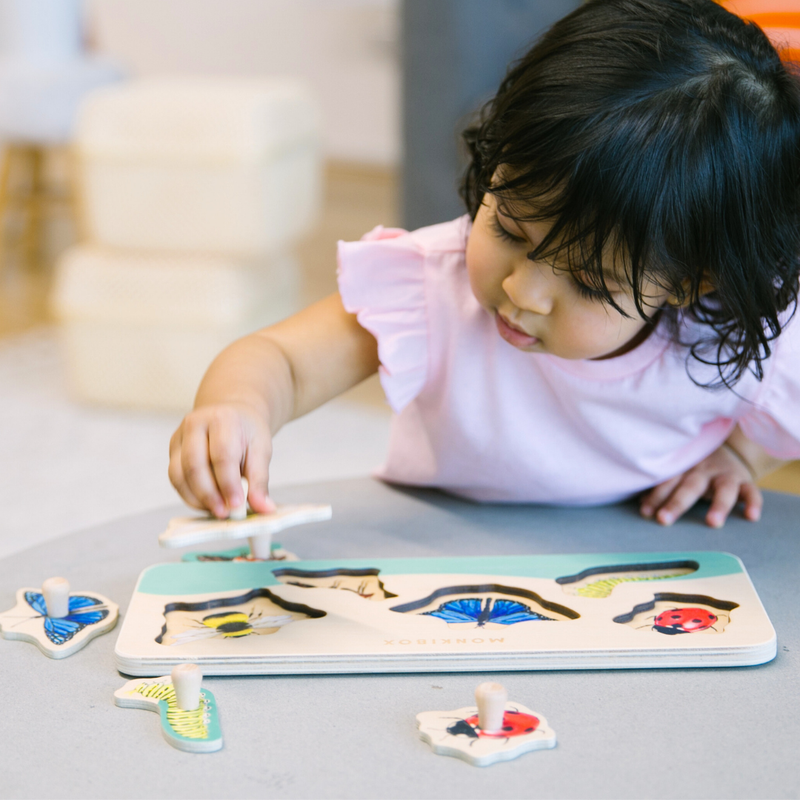
Insect Puzzle
What insects do you see?
Why this matters?
Your toddler will gravitate towards activities that boost their fine motor skills, and the Insect Puzzle is an excellent tool for further refining these skills. With its smaller knobs, it prompts your toddler to use a precise pincer grip with their thumb and index finger. As your toddler's fine motor skills develop, they'll soon be able to engage in various activities, from pulling and pushing to unwrapping, twisting and scribbling.
How to use it?
- Show your toddler how to take puzzle pieces out and put them back.
- It's okay if they're not matching pieces yet. Let them enjoy removing the pieces for now.
- Talk about what you see, like "Look, an ant! Do you see it?" This helps them learn to identify and pick up pieces.
- Give them lots of time to play with the puzzle. You might see them trying to slide and fit pieces in place, which is good practice.
- Later on, they'll learn to pick up pieces using their thumb and index finger, which is a key skill.


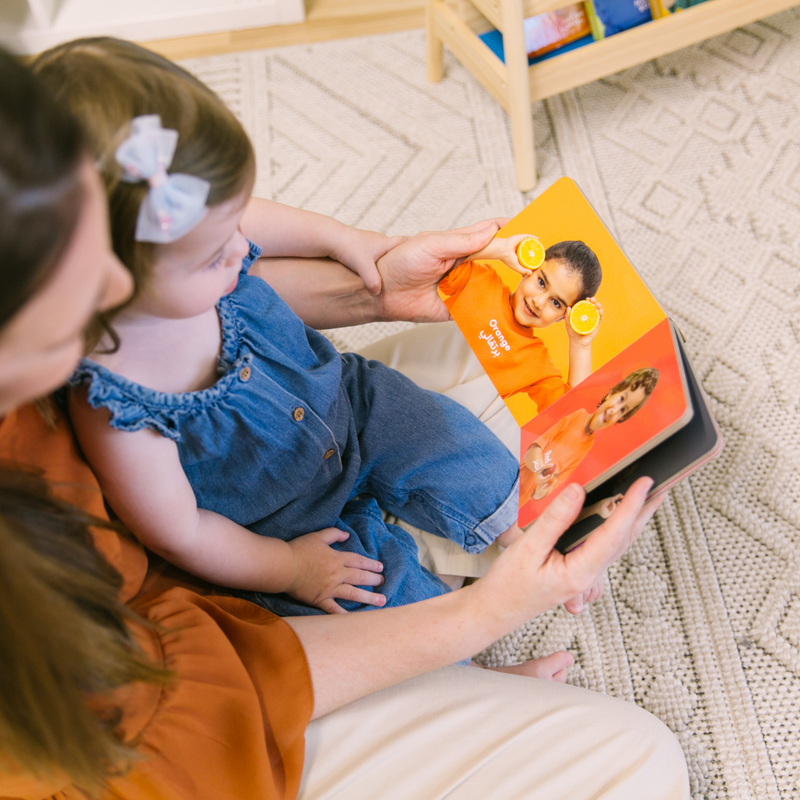
Colors I Eat Book
Why this matters?
Your toddler's brain is making lots of connections every time they learn something new. They are starting to recognize and understand colors by seeing them in different places. Montessori education and brain science both say that playing with real things helps toddlers' brains grow stronger and smarter.
How to use it?
- Say the object's name before its color, like "the ball is green" instead of "look at the green ball."
- This method helps toddlers better understand and identify colors by matching how they process language.
- Use this strategy consistently to help your toddler learn that colors describe objects.
- Based on Stanford University research, this approach is a simple adjustment in how we talk about colors to support toddlers' learning more effectively.
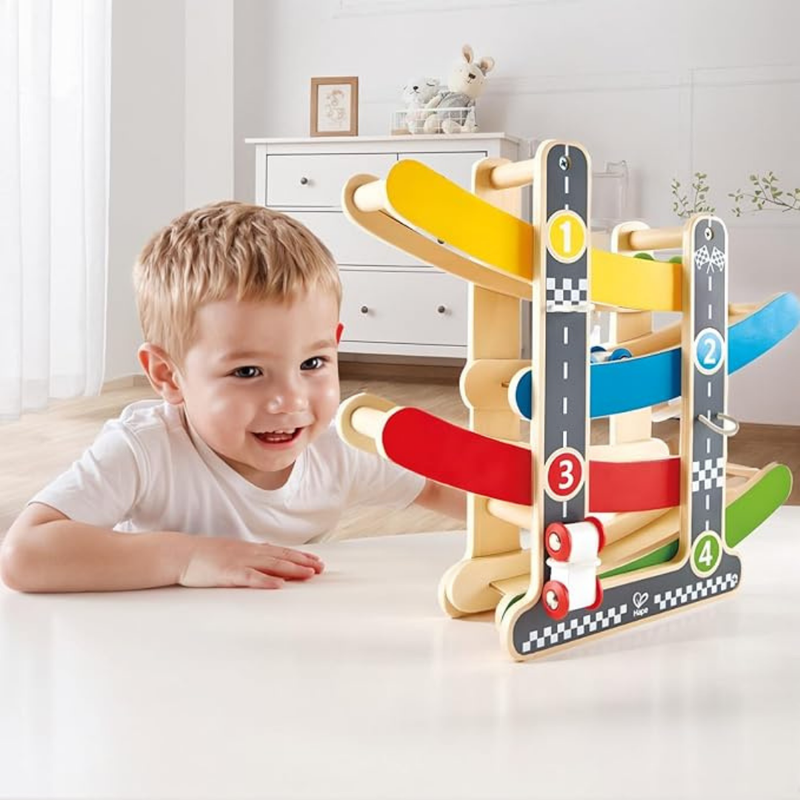
Race Track
Playing with the Forces of Motion and Gravity
Why this matters?
Around 17 months old, your baby begins to understand how things work and that they can use tools to fix problems. They discover cause and effect by watching what happens when they drop rollers onto a ramp. This also helps them with visual tracking, a key skill for toddlers. Skills like speaking, coordinating their hands and eyes, and learning to read all rely on how well they can follow things with their eyes.
How to use it?
- Allowing your child to play with the toy independently is ideal. They can choose to place both cars on the ramp simultaneously or one right after the other!

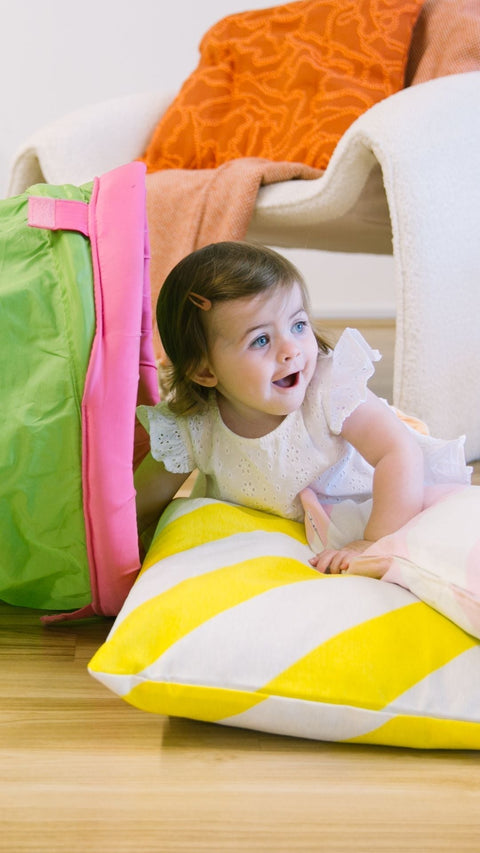
Pick a toy 5
Shop Imagine With Me →Months 19,20+
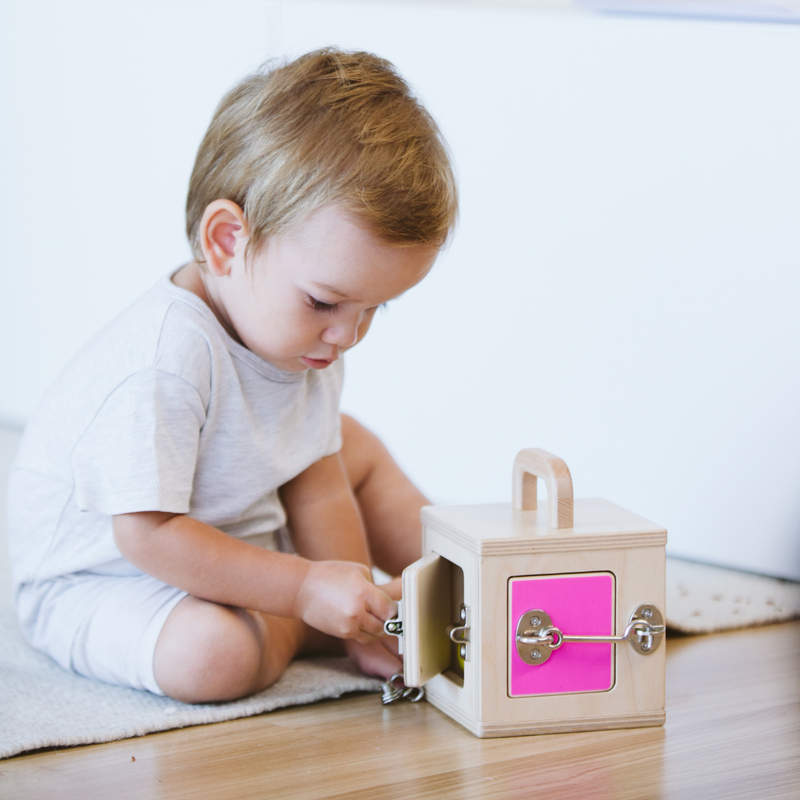
Lock Box
Understanding How Things Work
Why this matters?
Your little one is now getting the hang of how to manipulate things to open or close them. Previously, if he couldn't manage something, he would hand it to you for assistance. Now, he's determined to solve how things work on his own.
How to use it?
- Let your toddler experiment with the lockbox, enjoying the simple action of opening and closing its doors and locks.
- If he finds it difficult to unlock something, guide him through the process slowly. He might need to see it done a few times before he understands.
- Notice if your toddler becomes upset because he can't figure out how to use something. He's eager to do more than his current abilities allow and seeks independence.
- Hide treats or small toys inside for him to find, adding an element of surprise and discovery.
- Use the lockbox for a sensory guessing game: hide items like a small car, pom pom, or ball inside, and let him guess by feeling before revealing the object.
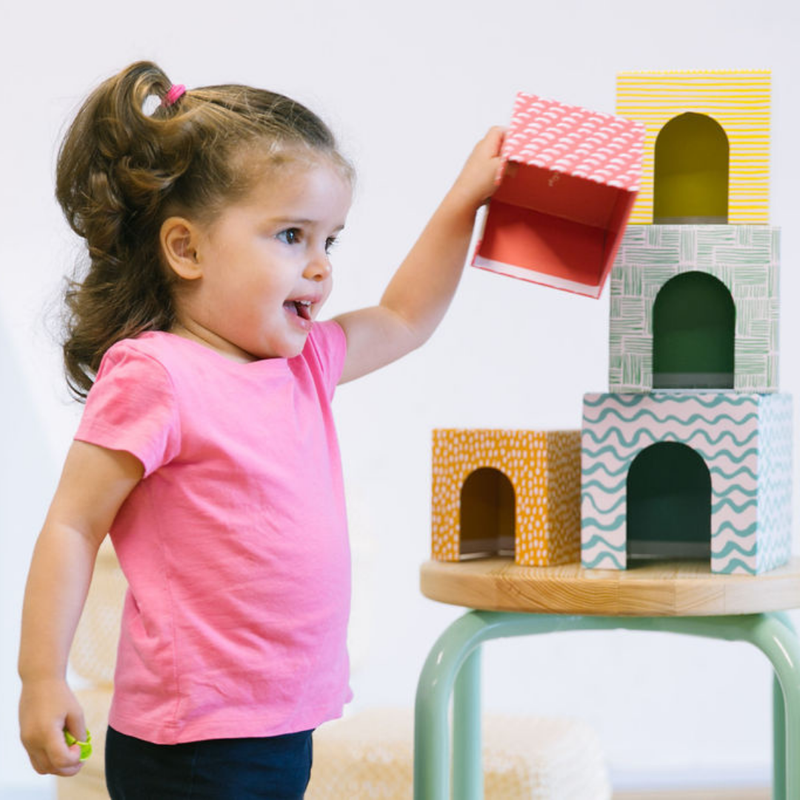
Nest & Stack Houses
Fitting Shapes Within Each Other
Why this matters?
At around 18 months old, stacking and nesting cubes aid in developing their fine motor skills, spatial awareness, and cognitive abilities. Your toddler will learn about size, shape, and order as they figure out how to stack or nest them. They encourage problem-solving and critical thinking, as children must determine how to balance and fit the cubes together. It also supports language development as toddlers love to use them as building blocks for structures in your child’s pretend play.
How to use it?
- Start by letting your child explore the cube houses, looking at their sizes and colours
- Show your child how the cubes can nest inside each other. Start with the largest and work your way down to the smallest, discussing the concept of size and how smaller items fit into larger ones.
- Encourage your child to stack the cubes on top of each other to build a tower. The fun part is knocking it down!
- Show them how to match the colors of the cubes with peg people.
Read more
Understanding Placement Play Schemas: How Your Baby Learns Through Organizing, Wrapping & Arranging
Read →
Playing with blocks. What are the benefits for your child?
Read →
Why Is Categorizing and Sorting Important?
Read →
Color Sorting Activity
Read →
Introducing Math Skills Through Patterns
Read →
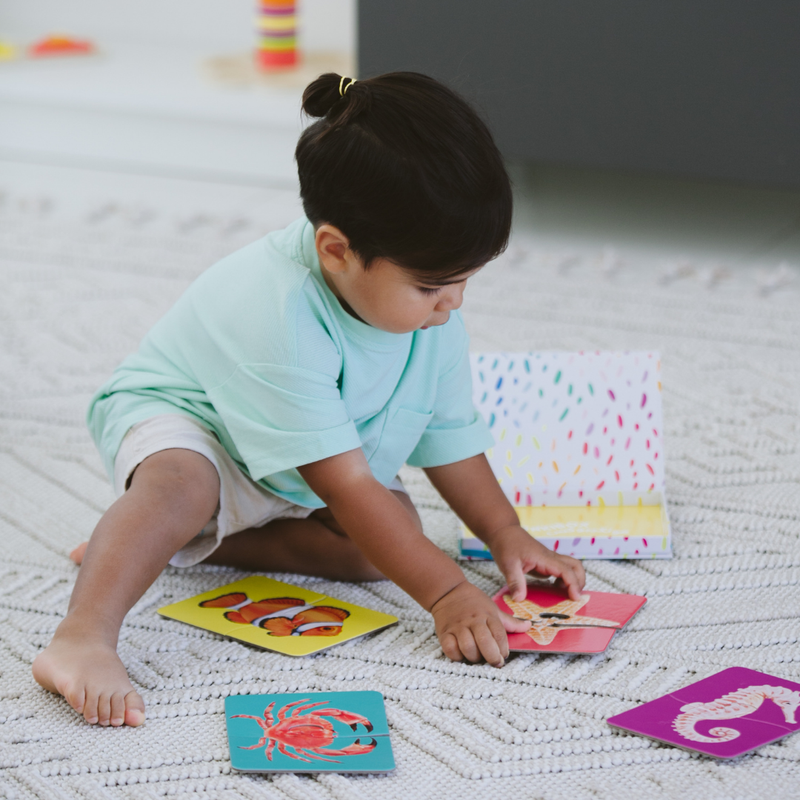
Sea Life Puzzle
Early Puzzle Play
Why this matters?
Your toddler is mastering the art of solving basic puzzles and recognizing when pictures are upright or turned sideways. These initial puzzles mark the beginning of many enjoyable puzzle-solving experiences for your child.
How to use it?
- Begin with a single puzzle, allowing your toddler to understand how its two pieces connect.
- Once he successfully completes the first puzzle, introduce a second one to continue the challenge.
- Discuss how the colors on the puzzle serve as hints for matching the pieces.
- Over time, your toddler will develop the skill to solve all the puzzles when presented with all eight pieces.
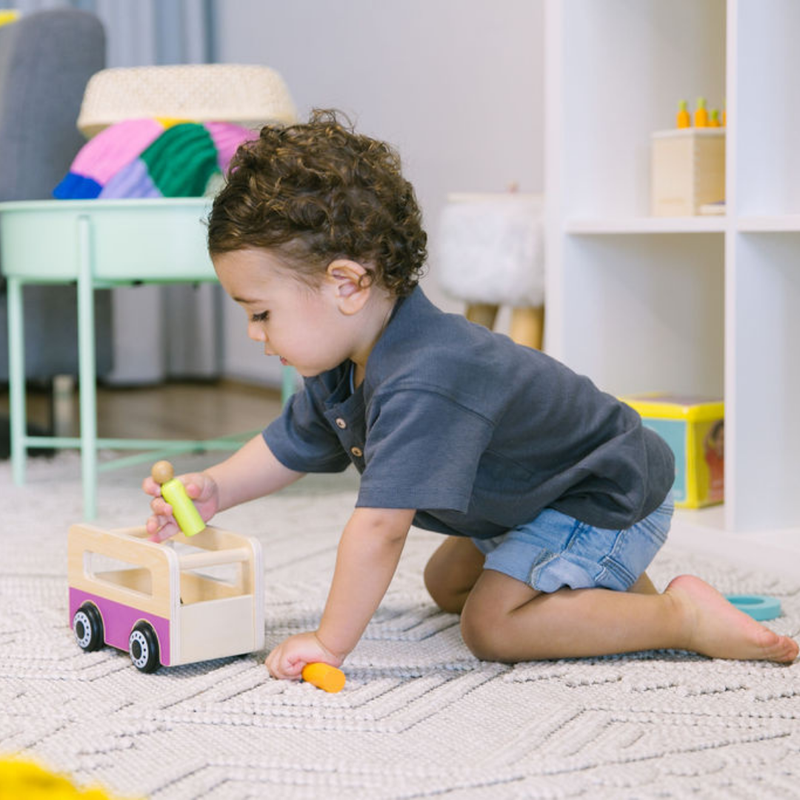
City Bus
Boost Body Awareness
Why this matters?
Around 18 months, children often become interested in moving objects like toy buses or cars, which is more than just play. This activity, known as "heavy work," helps them develop body awareness by interacting with their environment, enhancing their understanding of their physical position and movement through sensory signals sent to the brain.
How to use it?
- Introduce the bus toy to your child, encouraging them to push and hold it.
- Point out and name the colors on the bus, enhancing their color recognition.
- Demonstrate placing a peg person in a hole with the matching color, explaining the match.
- Allow your toddler to try the activity, practicing their color-matching skills.
Read more

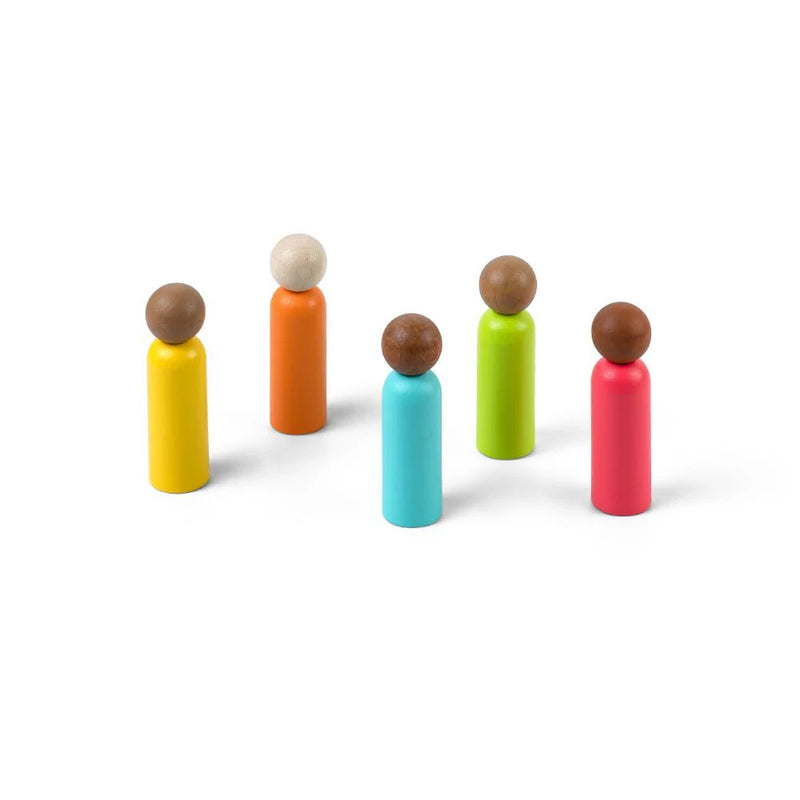
Peg Friends
Practice Pincer Grasp
Why this matters?
During this developmental phase, children enjoy handling small items, making the wooden peg people set ideal for enhancing their pincer grasp. This grasp is essential for future writing tasks. Engaging with the set improves their fine motor skills and hand-eye coordination, preparing them for school.
How to use it?
- Introduce the Waldorf peg people and toy bus to your child for exploration.
- Match peg people with the bus and stacking cubes based on color.
- Encourage your child to stack the cubes and place peg people on or near them.
- Foster color recognition, motor skills, and imaginative play through these activities.
Read more
Pick a toy 6
Shop Move With Me →Months 21,22+
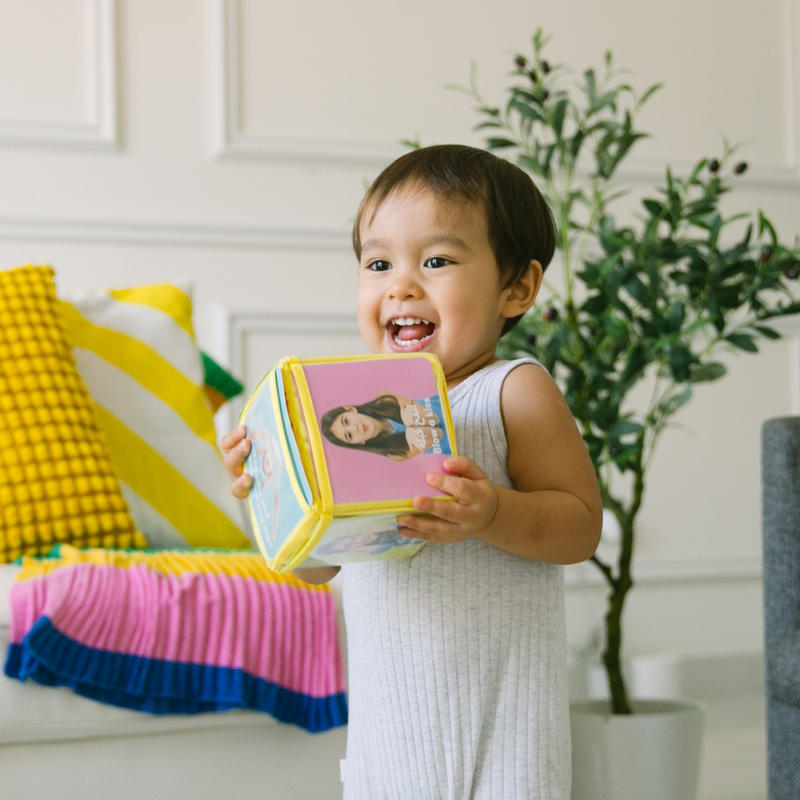
Simon Says Cube
Recognizing & Naming Body Parts
Why this matters?
Your baby is beginning to understand (but not yet say) the names of a few body parts. By around 21 months, they will be able to identify body parts by pointing to or touching the named part.
How to use it?
- Partially insert the card into the die and let your baby push it in or pull it out by themselves.
- To play, have your baby roll the die, then look at the card that lands face-up and read the action or body part name aloud.
- Demonstrate the action and encourage your baby to copy the activity shown in the picture.
- Use everyday moments to point out and name body parts.
Read more
Helping Your Child Understand and Name Body Parts
Read →
 Toddler Yoga: Boost Your Child’s Development with Fun, Mindful Movement
Read →
Benefits of Setting Up an Obstacle Course and How to Do It
Read →
How to Support Your Toddler’s First Steps: 6 Fun and Effective Ways to Encourage Walking
Read →
 Fun and Safe Climbing Activities for Your Toddler
Read →
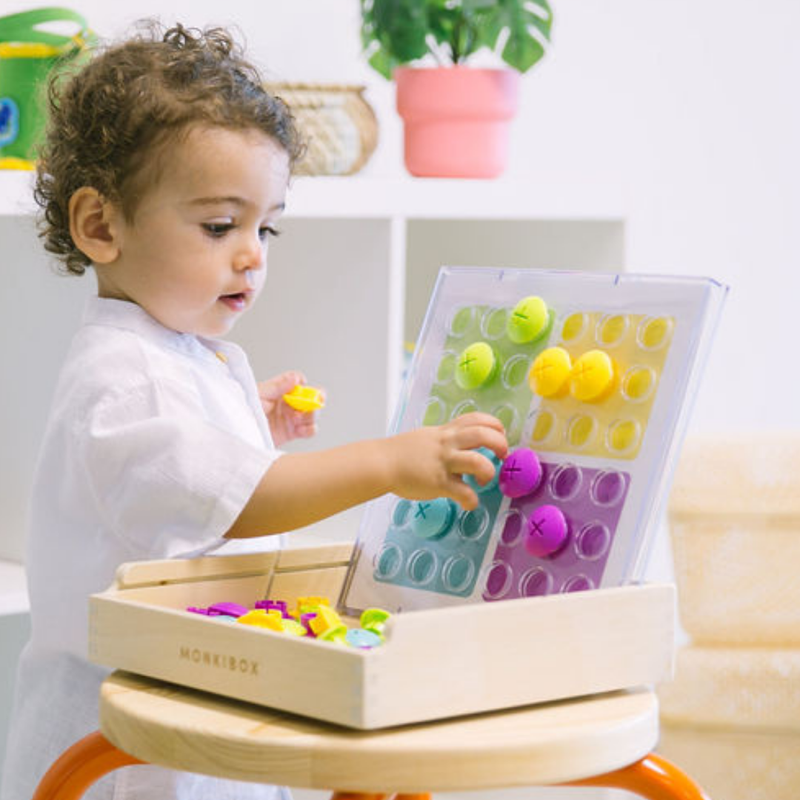
Button Board
Building Fine Motor Strength with Upright Practice
Why this matters?
Many kids are starting school without the hand strength and fine motor skills they need for writing. With electronics replacing traditional toys, toddlers aren't getting the chance to develop their hand and finger dexterity. That's where the Button Board comes in! This simple yet powerful tool strengthens those tiny muscles, setting your child up for future success.
How to use it?
- Encourage your toddler to push the buttons into place, then let them explore removing and replacing them on their own. They might surprise you by figuring it out without any help!
- Use the cards to show how to match the buttons to the colors and patterns, starting with the simpler ones for easier learning.
- Work together to sort the buttons by color, making it a fun and educational activity.
- Practice pouring by putting the buttons in a pitcher and letting your toddler pour them from one cup to another.
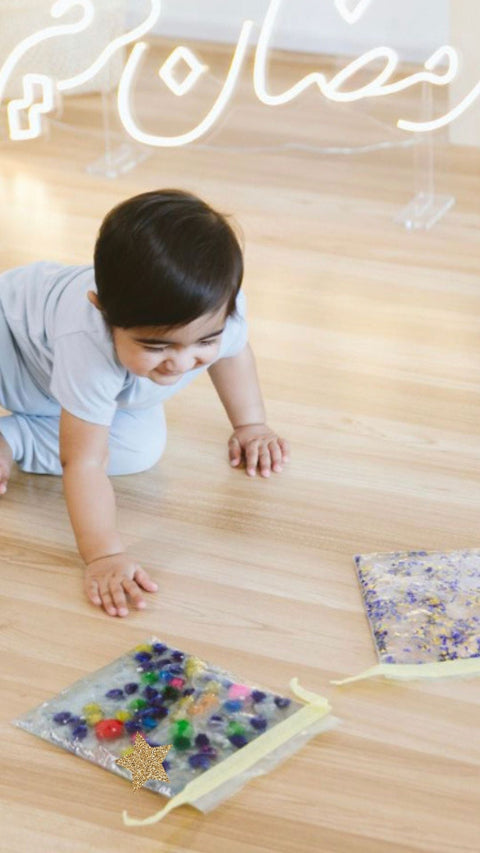
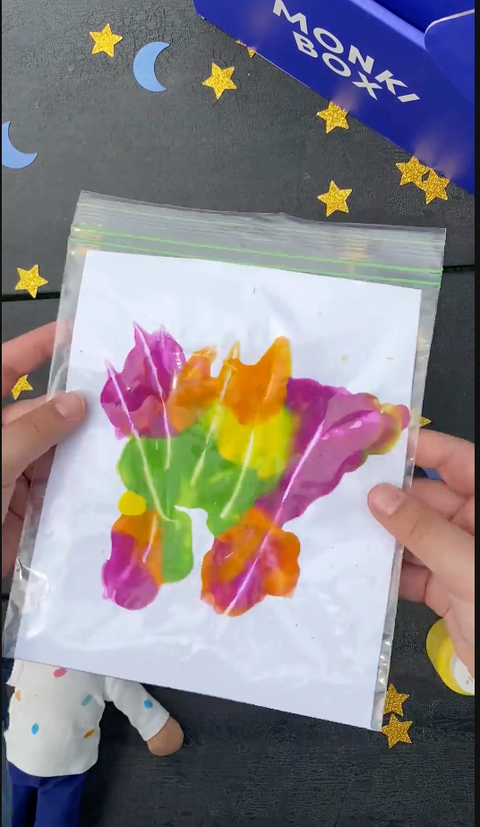
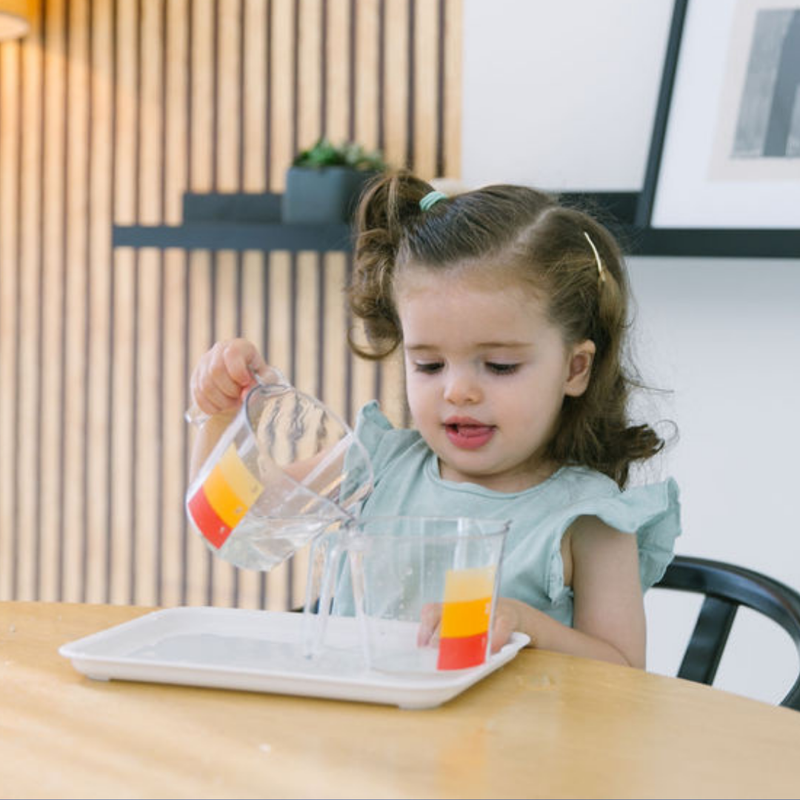
Montessori Pitcher Set
Practicing Hand Control
Why this matters?
It's surprising how much toddlers love pouring, a fundamental activity in Montessori education. Letting them practice pouring (outside the bath to see any spills) aids in developing their hand-eye coordination and self-control, as they learn to stop when the water reaches the rim of the glass.
How to use it?
- Arrange a designated pouring area on a tray.
- Start with dry materials such as rice or lentils, allowing your toddler to practice before moving on to liquids.
- When she's ready, introduce a small amount of water and slowly increase the quantity over time.
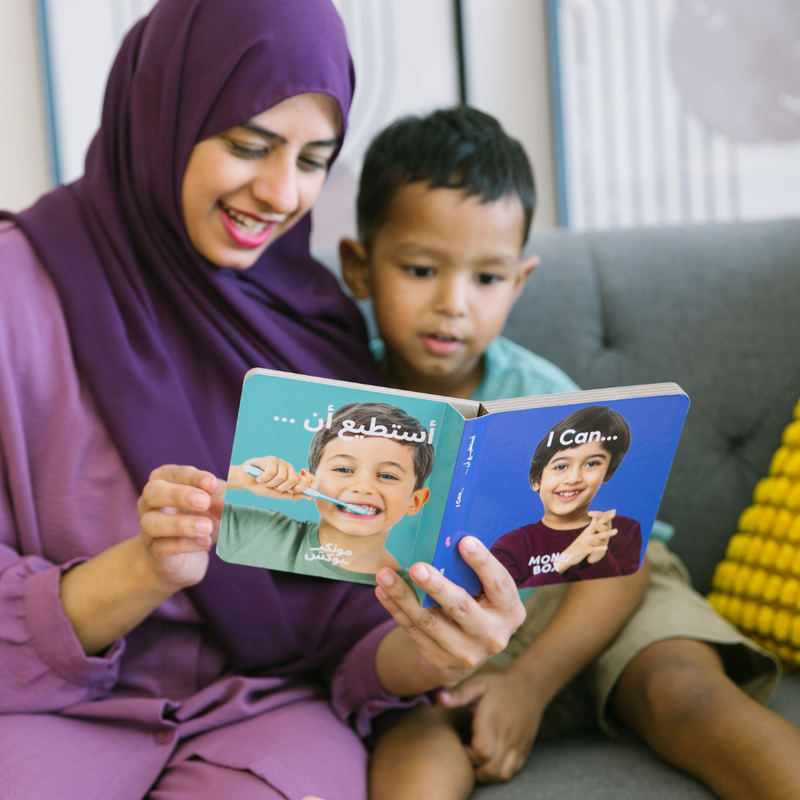
I Can… Book
Growing by Imitating
Why this matters?
Your baby develops by mimicking actions and expressions they observe in others. This includes both visible gestures, like clapping hands, and more complex "invisible gestures," such as sticking out their tongue, which they can't see themselves doing. This process of imitation demonstrates their growing cognitive abilities, as it shows they are not only observing but also understanding and replicating actions
How to use it?
- Point to the pictures and describe the actions as you read. Use expressive gestures and facial expressions to show each action clearly.
- Encourage your child to imitate the actions you demonstrate.
- Repeat the actions regularly to reinforce learning and praise your child when they successfully imitate for positive reinforcement.
Read more
Helping Your Child Understand and Name Body Parts
Read →
How to Encourage Early Reading and Writing Skills Through Play
Read →
Your Baby’s First Library: A Stage-by-Stage Guide to Building a Love for Books
Read →
Signs Your Toddler Is Starting to Talk
Read →
Is Your Toddler Going Through a Language Explosion?
Read →

Fruit Playset
Why this matters?
Enhances fine motor skills, hand-eye coordination, and imaginative play with wooden and velcro cutting mechanisms.
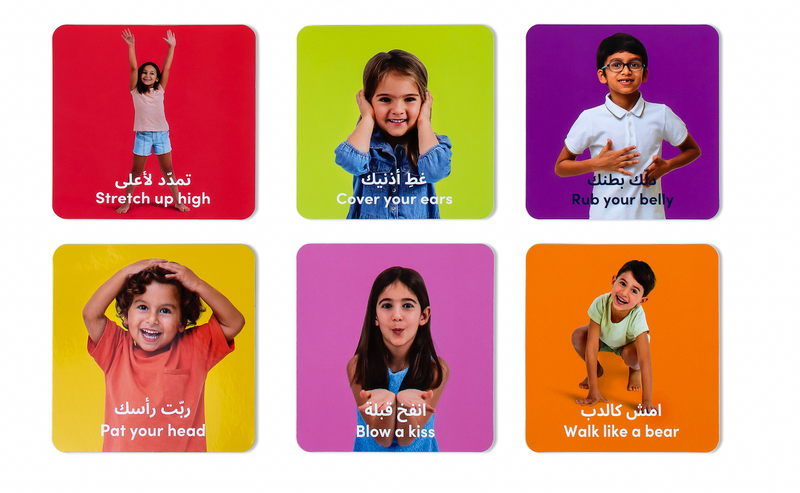
Bilingual Movement Cards
Read more
Toddler Yoga: Boost Your Child’s Development with Fun, Mindful Movement
Read →
Benefits of Setting Up an Obstacle Course and How to Do It
Read →
How to Support Your Toddler’s First Steps: 6 Fun and Effective Ways to Encourage Walking
Read →
Fun and Safe Climbing Activities for Your Toddler
Read →
How to Help Your Baby Learn to Walk: Tips & Play Ideas
Read →
Pick a toy 5
Shop Solve With Me →Months 23,24+
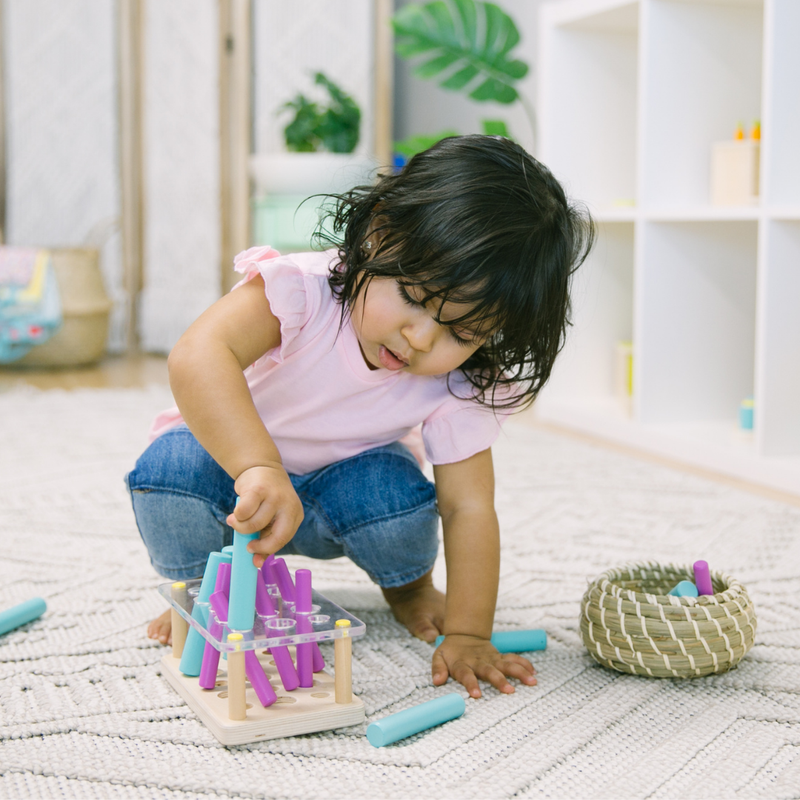
Depth Perception Board
Exploring Depth & Dimensions
Why this matters?
This posting stand is more challenging than it looks. Your child needs to figure out which peg goes into which hole, and then slide it in. It's a great way to improve their hand-eye coordination and problem-solving skills, all while having fun!
How to use it?
- Show your child the two different pegs and the openings on the stand. Explain that each peg fits into a specific hole.
- Encourage them to try to fit the thin peg into one of the holes. Hand them a thin peg first, allowing an easier start, as it fits into any hole.
- After they succeed with the thin peg, hand them a thicker peg. This introduces a slightly more difficult task, requiring them to match the peg to a hole of the corresponding size.
- Encourage them to match each peg to the right hole and slide it into the base. It's like a puzzle!
- Once done, have them dump it out and repeat! This repetition is fun and reinforces their learning and skill development.
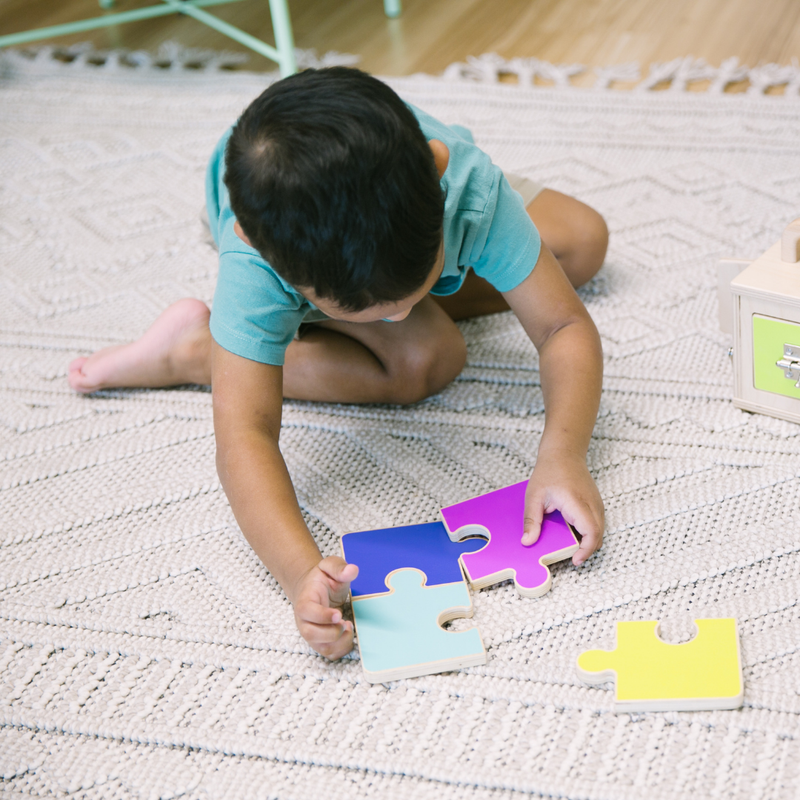
First Jigsaw Puzzle
Practice Spatial Connections
Why this matters?
Playing with puzzles early on can predict how good preschoolers will be with spatial tasks. By the close of their second year, your toddler is starting to understand how to assemble three-dimensional objects.
How to use it?
- Teach him how to separate the puzzle pieces and then put them back together.
- Give him lots of time to play with and explore the pieces.
- It's okay if your toddler puts the puzzle pieces together in a way that doesn't form a square.
- He'll be proud of completing the puzzle in any way, so be sure to appreciate his effort and perseverance.
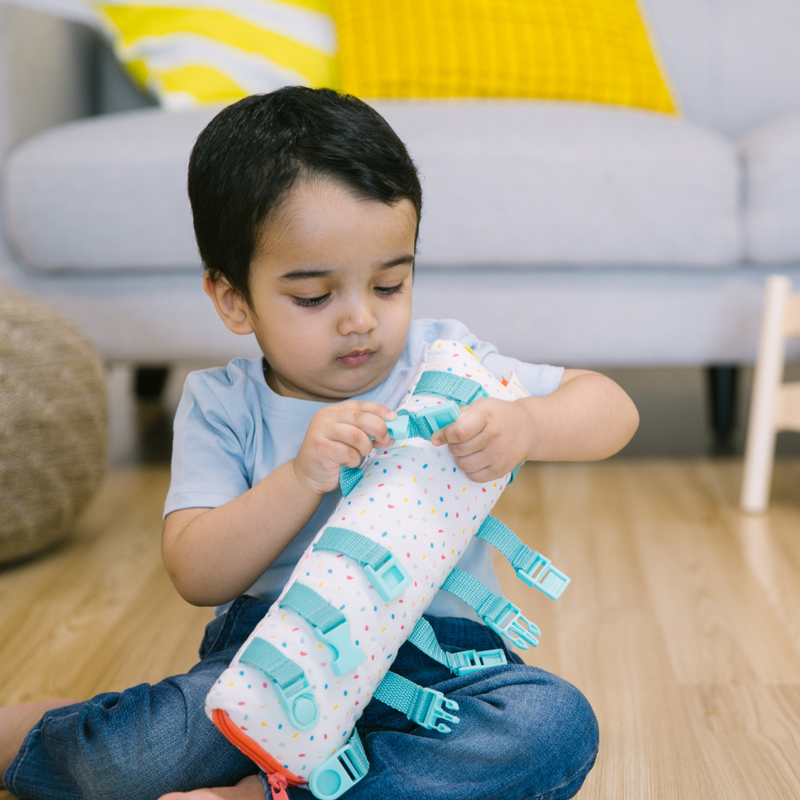
The Buckle Bolster
Practice Bilateral Coordination
Why this matters?
Toddlers love the challenge of buckling things. Mastering the use of buttons, snaps, zippers, and buckles engages them and sharpens their fine motor skills. The Buckle Bolster enhances bilateral coordination, enabling your toddler to use both hands effectively. It also improves hand-eye coordination, boosts finger agility, and develops their ability to grasp objects accurately, all through engaging and playful interactions.
How to use it?
- Begin by opening all the buckles and demonstrating how they click back together to your toddler.
- Encourage her to fasten the buckles on her own.
- Allow her to play with the toy on her terms.
- As her finger dexterity and fine motor skills improve, she'll gradually learn to unbuckle them herself. This process takes time, and some buckles might be simpler than others. It's common for many two-year-olds to find still this challenging.
Read more
Fun and Safe Climbing Activities for Your Toddler
Read →
Toddler Yoga: Boost Your Child’s Development with Fun, Mindful Movement
Read →
How to Support Your Toddler’s First Steps: 6 Fun and Effective Ways to Encourage Walking
Read →
 Montessori Practical Life Skills
Read →
Benefits of Setting Up an Obstacle Course and How to Do It
Read →
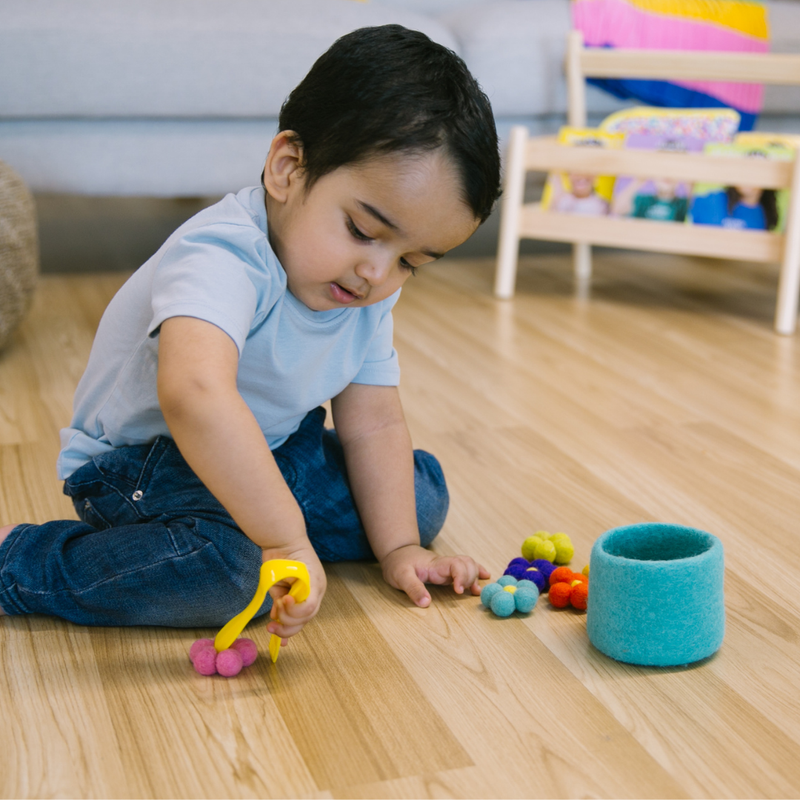
Transfer Tweezers & Felt Flowers
Why this matters?
Refines fine motor skills by practising the pincer grasp to pick up and transfer felt flowers.
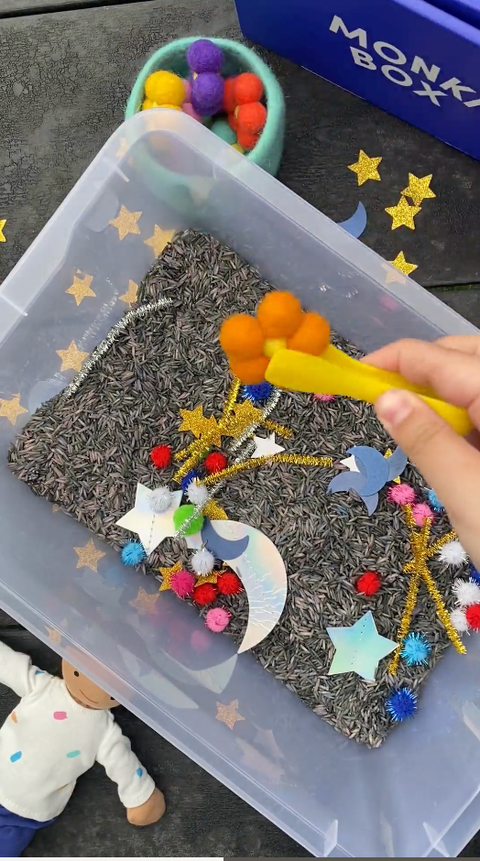
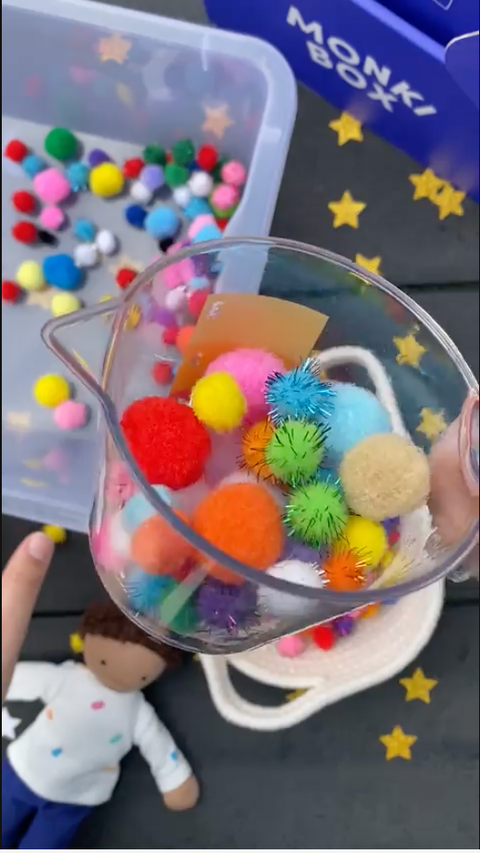
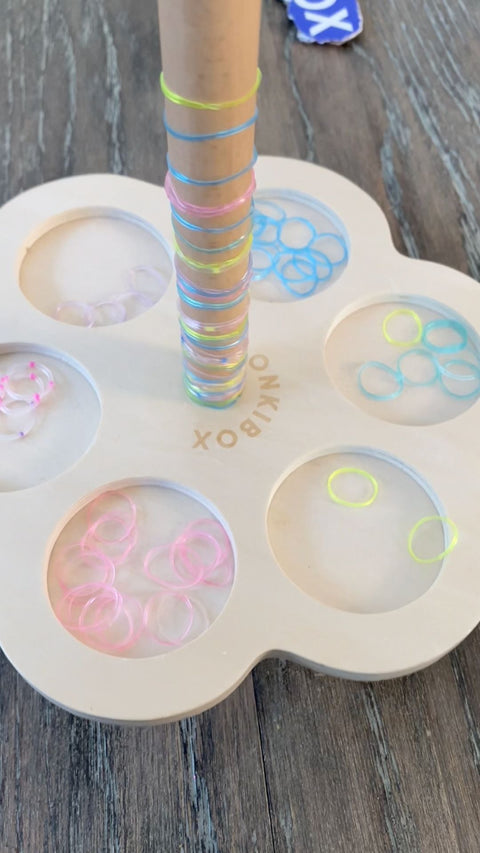
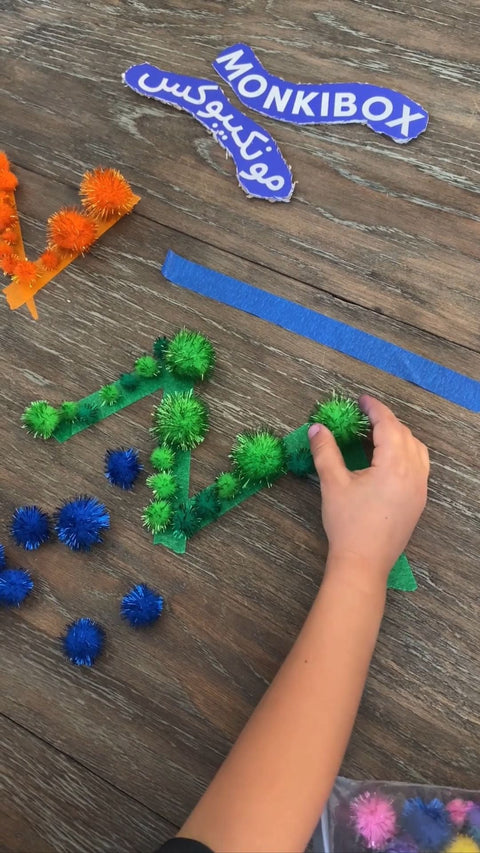
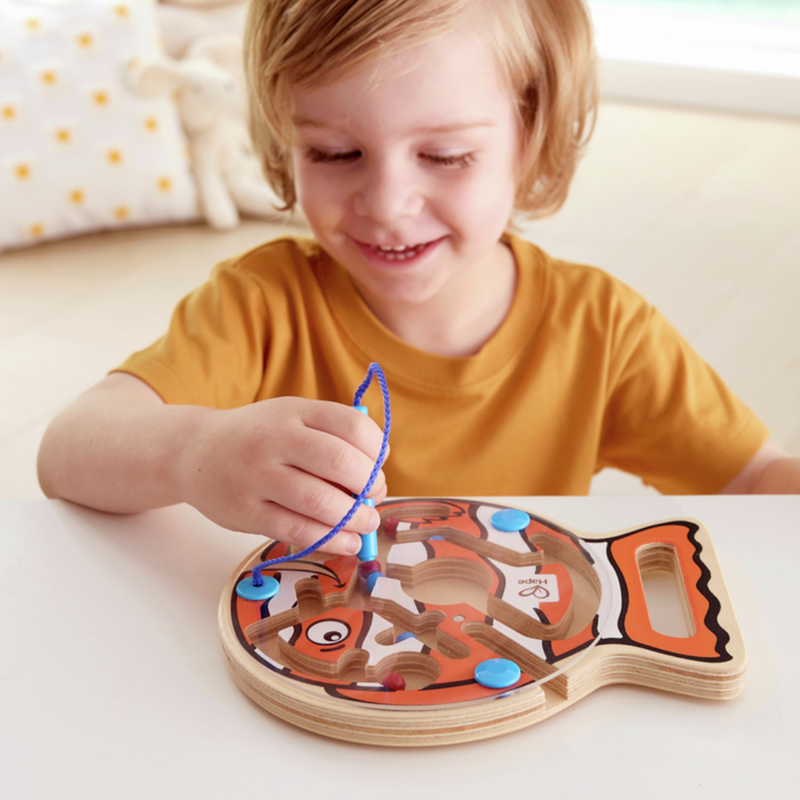
Go Fish Maze Puzzle
Why this matters?
Combines fun and learning as your child navigates the maze, promoting spatial awareness and fine motor skills.