Three questions you can expect as a new mom:
- How’s your baby’s sleeping?
- How’s your baby’s eating?
- How often does your baby have tummy time?
But there’s a good reason so much attention is placed on that third question.

Tummy time isn’t just another parenting trend; it’s one of the simplest and most important ways to support your baby’s early development.
It helps lay the foundation for major milestones like rolling, sitting up, crawling, and eventually walking.
In fact, pediatric experts recommend tummy time from the earliest weeks of life, as part of your baby’s daily awake routine.
Did you know?
Even a few minutes of tummy time spread throughout the day can make a meaningful difference in your baby’s motor development.

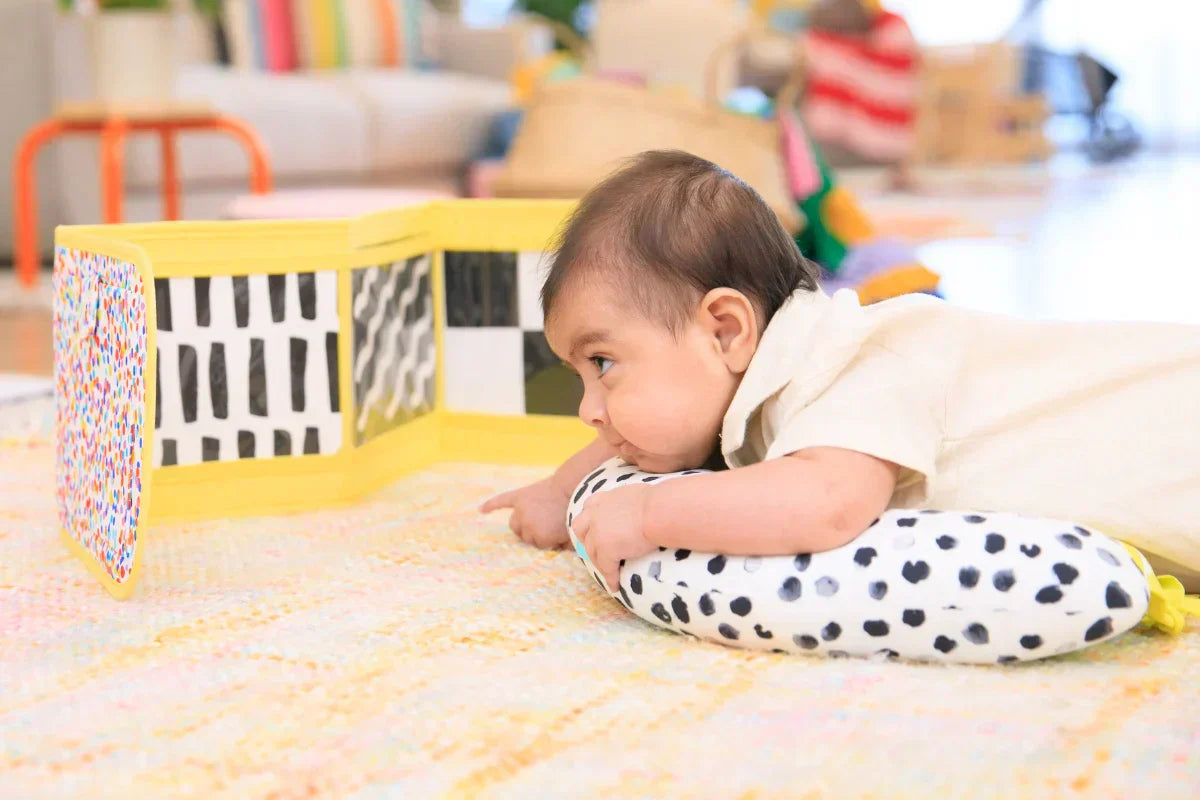
In photo: Standing Card Holder & Tummy Time Pillow from the Look With Me Playbox
The top 3 benefits of tummy time
Here’s why a few minutes a day really matters:
1. Builds essential muscles
Tummy time helps develop:
- Neck strength
- Back muscles
- Shoulder stability
- Core strength
These are the muscles your baby will rely on for rolling, sitting, crawling, and walking.
2. Supports developmental milestones
Tummy time helps your baby practice early movement skills like:
- Lifting their head
- Pushing up on their arms
- Reaching for toys
- Pivoting and turning
These early movements are the building blocks of crawling and independent mobility.
3. May help prevent common early issues
Regular tummy time is often recommended to help reduce the risk of:
- Flat head syndrome (positional plagiocephaly)
- Positional torticollis (tight or twisted neck muscles)
These conditions are often linked to babies spending too much time on their backs.
Trusted health organizations such as the American Academy of Pediatrics and the World Health Organization recommend supervised tummy time as part of daily infant care.

When to start tummy time
You can begin tummy time as early as:
- Around 2 weeks old, or
- Once your baby’s umbilical cord has fallen off and healed
Start small.
Even 30 seconds to 1 minute at a time is enough in the beginning.
A few helpful positions:
- On your chest (great for bonding and comfort)
- Across your lap
Avoid:
Tummy time immediately after feeding.

What if your baby doesn’t like it?
It’s completely normal for babies to fuss during tummy time at first.
This doesn’t mean something is wrong; it just means it’s new and takes effort.
Try:
- Short, frequent sessions instead of long ones
- Doing it when your baby is calm and alert
- Adding tummy time after diaper changes
- Getting down to their level and talking or singing
And remember:
Tummy time doesn’t have to happen only on the floor. Chest-based tummy time counts too.
Make tummy time part of your routine
Instead of treating tummy time as a “task,” think of it as part of everyday interaction:
- After naps
- After diaper changes
- During playtime
- On your chest while bonding
You also don’t have to be bound to the floor for tummy time
Check out this post for alternatives that your baby won’t hate.
Safety reminder
Always ensure:
- Your baby is awake and supervised
- The surface is safe and firm
- You never leave your baby unattended during tummy time

When you're ready for the next stage of development, MonkiBox Play Boxes are designed to support each milestone with expert-selected Play Tools that make purposeful play simple and stress-free.