

Parenting with Me

Week 5: Is It Better to Swaddle a Baby?
Your baby spent nine months in the womb, warm, snug, and gently rocked with every movement you made. After birth, that cozy space vanishes, replaced by a bright, open world. For many newborns, this dramatic change is overwhelming. That's why many parents turn to swaddling: to recreate that comforting sensation and help their baby adjust to life outside the womb. Swaddling can indeed improve sleep for some babies, especially in the early weeks. But not every baby needs it. Some infants naturally enjoy stretching out and exploring their newfound freedom. If your baby sleeps well without being swaddled, there’s no need to force it. The golden rule remains the same either way: always place your baby on their back to sleep If you choose to swaddle, here are a few essential tips to keep it safe and effective: 1. Get the Tightness Just Right A loose swaddle can unravel and pose a suffocation risk. - Ensure the wrap around the chest is snug enough to fit two to three fingers between the blanket and your baby's body. - The bottom should be loose enough to allow free leg movement; tight swaddling around the hips can lead to developmental issues. - Struggling? Consider a sleeping sack as an easy, safe alternative. 2. Know When to Swaddle According to the American Academy of Pediatrics, babies can be swaddled up to 12–20 hours per day, primarily during sleep. Avoid swaddling when your baby is awake and alert, as those moments are crucial for muscle development and motor skills. 3. Mind the Temperature Swaddling can lead to overheating. Warning signs include sweating, flushed cheeks, or rapid breathing. If the room temperature is comfortable (20–21°C or 68–72°F), dress your baby in a single layer more than you’re wearing 4. Follow Your Baby's Lead Babies can be unpredictable. If yours fusses or resists being swaddled, don’t force it. Try different methods or sleepwear until you find what works best. When Should You Stop Swaddling? Swaddling can soothe and comfort newborns, but it's not meant to last forever. Once your baby starts showing signs of rolling over, typically between 8 weeks and 4 months, it's time to stop. Continuing to swaddle at this stage increases the risk of suffocation. Always monitor your baby closely, and make space for them to roll and explore safely. With or without swaddling, your love and attention are what help them feel most secure Explore our expert-designed sleep and development tools at www.monkibox.com

Week 2: Why Is It Important to Schedule Tummy Time for Your Baby?
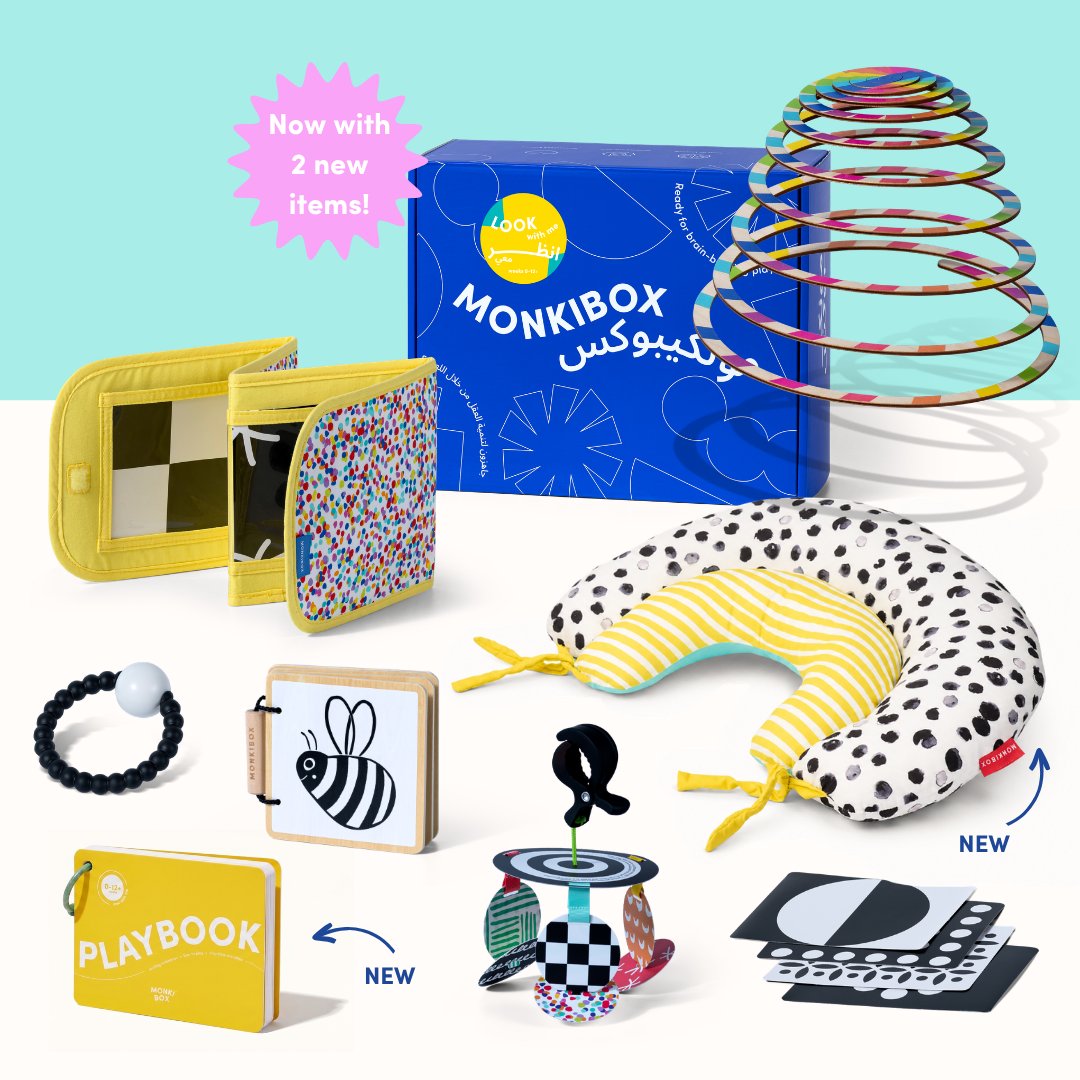
There are three essential questions every parent should ask: Is your baby sleeping well? Is your baby breastfeeding enough? Are you making time for tummy time each day? The American Academy of Pediatrics notes that while babies may prefer sleeping on their stomachs because it mimics the fetal position and reduces the Moro (startle) reflex, stomach sleeping is not safe for unsupervised rest. It increases the risk of Sudden Infant Death Syndrome (SIDS). Infants should always be placed on their backs to sleep until at least 12 months of age. In photo: Tummy Time Pillow & Wooden Book in the Look With Me Play Box However, supervised tummy time during awake hours is a vital part of early development. It builds the foundation for milestones like reaching, crawling, standing, and walking. Tummy time is essentially your baby's first workout and should begin from birth (after the umbilical cord falls off and the area heals). Research-backed benefits of tummy time include: - Strengthens neck, back, shoulder, and abdominal muscles. - Encourages motor skills like reaching, turning, and lifting limbs. - Supports gross motor development and prevents delays. - Helps prevent flat head syndrome (positional plagiocephaly) and torticollis (tight neck muscles). - Improves hand-eye coordination and environmental exploration. How to start tummy time: You can begin tummy time when your baby is around two weeks old. Start by placing them on your chest or lap for 30 seconds to one minute. Avoid tummy time immediately after feeding to reduce discomfort. Important safety note: While your baby may seem to enjoy lying on their stomach, do not let them sleep on their tummy. Even if they start rolling over at 4 or 5 months, it is still unsafe for sleep until they are at least 1 year old and can independently reposition themselves. Tips for tummy time success: - Lay your baby on a clean, firm surface like a play mat or blanket (never on pillows or beds). - Position their arms forward under the shoulders to help them push up. - Turn their head to the side to ensure they can breathe freely. - Use songs, toys, and your voice to make the experience enjoyable. - Try tummy time after diaper changes to help build the routine. It’s normal for babies to resist or show startle reflexes during early tummy time. These jerky movements are typical in the first 2–4 months and are linked to an immature nervous system. Stay consistent and positive. Daily tummy time while your baby is awake and alert lays the groundwork for healthy motor development. In photo: Tummy Time Pillow in the Look With Me Play Box Start the development journey with MonkiBox. Our Montessori-inspired toys are thoughtfully designed to support tummy time and every step of your baby’s growth.

Week 3: For Your Baby, It's All Black & White
Did you know that shortly after birth, your baby can detect shapes and edges, specifically where light meets dark? Luckily for new parents, their little one is naturally drawn to familiar faces. Since newborns can only see 15–30 cm ahead, your face is at the perfect distance for them to study and connect with. In photo: Wooden Book in the Look With Me Play Box In addition to face-to-face bonding, providing your baby with high-contrast black-and-white images can help exercise their eye muscles, improve focus, and increase attention span. Since their vision remains blurry and color perception is limited until around 3–4 months, experts recommend using simple black-and white visuals within 8 to 12 inches of their eyes. These images send stronger neural signals to the brain, which helps with tracking objects and developing overall visual strength Here are research-backed benefits of black-and-white images for your baby: - Stimulate underdeveloped optic nerves - Support healthy brain development without overstimulation - Improve visual focus and make tummy time more engaging - Encourage shape recognition, distance estimation, and gross motor coordination - Boost curiosity and memory by sending strong visual signals to the brain - Enhance hand-eye coordination through visual tracking When should you start? You can introduce high-contrast cards from day one. Color vision typically matures around the fourth or fifth month. Just be sure to hold images within their visual range—about the same distance as your face during feeding. Ways to incorporate visual stimulation into your routine: 1. Face-to-Face Play Looking into your baby’s eyes supports visual development. Try making funny faces—your baby will be drawn to features like your lips and eyebrows 2. Tummy Time It’s perfectly safe to place black-and-white cards in front of your baby during tummy time (1–5 minutes a day is great for newborns). As they grow stronger, these visuals can motivate them to lift their head and necks. 3. Crib or Changing Table Cards Hang black-and-white visuals on the wall near their crib or changing area. Alternate sides to help them practice looking both ways and prevent flat head syndrome 4. Bold Fashion Your baby in black-and-white mittens for short periods. High-contrast patterns promote hand discovery, which is key for hand control and fine motor skills. Your baby’s eyes are still learning to work together. Don’t worry if they occasionally appear cross-eyed—it’s completely normal. Pediatric experts suggest starting with basic shapes and curves in the first few months As your baby’s vision sharpens (around 2–3 months), you can introduce more complex patterns like checkerboards. If you notice any persistent or significant visual irregularities, consult your pediatrician. For a better understanding of how your baby sees, check out this helpful video demonstration. Try holding an image card and waiting until your baby looks away. When they look back, rotate the card to show the same image from a different angle. Repeat 2–3 times before switching to the next image. Start your baby’s developmental journey with MonkiBox. Our Montessori-inspired toys are carefully crafted to give your child the best start in life.

Why High-Contrast Visuals Matter: For your baby, it really is all black & white
Did you know that even in the womb babies can tell the difference between light and dark? Here's why your baby will benefit from black-and-white images.

7 Simple Ways to Enjoy Skin-to-Skin Contact With Your Baby Every Day
Holding your baby just feels right. Skin-to-skin contact with your newborn is encouraged and finding opportunities to create this special bond is easier than you think.

The Powerful Benefits of Skin-to-Skin Contact for Your Newborn
Learn why your instinct to hold your baby and skin-to-skin time is good for their development.

Baby Developing a Flat Spot? 6 Activities to Prevent Flat Head Syndrome
Did you know that about 1 in 5 babies will develop a flat spot on their head? Here are our 6 favourite activities to prevent flat spots on your baby’s head.

The Benefits of Tummy Time: Why Your Newborn Baby Needs Tummy Time Every Day
When your baby is on his tummy, you are helping him lay the foundations for future milestones. Learn why tummy time is essential.

How to Support Your Baby's Milestones Through Play at 12 Weeks Old
Your baby is still reaching many milestones. Help him achieve them with these play ideas.